
I have just finished reading one of the most outrageous, shocking, man-humbling, God-exalting, books ever compiled:
Calvin's Calvinism - including
God's Eternal Predestination and Secret Providence,
A Brief Reply, and
Reply to the Slanderous Reports, written by that inescapably biblical Reformer, John Calvin, of unparalleled significance in that glorious work of God, the Protestation Reformation, and translated from the Latin by Henry Cole, first published in 1856, and now published again by the RFPA with absolutely essential and hugely helpful historical introductions by Prof. Russell J. Dykstra of the
Protestant Reformed Theological Seminary.
Anyone who has quarrel with
Calvinism can turn here to read the man's own words as he demonstrates with candid language and compelling truth-power how thoroughly biblical and apostolic, not his doctrine, but God's doctrine of absolute, all-encompassing, unconditional, glorious, good, and perfect predestination is. Opponents of this doctrine need to take up their bitter argument with God Himself, and read His own Holy Word to be soundly refuted and silenced. Calvin, perhaps more capably and more clearly than others who have endeavoured to write on this subject
defending the glory and majesty of the eternal and immutable God who works all things after His own good pleasure, wields the Sword of Spirit mightily, by God's grace to rend asunder all the calumnies and insane ravings given birth by the unbridled, astonishing pride, and bestial reasoning of heretics. Need I say,
read it!
In this masterpiece of exegesis and apologetics, Calvin almost preempts the theodicy of the final judgment on the last day, so far does he see through this dark glass into that unapproachable light. Brandishing the revealed things of God as a mighty hammer, he crushes the unimaginable arrogance of those mere mortals of clay who presume to pontificate upon the supposed unrighteousness in God's secret things: "Nay but, O man, who art thou that repliest against God?" (Rom. 9:20).
Calvin says m

emorably that their purpose is nothing more than, "...to fabricate monsters of [their] own bra
in and to slaughter them in [their] own imagination, glorying to [themselves] in a mighty triumph..." He expresses the futility of their audacity and profanity very clearly, "Now, then, dog as you are, bark as loud as you will. You will no more obscure the glory of God by your revilings than you can obscure the brightness of the sun by spitting in his blazing face."
But this is not a subject for mere talk - it is massively practical. It changes everything in how we view everything that ever happens, or has
happened, or will happen everywhere, without exception. And it changes how we live in that assured confidence - the confidence that God works all things for the good of them that love Him, who are the called according to His purpose (Rom. 8:28). Calvin calls it one of the "first principles" of godliness.
Take for example, the recent atrocity committed by Mark Driscoll, reviewed perhaps as graciously as possible here:
http://www.irishcalvinist.com/?p=3221To put things in perspective, you can read an interview between Michael Horton and Robert Schuller here:
http://www.whitehorseinn.org/free-articles/interview-with-robert-schuller.htmlThere's no question, Schuller is a wolf, teaching people to be lovers of themselves - that the ultimate condition of sin is not loving yourself - i.e. being proud of yourself. Now Mark Driscoll himself has some very objectionable views (some very dangerous!) - but I am still hoping that he will grow out of them. Maybe not - and for sure I would not recommend his preaching to anyone, even though he is a breath of fresh air compared to most. My own comments, were these:
Pragmatism is a heinous and evil sin – especially for a Calvinist. I’m trying to be gracious with Driscoll, because he’s come from terrible stuff, and improved a lot in many areas. I think he’s still got a lot to learn. But this is one lesson which I think he should have learnt before, and I hope that he will see this and not do likewise again.
It’s always difficult for onlookers I think – because we know people need to hear the Gospel – it’s always difficult for us to say that no matter what our ideas are or what we think would work, that He requires that we worship Him according to His commandments and no other way. Pragmatism is a [sic] evil philosophy – one for which Saul lost his kingship. This should be a warning for us.
But the other side of it is this. As Calvinists, while we ought to be confident in God’s unhindered purposes when we refuse to fall into pragmatism – however enticing it may be, we also can see that just as God uses all things for good – he can use even the sin of pragmatism for good. It may be that God used Driscoll’s sin here to bring life and light to members of that congregation.
Who are we to reply against God? Did not God cause David to count the number of the children of Israel? Did not God use the Babylonians to chastise His people? Did not God use the Jews and Gentiles and Pilate and the Sanhedrin to crucify Christ? God performed righteous acts in all these things – carrying out His good and perfect purposes – but there is still a warning.
Calvinism is the sworn enemy of antinomianism! Shall we sin that grace may increase? GOD FORBID! But if our unrighteousness commend the righteousness of God, is God unrighteous who taketh vengeance? GOD FORBID! And not rather, (as we be slanderously reported, and as some affirm that we say,) Let us do evil that good may come? Whose damnation is just. How shall we, that are dead to sin, live any longer therein?
In love for Driscoll, we ought to have more than a raised eyebrow for him ("open rebuke is better than hidden love") – even though we worship God for having brought the Gospel to that congregation (even through such an instrument), and while we certainly do not foolishly charge God with Driscoll’s sin of pragmatism.
I just finished reading this book by Calvin – amazing how it deals with this: http://rfpa.org/Scripts/prodView.asp?idproduct=59
“O the depth…!”
The point is this - that God works everything for good does nothing to justify the evil sins of the instruments He uses - including Mark Driscoll, as much as their sins do nothing to mar the supreme righteousness of God, and the guilt can only be ascribed to the sinner, not to the one who is just and true in all His works. Anyone who would try to deny this need only study the prophet Habbakkuk.
I have said it before that Arminianism is at base, Romanism, and atheism. Nothing could be more evident when we look at the doctrine of God's providence. Theodicy is not a concern of Arminianism, because in this hellish system,
there is no God of providence. This is their insane and heretical "apologetic". I recently heard a man reasoning from the supposed free will of man, who went so far as to say that not God, but people are in control. One cannot argue with the validity of his argument - only with his premise. I am glad that the Bible denies this so strongly. So, I conclude this review of Calvin's best treatment of predestination with a memorable comment from Prof. David J. Engelsma:
"Always the gospel of salvation by grace alone provokes the response that this gospel denies the responsibility of man and makes God the author of sin (see Romans 3:5-8, 31; Romans 6:1; Romans 9:19). If the message of the church does not elicit this response, the church may well ask whether it is preaching the gospel of grace."
Do you believe the Gospel of grace? Is the defense of God's glory in all providence a concern for you? It certainly was for Calvin.
- Sam W.
P.S. This book has many other commendable merits, which at this point I'll only briefly mention. In it, Calvin's absolutely repudiates any notion of a "free offer" calling it a "puerile dream". He repeatedly, and emphatically, and logically, argues that God does not will that all are saved, and that it is a denial of the oneness, and immutability of God's will to teach such a thing. He touches on the subject of infant baptism - in denying the "absurdities" of Pighius, he also denies the imaginations of those who now currently teach a conditional covenant - proving unequivocably that the sacraments profit only the elect, just as the PRCA hold and teach.
Clarkians would appreciate also how Calvin never allows an inconsistency or contradiction. He often exclaims on how we can only see so far into those depths of God's wisdom, and frequently warns us of presumption and pride in trying to peer beyond the limits of our own feeble minds, but at the same time, he utterly denies any form of Van Tilianism - indeed defending God's providence by showing how it is logically consistent, and refuting his opponents by showing how their positions is logically inconsistent. Finally, in
Reply to the Slanderous Reports, he also underscores, and exposes the profound idiocy of building upon human imaginations, instead of upon Scripture alone. At this point, I have to quote at length:
"As to your description of the nature of the true God, let readers judge how appropriately you argue concerning his divine being from the absurd fact that you make the beginning of all true knowledge of him to proceed from common sense. That there is a God is a truth received by the one consent of all nations and all ages, because the seed and principle of this knowledge is imparted by nature in every human mind. But how shall reason define what God is, when by its own power of sight, it can do nothing but turn the truth into a lie and adulterate whatever of light and understanding true religion and faith possess. The Holy Spirit commands us to become fools, if we would be the true learners of heavenly doctrine, because the natural man himself can neither receive nor taste anything of divine wisdom. On the contrary, you would have human reason and common sense to form a judgment of the great and adorable God. And you would not only set up reason, which by its blindness ever extinguishes God's glory as a leader and guide, but you would exalt that blind reason above Scripture itself. What marvel is it, then, if you should permit, without hesitation, religions of all kinds to be confounded together and should consider the Turk - who is enveloped in the deliriums of Mohammed and who adores as his deity no one knows what - as much a worshiper of God as he who calls upon the Father of Christ our redeemer, instructed by the sure word and faith of the everlasting gospel? Although you do not patronise infidels seriously is a fact proclaimed aloud by those sarcastic grins of yours, which show your teeth gnashing at every plainest and holiest article of our faith while the excuses that you make for the superstitions of all nations prove your malicious purpose to be to root out of the earth every doctrine of that holy religion that the sacred oracles of God reveal and teach."
Then Calvin places his finger on the vital point:
"Out of that very human reason that is the mother of all errors, you form that God of yours, who wills, without any election or predestination of his own, that all men should be saved. Has, then, the word election, which occurs so frequently in Scripture, no meaning whatever? Is it altogether a vain and empty term? Have the law, the prophets, and the gospel no meaning whatever when they everywhere proclaim aloud that all those chosen by the eternal counsel of God before the foundation of the world are called and illuminated unto salvation? We repeat, is the united and harmonious testimony of the law, the prophets, and the gospel an utter vanity when they pronounce, free from all ambiguity, that the source and cause of eternal life is the free love of God by which He has loved and embraced not all mankind, but those out of mankind whom He pleased? What will you gain after all, I ask you, by thus roaring against this truth a hundred times over? You dazzle the sight of the ignorant and the inexperienced by setting before their eyes as a shining cloud your doctrine that God will have all men to be saved."
Modern moderate "Calvinists", who everywhere boast the same doctrines as these heretics that Calvin is refuting, are manifestly not proper Calvinists at all. More importantly, they are not biblical - which is exactly what Calvin here exposes.
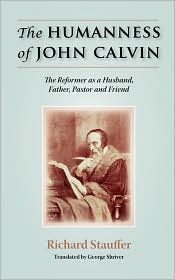 ce I finished the lengthy introduction, I've been craving an opportunity to write a review of this book. Now, a shock for everyone - it is neither doctrinal, not polemical. It is simply biographical. Last Saturday evening I read "The Humanness of John Calvin: The Reformer as Husband, Father, Pastor, and Friend" written by Richard Stauffer, and translated from the French by George Shriver. You will not find a study of Calvin's theology here, though a new book by Engelsma which I am persuaded by many, deals with this subject superbly (I hope to review this in due course too, though I've a heavy weight of other books to get through first).


