Showing posts with label creation. Show all posts

Tuesday, May 21, 2013

God loves the kosmos

"For God so loved the world, that he gave his only begotten Son, that whosoever believeth in him should not perish, but have everlasting life." - John 3:16

Please read your Bible correctly - this love is the love of God expressed in Him giving the greatest possible gift, the gift of His only begotten Son. Is this describing a lesser universal love? Does He have a greater love than this for the elect? Not only so, but the verse says "so", meaning "in this way" - this way God loved the "kosmos", that He gave His Son for the salvation of all who believe (that is, His sheep, those given by the Father, the elect).

Secondly, the very context: spoken at night in secret, to just one person. But significantly spoken to a Jew still thinking in Old Testament terms who thought the love of God was restricted to the Jews. Christ shows that God loves the whole world, every tongue, tribe, and nation, and so gave His Son for the salvation of all who believe. Not the descendants of Abraham therefore, and not merely the believing descendents of Abraham.

Thirdly, there is not one place in Scripture where "world" can be shown to mean "every single person throughout all history". In almost cases it very obviously cannot mean this: http://www.cprf.co.uk/articles/allmeansall.htm

Fourthly, where therefore does your definition of "world" come from? Is it from the context? Is it from the use of the word elsewhere in Scripture? Or is it simply your reading into the text your own pre-conceived ideas (or someone else's)?

Furthermore, in ransoming the elect, God saves the kosmos. By preserving a remnant saved from every tongue, tribe, and nation, God saves the entire world (Rev. 5:9). Did God need to save every animal and every human to save the kosmos through the Flood of Noah? No, rather, the destruction of the wicked was necessary for the salvation of the world.

Concerning the salvation of the kosmos, which God loves (the salvation of which rests on the salvation of the elect) the Scriptures say this:

"For I reckon that the sufferings of this present time are not worthy to be compared with the glory which shall be revealed in us. For the earnest expectation of the creature waiteth for the manifestation of the sons of God. For the creature was made subject to vanity, not willingly, but by reason of him who hath subjected the same in hope, Because the creature itself also shall be delivered from the bondage of corruption into the glorious liberty of the children of God. For we know that the whole creation groaneth and travaileth in pain together until now. And not only they, but ourselves also, which have the firstfruits of the Spirit, even we ourselves groan within ourselves, waiting for the adoption, to wit, the redemption of our body." Romans 8:18-23.

The whole creation is included in God's everlasting covenant of grace:
"And God said, This is the token of the covenant which I make between me and you and every living creature that is with you, for perpetual generations: I do set my bow in the cloud, and it shall be for a token of a covenant between me and the earth. And it shall come to pass, when I bring a cloud over the earth, that the bow shall be seen in the cloud: And I will remember my covenant, which is between me and you and every living creature of all flesh; and the waters shall no more become a flood to destroy all flesh. And the bow shall be in the cloud; and I will look upon it, that I may remember the everlasting covenant between God and every living creature of all flesh that is upon the earth. And God said unto Noah, This is the token of the covenant, which I have established between me and all flesh that is upon the earth." - Gen. 9:12-17.

The inheritance of the saints, is the new heavens and the new earth, renewed by God, as we are being, and will be - through fire. This kosmos was created for man to dwell in fellowship with God. But through the work and person of Christ, heaven and earth are united, and we who have borne the image of the earthy shall also bear the image of the heavenly, being equipped in the resurrection with a spiritual body by the last Adam: so that then the tabernacle of God will be with men, the final fulfillment and goal of the covenant will be realised and enjoyed forever.

"And I saw a new heaven and a new earth: for the first heaven and the first earth were passed away; and there was no more sea. And I John saw the holy city, new Jerusalem, coming down from God out of heaven, prepared as a bride adorned for her husband. And I heard a great voice out of heaven saying, Behold, the tabernacle of God is with men, and he will dwell with them, and they shall be his people, and God himself shall be with them, and be their God. And God shall wipe away all tears from their eyes; and there shall be no more death, neither sorrow, nor crying, neither shall there be any more pain: for the former things are passed away. And he that sat upon the throne said, Behold, I make all things new. And he said unto me, Write: for these words are true and faithful." - Rev. 21:1-5.

See the problem is, people know sound-bites and superficial verses without understanding context, and without learning how the Bible fits together in glorious theology. And so they exude this confidence in their views, which doesn't stand contextual, theological scrutiny.

Our first principle must be that Scripture alone interprets Scripture, because it is God's Word, not ours. We must not let our own ideas run ahead.

Monday, May 20, 2013

Did We Lose the Image of God?

This is to post a link to an article on the image of God you should read. The references in the Heidelberger, and the Canons of Dordt strongly support the moral view of the image of God as righteous, holiness, and the knowledge of God, which man has lost since the Fall, and therefore needs renewed in the new creature of the Christian. This is taught explicitly in Ephesians 4:22-24 and Colossians 3:9-10.

"be renewed in the spirit of your mind; And that ye put on the new man, which after God is created in righteousness and true holiness"
"have put on the new man, which is renewed in knowledge after the image of him that created him"

In both cases this is contrasted with the old man of sin (man's nature since the Fall). If the image of God in man consists in these three things, then the truth of total depravity would certainly preclude the idea that man retained the image of God, even in some small sense.

"Man was originally formed after the image of God. His understanding was adorned with a true and saving knowledge of his Creator, and of spiritual things; his heart and will were upright; all his affections pure; and the whole man was holy; but revolting from God by the instigation of the devil, and abusing the freedom of his own will, he forfeited these excellent gifts; and on the contrary entailed on himself blindness of mind, horrible darkness, vanity and perverseness of judgment, became wicked, rebellious, and obdurate in heart and will, and impure in his affections." (Canons III&IV:A1)

Notice, he was "originally formed after the image of God". Then it describes this image as "true and saving knowledge of His Creator, etc", "his heart and will were upright" (righteousness), "all his affections pure; and the whole man was holy" (holiness). Then it follows, he forfeited these excellent gifts. There is no doubt that the first gift mentioned, "the image of God" is included in this forfeiture as an "excellent gift". What man retains is described in article 4 concerning the "glimmerings of natural light". This is a thorough, consistent Reformed view of the Fall of man, and total depravity. Of course, man's nature remains as that of an image-bearer, but as Christ taught that in our old nature we bear the image of our father the devil:

"Jesus said unto them, If God were your Father, ye would love me: for I proceeded forth and came from God; neither came I of myself, but he sent me. Why do ye not understand my speech? even because ye cannot hear my word. Ye are of your father the devil, and the lusts of your father ye will do. He was a murderer from the beginning, and abode not in the truth, because there is no truth in him. When he speaketh a lie, he speaketh of his own: for he is a liar, and the father of it. And because I tell you the truth, ye believe me not. Which of you convinceth me of sin? And if I say the truth, why do ye not believe me? He that is of God heareth God's words: ye therefore hear them not, because ye are not of God. Then answered the Jews, and said unto him, Say we not well that thou art a Samaritan, and hast a devil? (John 8:42-48)

This article deals with the common objections such as in Genesis 9:6 and James 3:9.

http://www.cprf.co.uk/articles/imageofgod.htm

Westminster Larger Catechism:

"After God had made all other creatures, he created man male and female; formed the body of the man out of the dust of the ground, and the woman of the rib of the man, endued them with living, reasonable and immortal souls [this is man’s constitution]; made them after his own image, in knowledge, righteousness and holiness [this is the image of God in man] (A. 17)"

The Heidelberger:
Question 6. Did God then create man so wicked and perverse?
Answer. By no means; but God created man good, [a] and after his own image, in [b] true righteousness and holiness, that he might rightly know God his Creator
[b]: Gen. 1:26,27; ***Col. 3:10, Eph. 4:24***

Belgic Confession:
Article 14: We believe that God created man out of the dust of the earth, and made and formed him after his own image and likeness1, good, righteous, and holy, capable in all things to will, agreeably to the will of God.2
1 Gen. 1:26, Eccl. 7:29, Eph. 4:24
2 Gen. 1:31, Eph. 4:24

Monday, November 26, 2012

Why were we made?

We are here for God's glory. His ways ARE deep and mysterious, but His Word DOES teach us general principles to help us understand in part.

One important thing to remember is that we are mere creatures, and God owes us nothing, while we owe Him everything. Not only that, but we are sinful creatures, desperately wicked. If not for so many external restraints which God has appointed in the world (laws, governments, police, society, culture, limitations of power), this would be even more manifest. Because we are human, it is especially difficult for us to consider the end of many other humans, but we think too highly of ourselves.

Consider the demons, angelic beings who were originally created good as the others, before they fell. God made no plan of salvation for them, but left them in chains of darkness to await the day of torment. We find this easier to acknowledge and see the justice and righteousness of God in, and how He reveals thereby His just and good holiness and righteousness in not sparing them. Yet with humans, through which He also reveals His infinite grace and mercy in our salvation from sin, we are more troubled (and rightly so), ultimately because those who end in hell are our brethren according to the flesh, and because we are impressed enough with our own unworthiness and sinfulness, and God's divine perfection, that all things must serve His glory, not ours, because He alone is God.

We are the clay, He is the potter, and He must be free to do as He will with the clay. The vessels made for dishonourable use cannot complain against their maker. Neither can the vessels made for honourable use boast as if they formed themselves.

So on the final day, when God reveals His handiwork, and His righteousness is demonstrated in all things, we will be utterly awestruck, even dumbstruck, for all created things will not be able to say a word, except that He alone is the Lord who does as He wills, according to His own divine good beautiful glorious perfections.

Friday, February 11, 2011

Selling Out Scripture for Evolutionism

"It is something like a case of an honest, God-fearing grocery store owner being robbed at gunpoint by a murderous crook. Investigating the incident, the crook tells the police that the store owner gave him everything from the store, while the owner says that the criminal boldly threatened his life. The policeman, content to adopt the crook's version, tells the store owner that he must have been under the influence of a powerful narcotic when he gave all those things to the crook, or that his description of the robbery cannot be taken literally. The owner really meant that his gift to the robber can be construed as robbery because his conscience so smote him when he saw the poverty of the crook that it compelled him to give the store's contents to the crook. So theistic evolutionists are ready to sell out Scripture for evolutionism, and they do it by explaining that the scriptural narrative of creation cannot possibly be taken literally."

Such is the verdict of Prof. Herman Hanko in his section on evolutionism in his unique book on the history of heretics in the church over the last two thousand years, "Contending for the Faith" (http://www.rfpa.org/catalog/product_info.php?cPath=23&products_id=114). I'm amazed at how vivid and accurate this illustration is!

Tuesday, September 28, 2010

Defence of Christianity Against a Proud Scoffer

In answer to a believer's query about science and the Bible, I referred to this website: http://www.creation.com.

A scoffer replied by comparing the highly qualified and intelligent authors of the material on this website to "The Banana Man" (so quickly that I concluded that he had in fact not even looked at the website), and advised me to only pay attention to "REAL scientists", by which I supposed he meant, those who attempt to explain the world in a materialistic framework regardless of how awkward and self-contradictory the fit becomes. To answer this challenge for the sake of the believer who had first made the query, not for the professed atheist (since if one denies the Bible outright, it is impossible to prove anything to them, and irrational to try to do so, and therefore argument with them is unprofitable), I responded:
Absolutely, of course I prefer the theories of scientists who dare not contradict God, who created everything and was there when all was created. Since those who deny Him, who is the Author of all truth and history, are nothing but willfully ignorant fools (Rom. 1:18ff), then of course I would be insane to take their proud imaginations seriously. If they deny the very first principle of all knowledge, then surely all their speculation is worthless. What need could I possibly have to pay heed to their vain attempts to ignorantly explain what is now seen, within such a self-contradictory and godless framework, intent on calling God a liar. But while men can lie and be deceived, it is impossible for God to lie. And those who call Him a liar are calling themselves, who are mere creatures, the Authors of truth; yet without God there is no truth. But they were born as wicked men only a few short years ago, are finite, and their lives are like the flower that fades and withers away quickly; they were not there to tell how things came to be. But God is from everlasting to everlasting, infinite in power and knowledge and wisdom, He was there, and none else.
The professed atheist then attempted to criticise the Christian faith on the basis that:
  1. It only believes what reaffirms its presupposed ideas.
  2. These ideas cannot be based upon "tangible evidence".
  3. It is therefore, "deliberate stupidity".
Again, lest anyone be fooled by these empty and self-contradictory words, I responded:
Blind and godless Empiricism is also a presuppositional belief. The difference is that there is no man who has not heard the witness of God in their own consciences (and therefore their denial of it is universally self-evident, no matter how much evil men deny it), and since the Lord has graciously granted me faith, I believe God's testimony which is greater than any other, and indeed is the only way in which I can test all other witnesses, and see the world as He does, and apart from which, all my own interpretations would be merely groundless stabs in the dark. Hence, I have nothing to discuss with such lying fools as you, unless you assert that God alone is the authoritative Author of all truth, and denounce your own feeble understanding, in order to learn from Him how we are to interpret the data and evidence which He has set before us.
Not content with this (of course), the God-hater dug himself a deeper pit, by denying that his empiricism was presuppositional, and calling it rational instead (as if the latter did not demand the former)! And then he gave a definition of empiricism which he presented as a vindication of his philosophy, rather than its very indictment, which it actually was. He then also claimed that his criticism of Christianity was "kind and gentle", and that he was speaking for my benefit, and asked me to do the same as if he were willing to be persuaded (but of course, only upon his own presuppositional grounds of godless materialism, which is the very thing I refuse to do, and would consider wholly irrational), as if I had not already laid before him his errors. Since the believer responded by giving his own definitions of materialism and of theism, which were unsatisfactory, and did not display the folly of the professed atheist, nor the Bible's evaluation of such scoffers and their godless philosophies, I finally responded at length:

Materialism: Trusting in your own experiences and your own interpretations of those experiences, while willfully denying God's trustworthy testimony.

Biblical Theism: Trusting in God alone, by whose Word all our experiences must be tested and interpreted.

"I'd really hope someone would extend a hand of knowledge to me" - the Roman Catholics once put the Bible on their forbidden book list, but to you, I am sure it is readily available - even in your own language. How much less excuse then, you have for inventing your own theories about why the world is the way it is, when you refuse to learn from the Creator who is the only One whose testimony can be trusted altogether.

The natural world indeed speaks powerfully about the greatness of the divinity and power of God (Psalm 19; Rom. 1:18ff), and God has even given us eyes, ears and all the other senses by which we can perceive the created things and thereby know of the wisdom, divinity, and power of the One who created them. This witness is sufficient to leave us without excuse for our wickedness in not glorifying Him as God. No wonder then that many in our day deny this.

Yet if we deny this, by what means do we suppose we can trust anything we observe? What reason would we have to put any confidence in our senses? Would we not simply then we left adrift in nihilism, perhaps "I think therefore I am", and all our experience may be simply a dream? Therefore the atheist contradicts himself, when he speaks of empirical rationality, because if there is no God who does not lie, and who has created all things, and who has given us these senses, then there is no reason to presume that anything is real. This is why atheism, contrary to the popular, yet foolish misconception of it, is actually the death knell to all scientific endeavour, while true Christianity is its very foundation. And this is true both philosophically, and historically. Science was given birth by Christianity which believes in one Almighty God who created all things and orders them according to natural laws which only He may alter by miraculous works which display His sovereignty over these laws. Without this, all is merely proud, blind speculation, as I said.

But He has given a far greater light in the Scriptures by which we might see things as they truly are and understand God's purpose for them in His eternal will to glorify the Son through the salvation of the company of the predestinate by Him. By these Scriptures we understand the origin of the world, and the history of it (including the flood by which the world that then was, perished by water), and the purpose of it for the glory of God. And by these Scriptures too, it is revealed to those whom God grants the gift of faith, how we are to be saved from the terrible wrath which we deserve - and there is no greater blessedness than to have been given the knowledge and assurance of this. Those who believe these Scriptures are the only ones who can really tell about why things are the way they are (but even then, only to a very limited extent), and why things work the way they do.

Furthermore, the study of things as they currently are and as they currently work, cannot tell us how things were in the past, or even how things will be in the future. In Scripture this notion is explicitly denied (II Pet. 3), because God did not leave things to continue as they were from the beginning, but everything changed at the fall of Adam, and about 1500 years later, this wickedness had manifested itself so universally that God destroyed the world by water, in order to preserve the church, and so the world that we now see is the aftermath, and quite different. If a bomb causes a building to explode in to dust, do we suppose that we can tell by looking at the aftermath how things were beforehand? Maybe certain things can be speculated upon, but all is vanity if it is denied that the explosion ever occurred.

This is one example of the proud vanity of those who speculate upon the past.

As for the future, if one denies God's providence in upholding the world by the word of His power (just as they deny that He created it by the word of His power), then they again have nothing but groundless inductive reasoning to go by and it is folly also to presume that all things will also continue as they are. But Bible tells us that though we ought to plan ahead, we ought to do so in the fear of God and prayer, because we do not know what a day will bring forth. We cannot say what will happen tomorrow because it is God who is the author of history not us; we can only say that if the Lord wills, such and such will happen (James 4:13-16), and we must study Scripture to understand the will of God, and we trust in His good providence for His people, knowing that He works all things for the good of those whom He has loved with an everlasting love (Rom. 8:28ff).

The Bible explicitly condemns this notion too in the same passage (II Pet. 3), as coming from the mouths of scoffers who deny the Flood and the first coming of the incarnate Son of God. It explains that Christ will certainly return on the last day, to end history and destroy the world, this time by fire, and to judge the living and the dead. And it explains also that Christ is not slow in coming, but He is carrying out the Father's will, that He will not lose one of those whom the Father has given to Him (how could He since He is omnipotent and has paid fully for their sins by His own infinitely worthy sacrifice? - John 6:37-40; Rom. 5:9). So He is not willing that any should perish; He will bring all His elect to repentance and faith before He returns in judgment.

I have written this in defence of the Christian faith against the scoffers which were prophesied beforehand, which were ordained to this condemnation, but I hope that God would bring all who read this to repentance to the acknowledging of the truth, rather than for greater condemnation to be poured out on them for denying it - but if that is the Lord's will, then so be it.
 I hope that believers readers will understand more fully that the Christian faith has nothing to fear from scoffers who irrationally boast about their rationality. As our Canons of Dordt say in head 3/4, article 4:
There remain, however, in man since the fall, the glimmerings of natural light, whereby he retains some knowledge of God, of natural things, and of the differences between good and evil, and discovers some regard for virtue, good order in society, and for maintaining an orderly external deportment. But so far is this light of nature from being sufficient to bring him to a saving knowledge of God, and to true conversion, that he is incapable of using it aright even in things natural and civil. Nay further, this light, such as it is, man in various ways renders wholly polluted, and holds it in unrighteousness, by doing which he becomes inexcusable before God.
It is sometimes amazing to observe what proud boasts men make with only their mere glimmerings of natural rationality, and how they use it, as with all their remaining "wholly polluted" faculties, in the service of sin and the devil, endeavouring with all their powers to hate God will all manner of contrived blasphemies, and to oppose the work of Christ in the salvation of His people. But every observation of this, rather than puff us up, should instead remind us that we are no different except for the grace of God, and so we ought to take occasion to be more humbled, and to be more grateful to God, and exalt Him alone.

Thursday, December 03, 2009

Tales of the Visit of a Reformed Pastor to Limerick: Part II

I was also talking to Rev. Stewart a little about Erik Guichelaar's essay (related to evolutionism) in connection with the recent speech on Calvin vs. Darwin given in a Christian High School in the US. Angus suggested the great idea of putting it on our website, so I contacted Erik and did that the same week.

On Wednesday, we had a Bible study on I Peter 3:1-7. This was a very blessed time, as we discussed the Holy Scripture and meditated on it together and how it applies to us in so many ways. Of course there was much discussion about how the teachings here oppose the ungodly philosophy of the "feminist" movement. We also spoke about the dichotomy in verse 4 between the two different kinds of adornment (especially as it is important for a woman desiring to be sought by a godly man and a man desiring to seek a godly woman, but also in its intended context - that of a witness to an unbelieving husband for his salvation). It was a well-mixed group, and much profitable time was spent discussing the implications of the doctrine in verse 7 that husband ought to dwell with their wifes with understanding. One man who attended texted me early the next morning to say how much they had enjoyed this study. That week Ireland also lost one-nil to France at home, but fortunately we able to take that blow after such an uplifting Bible study.

On Friday then, we had our first lecture on “The Last Days,” and I had written a blogpost about this previously - making some comments about the bizarre philosophies of modern (or should I say modernist?) Irish Evangelicalism, insofar as they related. The lecture was a superb Scriptural explanation of sober eschatology - especially focused on a right exegesis of Acts 2. It showed absolutely conclusively that the last days reaches from the coming of our Immanuel, to the second coming, which in one event shall include the final resurrection, and the final judgment, and the ushering in of the new heavens and the new earth, etc - the consummation of all things and the end of days. It was argued that the last days are called the last days because there are no days after them (i.e. no earthly millenial kingdom!), and they finish with the last day (singular) which is also so-called because it is the final day with no more days after it.

One man commented at the end in astonishment, "You never used Revelation [the book]!" I think this is the source of a lot of confusion regarding eschatology - people immediately turn to the book in the Bible which perhaps requires the most intepretation using a comprehensive and thorough-going understanding of all the previous books, and so then they try to interpret it with little reference to the massive ground of revelation from which it draws its language, images, and ideas. No wonder with such a headstrong and ignorant approach to Scripture that the wild ideas from over-fertile imaginations of sinful men are so numerous. No, in contrast to this, if we speak of eschatology, the place to start is not the book of Revelation - the place to start is the simplest passages which speak most plainly.

No-one tries to work out a mathematics problem involving complex trigonometry and integration, without first having a thorough understanding of the basic algebra required, and even that is fruitless without the basics of arithmetic. But it is exactly our nature to turn things upside down and backwards in spiritual pride and ignorance. I remember Prof. Dykstra (of the PRTS) speaking about how many heresies come directly from ungodly hermeneutics. One friend enjoyed the lecture so much he felt like clapping afterwards. Another friend felt similarly, and they both bought some books I think - thankfully there were two copies of "Doctrine According to Godliness" by Ron Hanko, which is an absolute treasure, worth far more than the RFPA charge for it, and worth far more than its own weight in gold too.

More soon...

Tuesday, May 12, 2009

Evolution of the Computer Engineer

Let's look at living things, from the eyes of a computer engineer. Three components are necessary:
  1. Hardware
  2. Software
  3. Intelligence and ability to learn
Then we have to consider that so far, software has not been able to create any intelligence or ability to learn analogous to a human. Immediately the analogy fails, for computers can never be people, no matter how many Asimov stories we read. Next the software must be able to somehow influence the hardware. Much like a robot programmed to repair itself, and construct and programme new robots just like it. So the software must be able to cause the hardware to produce a manufacturing facility, and to produce the software to programme that facility. This facility must be able to produce the hardware and software which the first had, such that it too will be able to reproduce.

Now then, how did this hardware and software come about initially? Well, a computer engineer must have made it. It couldn't arise by itself. Neither the hardware, nor software could arise spontaneously. No amount of randomness and time can overcome a logical and mathematical impossibility - one will never be equal to two. If this is the case with something so simple as a computer or robot, then how much more is it impossible for the far more complex human?

What could provide the information, the software and hardware to produce the manufacturing facility and operate it to produce hardware and software with the same ability? Computer engineers ought to know that goo-to-you-via-the-zoo evolution is absurd. Chemists also ought to know this, physicists ought to, and especially biologists. But the atheist can't figure it out. He tries, but his a priori determination to hate the God that he doesn't believe in, keeps him from seeing sense.

Psalm 53

1The fool hath said in his heart, There is no God. Corrupt are they, and have done abominable iniquity: there is none that doeth good.
2God looked down from heaven upon the children of men, to see if there were any that did understand, that did seek God.
3
Every one of them is gone back: they are altogether become filthy; there is none that doeth good, no, not one.
4
Have the workers of iniquity no knowledge? who eat up my people as they eat bread: they have not called upon God.
5
There were they in great fear, where no fear was: for God hath scattered the bones of him that encampeth against thee: thou hast put them to shame, because God hath despised them.
6
Oh that the salvation of Israel were come out of Zion! When God bringeth back the captivity of his people, Jacob shall rejoice, and Israel shall be glad.
But even to these, people no worse depraved sinners than myself apart from the grace of God, Christ sends the call of the Gospel:
"O ye simple, understand wisdom: and, ye fools, be ye of an understanding heart."
- Proverbs 8:5
May the simple be wise, may Jacob rejoice, and may Israel be glad, for the glory of Christ!

Tuesday, March 10, 2009

The Colours of Redemption

All waters receding at last!
The longest year had passed.
A dove brought back the olive leaf,
With the sweet smell of relief!
The covering had been enough
To brave the waves so tough;
Divine design had proved the tub
Which bore them through the rub.

After much waiting for the Word
“Go forth with all”, they heard.
Living creatures, fowl, beasts, creepers,
Emerged with believers.
Two or more of every kind
Not a colour out of mind;
That altar built for offering
Gave thanks unto the King.

Remembrance of a sacrifice
Paid for their sin the price,
Of old and yet to come by death
To cover for their breath;
Confirmation of the promise
Made at their genesis,
Of transcendent friendship restored;
Most undeserved reward.

Of colour the restoration,
And only foundation.
Of colour the full salvation,
And its preservation.
Never would the waters return
Such was divine concern;
Never again would seasons fail,
Although our sins prevail.

And as a sign of this decree
Eternally to be,
“I do set my bow in the cloud,”
The mighty words were vowed.
So today these colours we see
Inseparably free,
In the circle vast, hung in air
Incomparably fair.

The rainbow beams amidst darkness
Despite despair to bless.
When bleakest clouds stretch, spread, and shroud,
Our hearts may still sing loud.
Colours myriad 'round the throne,
Make clear what has been shown
Some purchased, through judgment, by grace
From each tribe, tongue, and race.

Though clouds be vast and numerous
To damn the blasphemous,
Yet a remnant still, of each shade,
Just as vile, given aid.
Every colour distinct in beauty,
Yet all in one with glee.
Each part of eternal glory,
Forever praising Thee.

- Sam W.


Monday, January 05, 2009

Cosmology and Biblical Creation: God stretched out the heavens!

I have a book by Dr. John Hartnett called "Starlight, Time, and New Physics" which I had not quite finished reading yet (it was so exciting, I had to lend it to someone else). But I would nevertheless like to quote some info about it from this article: http://creationontheweb.com/content/view/6184
But this is only the beginning of the exciting implications of this
revolutionary book. Hartnett refers to recent observational data that
overwhelmingly leads to the conclusion that the universe must have a centre, with our galaxy somewhere near it. By plugging this ‘galactocentric’ universe into Carmeli’s equations, and then adding the biblical ‘stretching out of the heavens’ by God at creation (big bangers can scarcely disagree, as they call something like that ‘inflation’), what ‘falls out’ is an astonishing by-product. Namely, that there are built-in gravitational time-dilating effects such that:

a) Adam would have seen light from most of the same stars we see today
when he looked up on the sixth day and
b) light from even the most distant quasar, billions of light-years away from Earth, would reach us now within the six or so thousand years since creation.

Note that this is not the product of wishful thinking, or mathematics designed to give that outcome—just a straightforward chain of scientific reasoning:

a) Carmelian cosmology fits the observational data overwhelmingly, data which has been so puzzling that mysterious (and now unnecessary) fudge factors have been invented.
b) Observations also indicate that we are in a galactocentric universe.
c) Combining a) and b) mathematically shows that it is inevitable that an initial rapid ‘stretching out’ completely eliminates the so-called light-travel time problem for biblical creation.
I highly recommend reading the short article for more info on how to appropriately respond to the common attacks on God's Word from this area, even without Hartnett's book, and how to follow 2Co 10:3-5 in tearing down the fallacies of modern "big-bang theory" foolishness. I also highly recommend the book (although I cannot as yet give it a proper review).

- Sam W.

Thursday, December 04, 2008

Foolish Prideful Imaginations of Man: Evolutionism

This is one of the particularly poignant hurdles against the subject of this prideful man-made imagination of the naturalistic evolution of all things from pond-goo or inorganic molecules.

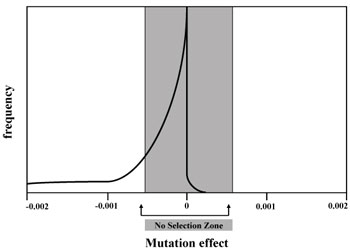
Heed the graph to the right. On the horizontal axis we have the probability of a positive or negative effect of a mutation to be selected for by natural means. On the vertical axis we have the relative frequencies of these (im)probable mutations. Now, first it must be said that this graph almost certainly wholly underestimates the unlikelihood of an environmental factor to meaningfully select for or against a mutation.

The problems are numerous, first a mutation has to actually correspond to some kind of meaningful phenotype (which is unlikely in the extreme), and then also the environmental factors have to be so fine-tuned as to select specifically for this awesomely minor phenotype difference, and ignore all the other more acute phenotypes which crowd it and vy for its attention. Secondly the environmental factor has to also somehow ignore all the other uninherited factors which constitute the largest part of the realised phenotype, and somehow distinguish between a phenotype ever so slightly (if at all) influenced by an ever so slight mutation, and the full range of phenotypes brought about by the synergism of inherited factors and uniherited factors (there most likely will not be any way to distinguish). For example, it is thought that 99.6% of fitness is not related to inherited factors at all.

But even setting all these insurmountable problems aside (for the sake of our foolish and deceived atheistic naturalists, knowing that is only by the free sovereign grace of God that we ourselves are not so deceived), this graph gives us a gray region in which it is considered that the effect of the mutation is so near neutral, that it is considered to not have any effect at all. First notice that most mutations fall into this bracket, second notice that almost all mutations are deleterious, third notice that some deleterious mutations do emerge on the left, but fourth notice that the positive mutations (which in fact cannot increase information or create new functions anyway) do not come close to escaping the gray band. What does all this tell us (at the very least)?

  1. No mutation can provide new information or new functions, only "fine-tune" (or hugely more likely mess-up) what is already there.
  2. Positive mutations are thoroughly out-weighed by deleterious ones.
  3. Almost all mutations have little or no effect on actual phenotypes (and positive ones even much less so).
  4. Any effect on actual phenotypes is wholly crowded out by all the other factors which influence phenotypes, most not even heritable.
  5. Even if the right environmental factor was present to select for this phenotype it would have next to no correspondence to the mutation.
  6. The environmental factor that would select for a particular phenotype would mostly be entirely crowded out by all the other environmental factors involved.
  7. Natural selection is totally blind and mostly does not select for the best phenotypes, but rather the selection is mostly determined by chance in a natural environment because the difference in phenotypes is usually insignificant anyway.

All this is without even mentioning the vast plethora of other insurmountable hurdles, such as every single step from inorganic chemicals to organic chemicals, organic chemicals to useful biological molecules, useful biological molecules to useful cell components, useful cell components to cells, cells to specialised cells, specialised cells to tissues, tissues to organs, organs to systems, simple systems to complex systems, and the list goes on and on. And in between each of these is hundred more impossibilities or more. Added to this is the innumerable irreducible complexities within even the smallest components of every single living organism on the planet, living systems, cells, molecules, etc.

No, not in a million years would even one of these hurdles be overcome (and most not even by carefully-guided and designed processes). Not in a billion. Its time evolutionists faced up to harsh realities of physics, chemistry and mathematics. And then take a look at the fossil record too - distinct species, not intermediates are found. And then turn around and look at everything sensible biology and genetics has discovered to date and see that it has flown in the face of this fantasy of evolution.

Everything in the true science of biology teaches us about the awesome wonder of creation and the glory of the incomprehensible transcendent Creator. But all we ever learn here can only ever condemn us for our sinfulness in not giving the praise that our Creator deserves. The Gospel of Jesus Christ alone is what tells us of how we may be redeemed from our sins and the punishment we deserve.

- Sam W.

Thanks to CMI for this article: http://creationontheweb.com/content/view/6102
For a full list of references see the above article.
Any questions or objections can be addressed to CMI but have probably already been answered or refuted by them.
See a previous post for more on why this issue is important for me and for all Bible-believing Christians.

Saturday, November 08, 2008

Glory to God alone for the lives of the saints!

I walk among a blind people,
The world, eyes shut, wonders.
My God has made the universe
The trees and the flowers,
The heavens, stars and planets all
With the fields, bogs and plains,
The mountains, hills, rocks and rivers,
Were form'd by God's good plans.

I gaze across the vast oceans,
Seeing the horizon,
This planet too great for my mind,
Amaz'd by our own sun.
The dawn takes my breath all away
The mist terrifies me,
The quaking earth throws me to ground,
In awe and fear to be.

The clouds billow and thunders roll
The sky flashes with light,
God makes His voice, His anger known;
Boasters all flee in fright.
Fear, all you men who boast, the Lord
Who alone is worthy
Who alone works obedience,
In the saints and in me.

You fools who boast in deeds and will,
Sacrifice and service,
Hear what the prophets spoke of old,
And wander not amiss.
The Lord delights not in these, but
A humble, contrite heart,
Such pleases Him who has no need,
Whose love does not depart.

As by the disobedience,
of one man all were sin,
So by the full obedience
of one man, redemption.
With one sacrifice was God pleas'd,
His Son and none beside.
And all His saints do nothing good,
And should not have such pride.

We love because He lov'd us first.
No good thing dwells in us,
Except His Spir't who works alone
Obedience in us.
Apart from this we only sin,
And nothing add do we,
That Scripture be prov'd when it says
All glory to Him be!

As God alone work'd to create,
That none else may glory,
So He alone work'd salvation,
To set His people free.
Now all you boasters in man's will
Who makes you to differ?
Does not the mighty Lord alone,
Set you from another?

Let him who boasts, make this his boast,
That he does know the Lord.
Without pride, let him who glories,
Glory alone in God.
God, I confess, open'd my eyes,
And freely forgave me,
And though God's this reveal'd to me,
I'm better not than thee.

Friday, October 24, 2008

Why am I a young-earth creationist?

First of all, I believe in the biblical and reformational principle of Sola Scriptura (2 Timothy 3:13-4:4, Hebrews 4:12, 2 Peter 1:16-2:3, Psalm 19:7-12, Acts 20:20, 27).

I do not find the idea of long ages or evolution in the Bible, and instead I find clear refutations of them in the plain matter of fact account at the beginning of a book about history (Matthew 1:1, Genesis 2:4, 5:1, 6:9, 10:1, 11:10, 11:27, 25:12, 25:19, 36:1, 36:9, 37:2, 1 Timothy 1:4, 4:7, 6:3-4, 6:20, 2 Timothy 4:4, Titus 1:14, 2 Peter 1:16, Titus 3:9, Matthew 22:29-32, Mark 7:9-13, 12:24-27, Luke 16:27-31, 24:27, 44-46, John 5:45-47, etc) of a six-day, miraculous finished creation, timed according to evening and morning of the 24 hour rotations of the earth (Genesis 1:1-2:4), which is then used as a model for our six-day working week and sabbath (rest, Exodus 20:8-11), which then is placed perfectly at the beginning of meticulous chrono-genealogies by the ages of the ancients and their ages at the birth of their sons (Genesis 5, 11, 1 Chronicles 1-9, Luke 3:23-38) and the subsequent and direct chronologies of events dated by years of kings etc (see Genesis - 2Kings - Nehemiah / 1Chronicles - Nehemiah), and in the matter-of-fact account of one man and one woman being created from which this unbroken line of descendants arises, and more specifically, the descendant/seed: the Lord Jesus Christ.

Now see that all creatures were created in these specifically 24hr days (Genesis 1:20-2:1), to multiply according to their own kind (Genesis 1:21-22, 24-25, 2:19-20). Notice, first, created as separate kinds, as kinds of fish, kinds of beasts, and kinds of birds etc, and second, that they reproduce according to their own kind. Granted, there is variation within these kinds (not the human definition of species, mind you) due to the various pressures of environment and degeneration and degradation due to the curse and bondage to decay which came as a result of man (Genesis 3:17-19, Romans 8:20-22, Isaiah 24:1-6), but God's decrees are more immovable than the universe.

Then couple that with the all theological arguments based on these simple historic facts, that by the sin of one man, Adam, all men, being his descendants, were born in sin, that death and suffering came about as a result of this Fall, and that also by the obedience of one man, the Lord Jesus, many will be saved (Romans 5:12-6:2, 1 Corinthians 15:21-22, 45-50), and that all peoples all over the earth are one blood (Acts 17:23-26, Genesis 3:20, 9:19), that Christ is then therefore our kinsman-redeemer (Hebrews 2:14-17, Leviticus 25:25), that women should not teach or be in authority over man because Adam was formed first and Eve was deceived (1 Timothy 2:11-14, Genesis 2:21-23, 3:4-17), and I could go on.

Also the treatment of these historical records by the biblical writers and the Lord Jesus who said, "From the beginning, God made them male and female." (Matthew 19:3-9, Genesis 2:21-24, Matthew 5:31-32, Mark 10:11-12, Luke 16:16-17, Romans 7:2-4). And so the basis for condemning all forms of homosexuality, bestiality, fornication, concupiscence, lust, adultery, divorce (though sufferable on account of fornication whereby the marriage is already defiled), remarriage (while the spouse is still alive) as perversions is laid down steadfast in the foundation of solid historical fact and again I could go on.

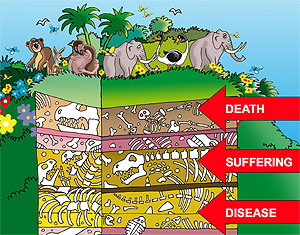
But this picture captures part of this issue very well for those who would confront God's word with the irreverent babblings and contradictions of what is falsely called knowledge (1 Timothy 6:20). Those who willingly deny the global Flood (2 Peter 3:1-7) look at the massive layers of sediment, filled with fossils depicting suffering, death and disease and blindly assert that these fossils are millions of years old. But when did the Fall happen? Before or after these "millions of years"? Is God unjust? When viewed in the light of Scripture this "long ages" or "deep time" view is nonsense and not only absent from, but entirely contradictory to, God's word.

In the light of God's word we look at these massive sediment layers, filled with gruesome fossils, and we see it as a terrifying testament to the wickedness of man and the righteous judgment of God, who looked upon the earth and saw that the thoughts of the hearts of men were only evil continually from birth (Genesis 6:5, 11-13). And so first in the garden of Eden, man and woman were cast out and condemned to die for their sin, and all of creation was cursed by their sin because they had dominion over it, and yet even in this God was abundantly merciful and gracious who caused Abel to present a pleasing sacrifice (Genesis 3:21-4:5) because its blood pointed towards the glory of the Son of God who poured out His blood to ransom a people from the curse from every tongue, tribe and nation (Revelation 5:9). And yet the seed of the serpent was and has always been in enmity against those to whom God sovereignly chooses to be gracious to (Genesis 3:14-15, Romans 8:28-39).

The curse was upon the earth and the wickedness of man waxed worse and worse as it does yet today until violence covered the whole earth and God in His righteous fury sent a Flood to destroy every living thing on the face of the earth except for those entirely undeserving ones whom He had graciously saved in the Ark covered by what pointed to the atoning sacrifice of Christ (Genesis 6:11-22, 7:16-24). And the LORD set up the rainbow in the cloud as sign of His everlasting unconditional covenant which He establishes for His people for the praise of His glorious grace (8:20-9:17).

So, we look at the layers of sediment and the fossils and we see brief time in which the devastating Flood happened upon the earth which laid up these massive sediments full of these creatures buried so rapidly that they became fossils, and we remember too that this earth is also currently being reserved for utter destruction with fire on the Last Day (2 Peter 3:5-15). Not "millions of years". Not evolution. The Creation, the Fall, the Curse, the Flood, the Ark, the Rainbow, the Covenant, the Redemption, the Christ.

As the rainbow is a sign of the covenant to His children, the ominous layers of sediment and fossils are a sign of the past and the coming judgment to the children of the devil. And yet, we who believe by the grace of God understand these things, yet they who have not received the love of the truth do not (2 Thessalonians 2:8-15, 1 Thessalonians 5:1-11), lest they should repent and be healed (Matthew 13:10-17, John 8:42-47, Isaiah 29:10-20, Isaiah 44:1-25, Mark 4:10-13). All glory be to God who works wonders in the heavens and upon the earth, and is righteous and just and good and merciful and gracious in all His works and all His eternal decrees, whose love to His people, and whose hatred toward the wicked will endure forever (Psalm 9:1-20).

Thanks to Creation Ministries International for the picture!
http://creationontheweb.com/images/fp_articles/2008/6105death-suffering.jpg

Sunday, June 08, 2008

Why should we defend the historical truth of the Bible?

I've been realising that many of the most devious attacks against the Gospel come from attacking an issue which seems at first to be secondary. But the Gospel is built upon the real space-time historical events recorded in the Bible; so undermining the historical accuracy and clarity of the Bible is then quite simply an undercover attack on the Gospel itself.

In particular the early chapters of Genesis which lay down the real historical events that give the foundation for all the major Christian doctrines, such as the nature of God, the nature of man, the nature of sin, the consequences of sin, the origin of death, the need for a saviour and more. Once the foundation of these doctrines is removed, the fundamentals doctrines that lay the foundation of the Gospel are removed.

But there is a lot of encouragement to be found, as many have not laid bare their foundations:

See: http://creationontheweb.com/content/view/5774/

R. C. Sproul says: "According to the Reformation hermeneutic, the first option is to follow the plain sense of the text. One must do a great deal of hermeneutical gymnastics to escape the plain meaning of Genesis 1–2."

The more that this age progresses with all its apostasy and lies and deceptions and even false signs and wonders, the more we will need to cling to the Bible and let go of everything else which claims to have any authority on truth.

It is vital that we fervently believe that Scripture itself is the only authority by which to interpret Scripture.

Otherwise we will be caught headlong in the snare of Satan’s lies, the evil of compromise, the malady of the world’s wisdom and the degeneration of doctrine, the death of certainty, the ignorance of the truth, and the defilement of the church.

Yet we have the precious promises of Christ; His Church will endure, His bride will know the truth and the truth will set her free.

Tuesday, March 20, 2007

The Frost

The Frost

I have seen beauty today.
It came swiftly,
Swiftly like the pearls of rain,
That splash and give life.
As the sun rose,
Lighting the sky in
What seemed to me,
A magical glow.
It cast down light,
Revealing the crisp landscape,
Frozen in time, edged in silver.
Tiny crystals smiled up at me,
Glistening in the yellow light,
The haze from the clouds.
And I smiled back at them,
For I too was enlightened
By the magical glow.
The light flooded the land
And my chains were released.
They came alive and danced,
Dancing with me in my joy.
Everything was fresh and new,
Preserved in eternal beauty.
As I danced in the garden,
I only wished I was like them.
The world was wonderful.
Dawn had come and
The world had been reborn.
Perfect and flawless,
White and mystical,
Filling my heart with wonder.
Fragile and delicate edges,
Each one carefully placed
And all intricately designed.
The crystals all with pride,
Each one different and special.
I tried to see them all,
Knowing all were waiting
To show me their beauty.
I wept that I could not make
A poem for each single one
Designed as a sign; millions,
Showing exactly what He can do.
I have seen beauty today.


Well, obviously this wasn't today, again, this is a poem I wrote a few years ago, on a cold winter's morning when there was frost. I didn't actually do all the things I said I did in the poem, but I guess that my failing. God is wonderful, and He has filled His creation with beauty. It's such a wicked shame that we don't enjoy it nearly as much as we should...