Showing posts with label historicity. Show all posts

Tuesday, July 19, 2022

The Time, Necessity, and Activity of our Believing

Suggesting that because the Reformed faith rebukes the errors of hyper-Calvinists who deny that we believe unto salvation, we are somehow claiming credit for faith and teaching it as a condition rather than attributing all glory to God is absurd. Consider this passage in which Paul describes his teaching:

"And I, brethren, when I came to you, came not with excellency of speech or of wisdom, declaring unto you the testimony of God. For I determined not to know any thing among you, save Jesus Christ, and him crucified. And I was with you in weakness, and in fear, and in much trembling. And my speech and my preaching was not with enticing words of man's wisdom, but in demonstration of the Spirit and of power: That your faith should not stand in the wisdom of men, but in the power of God. Howbeit we speak wisdom among them that are perfect: yet not the wisdom of this world, nor of the princes of this world, that come to nought: But we speak the wisdom of God in a mystery, even the hidden wisdom, which God ordained before the world unto our glory: Which none of the princes of this world knew: for had they known it, they would not have crucified the Lord of glory. But as it is written, Eye hath not seen, nor ear heard, neither have entered into the heart of man, the things which God hath prepared for them that love him." (I Cor. 2:1-9)

  1. Paul's preaching was Christ-centred, and specifically centred upon His crucifixion for us.
  2. Christ suffered under Pontius Pilate (one of the princes of this world) historically, and was crucified at a specific time according to the determinate counsel of God (Acts 2:23), therefore the centre of Paul's preaching was primarily this historical event rather than the eternal counsel in which it was determined and planned.
  3. The manner of Paul's speech was not that of a great orator trying to impress with his words, but of a man deeply humbled, broken before God, and in awe at the wondrous grace of God to him personally who was before a blasphemer and persecutor (I Tim. 1:12-16). I allow you to examine and apply this pattern to hyper-Calvinist preachers who typically attract followers by their demeanour and words and actions (with comparisons and incessant accusations against others) presenting themselves as somehow more orthodox and more profound and more powerful in their preaching than those who preach the simple gospel of Christ crucified. Paul simply presents Jesus Christ in power, and himself only in weakness.
  4. The central subject and manner of his preaching were necessary for the source of their faith, because true faith does not stand in the wisdom of men, but in the power of the Spirit. The Spirit is the only source and power of true faith.
  5. Our faith stands and our faith knows and our faith sees. These are inner spiritual activities (though not the works of our hands or deeds of the body). By faith, we stand, we know, and we see. Faith is living and active in us exactly because the source and power of faith is the living and active Spirit who bears witness in us by the word (Heb. 4:12). It cannot be otherwise.
  6. Because the centre of Paul's preaching was Christ crucified, he also spoke about God ordaining this mystery before the world and God preparing these things for them that love Him. Not in or by itself, or as the centre of His preaching, but in connection with and for the sake of the preaching of Christ crucified in time.
  7. By using the words "ordained before", "unto our glory" and "prepared", Paul instructs us that Christ crucified, as well as our faith purchased for us on the cross and by which alone we know what God has prepared for us, are after, in time, and historical, as well as absolutely and sovereignly determined, certain, fixed and caused by God alone, thereby excluding any and all external dependencies, conditions, or prerequisites.

Much more could be said from this passage alone, but faith is knowing what God has prepared for us, and to castigate the Reformed faith as if we say that faith is a condition when we only insist that it is the necessary means by which we know what God has prepared for us, is nothing but baseless slander and a shameless twisting of our confession. Believing the promises is how we receive the promises, and this activity of faith itself is part of what God has prepared for us. By accusing us of teaching faith to be a condition, when we insist that it is a necessary means, the hyper-Calvinists themselves disconnect it from the promises of God and from eternal unconditional election, and by accusing us of teaching faith to be a work of man because we say it is living and active, the hyper-Calvinists themselves disconnect it from the power of the living and active Spirit and make our activity stand in the wisdom of men. Paul spoke concerning such as those who deny the power of God at work in us (chiefly our faith by which power we overcome the world; I John 5:4): "Having a form of godliness, but denying the power thereof: from such turn away." (II Tim. 3:5)

"But God forbid that I should glory, save in the cross of our Lord Jesus Christ, by whom the world is crucified unto me, and I unto the world." (Gal. 6:14)

Consider the official teaching of the Reformed faith in Canons Head I:

Art 3. And that men may be brought to believe, God mercifully sends the messengers of these most joyful tidings to whom He will and at what time He pleaseth; by whose ministry men are called to repentance and faith in Christ crucified. ...

Art 4. The wrath of God abideth upon those who believe not this gospel. But such as receive it, and embrace Jesus the Saviour by a true and living faith, are by Him delivered from the wrath of God and from destruction, and have the gift of eternal life conferred upon them.

Notice it is men who believe (not Christ or the Spirit or God for us, or in us, or on our behalf instead of us) which is described as the activities of receiving and embracing, and we do not have the gift of eternal life and are not delivered from the wrath of God until we believe. These are the ABCs of the Gospel 101 which are being denied by those who are obsessed with pushing everything, including the application of salvation, into eternity past, and who pretend that man's believing activity by which he receives and embraces Christ is a work and a condition rather than the gift of God by the power of the Holy Spirit working in him. And they have the gall to boast of this wretched impious confusion as if it makes them holier or more orthodox or more humble or more God-glorifying while throwing at us the most vehement and despicable accusations that we deny the Gospel.

There is a sound reason why the Canons took this doctrine of our activity of faith unto salvation as their starting point (Art. 1 teaching the justice of God in condemning all mankind, and Art. 2 teaching the manifestation of the love of God in sending Jesus Christ to give life to all who believe). Having explained this first, then the Canons are able to take up the subject of eternal election in its proper place, to explain why some believe and others do not, in contrast to the conditional theology of the Arminians.

Calvin very harshly admonishes his readers when he begins to treat the subject of predestination, since it has to do with God's eternal counsel, so much of which is unimaginably far beyond our comprehension and has not been revealed to us:

First, then, let them remember that when they inquire into predestination they are penetrating the sacred precincts of divine wisdom. If anyone with carefree assurance breaks into this place, he will not succeed in satisfying his curiosity and he will enter a labyrinth from which he can find no exit. For it is not right for man unrestrainedly to search out things that the Lord has willed to be hid in himself, and to unfold from eternity itself the sublimest wisdom, which he would have us revere but not understand that through this also he should fill us with wonder. He has set forth by his Word the secrets of his will that he has decided to reveal to us. (Institutes 3.21.1)

Calvin's approach to this subject, as all others, is to approach only by the "pathway of faith" in Christ crucified as revealed in God's Word alone. He quotes Augustine:

"We have entered the pathway of faith," says Augustine, "let us hold steadfastly to it. It leads us to the King's chamber, in which are hid all the treasures of knowledge and wisdom. For the Lord Christ himself did not bear a grudge against his great and most select disciples when he said: 'I have ... many things to say to you, but you cannot bear them now' (John 16:12). We must walk, we must advance, we must grow, that our hearts may be capable of those things which we cannot yet grasp. But if the Last Day finds us advancing, there we shall learn what we could not learn here." If this thought prevails with us, that the Word of the Lord is the sole way that can lead us in our search for all that is lawful to hold concerning him, and is the sole light to illumine our vision of all that we should see of him [i.e. by faith], it will readily keep and restrain us from all rashness. (Institutes 3.21.2)

Like brute beasts, the hyper-Calvinists charge into the throne room of God's eternal wisdom, not holding to the pathway of faith, not bridled by the revealed Word, and so rush headlong into a labyrinth of their own making, and present us with the rottenness they find there in their own imaginations as if it were God's own secret wisdom (Jude 1:10). From the wisdom of men, may the Lord deliver us, that our faith should stand in the power of the Spirit.

The Canons of Dordt concludes with practical application to keep us from this error, as applicable to the calumnies of modern hyper-Calvinists as it was to those of the Arminians:

... some whom such conduct by no means became, have violated all truth, equity, and charity, in wishing to persuade the public [of various slanders, accusations, false doctrines, and calumnies] and many other things of the same kind, which the Reformed Churches not only do not acknowledge, but even detest with their whole soul. Wherefore, this Synod of Dort, in the name of the Lord, conjures as many as piously call upon the name of our Savior Jesus Christ, to judge of the faith of the Reformed Churches, not from the calumnies, which, on every side, are heaped upon it; nor from the private expressions of a few among ancient and modern teachers, often dishonestly quoted, or corrupted, and wrested to a meaning quite foreign to their intention; but from the public confessions of the Churches themselves, and from the declaration of the orthodox doctrine, confirmed by the unanimous consent of all and each of the members of the whole Synod. Moreover, the Synod warns calumniators themselves, to consider the terrible judgment of God which awaits them, for bearing false witness against the confessions of so many Churches, for distressing the consciences of the weak; and for laboring to render suspected the society of the truly faithful. Finally, this Synod exhorts all their brethren in the gospel of Christ, to conduct themselves piously and religiously in handling this doctrine, both in the universities and churches; to direct it, as well in discourse, as in writing, to the glory of the Divine Name, to holiness of life, and to the consolation of afflicted souls; to regulate, by the Scripture, according to the analogy of faith, not only their sentiments, but also their language; and, to abstain from all those phrases which exceed the limits necessary to be observed in ascertaining the genuine sense of the holy Scriptures; and may furnish insolent sophists with a just pretext for violently assailing, or even vilifying, the doctrine of the Reformed Churches.

Saturday, April 23, 2022

Three Witnesses in Earth

Rock of Ages, cleft for me,
let me hide myself in thee;
let the water and the blood,
from thy wounded side which flowed,
be of sin the double cure;
save from wrath and make me pure.

Not the labours of my hands
can fulfill thy law's demands;
could my zeal no respite know,
could my tears forever flow,
all for sin could not atone;
thou must save, and thou alone.

Nothing in my hand I bring,
simply to the cross I cling;
naked, come to thee for dress;
helpless, look to thee for grace;
foul, I to the fountain fly;
wash me, Saviour, or I die.

While I draw this fleeting breath,
when mine eyes shall close in death,
when I soar to worlds unknown,
see thee on thy judgment throne,
Rock of Ages, cleft for me,
let me hide myself in thee.

- Augustus Toplady, who understood pretty well what he was writing about!

I think I should add that Toplady's allusion to the water and the blood as a pledge of the effects of salvation is the signification given to these in Scripture (cf. I John 5:8, and Calvin's helpful commentary on it and verse 6, for example). In Scripture the water and the blood from Christ's side are highlighted specifically as witnesses (or signs), and this alludes to their use as agents of atonement and cleansing in the Old Testament rites. That these agents should flow from the crucified Christ is identified by John as a testimony that all our salvation is to be sought from Christ, the fountain of these saving agents, blood which purges guilt, and water which cleanses pollution.

John adds a third witness, which is particular to born-again Christians, the Spirit, which he speaks at length about in his whole epistle, as distinguishing true Christians from false professors (even lawless antichrists) not only by the inner testimony of the Spirit which cultivates and informs our faith as we hear the word, but also from the loving character of the Spirit as holy, so that fellowship with God is a holy fellowship of love, enjoyed in the way of walking in holiness and love (which John calls "light" as opposed to the blindness of impenitence or even apostasy, a darkness in which we do not see God in Christ through faith but which interrupts or prevents faith), such that those who live in hatred, and are careless regarding the law really do not have this Spirit. They can see the witness of the water and blood, but they can only see the witness of the Spirit in the lives of others who are genuine Christians walking in continuing, persevering repentance.

John also refers to three witnesses in heaven, a verse cited by our Belgic Confession in support of the Trinity, a verse also cited by various church fathers throughout history, even if evidential support is lacking in the more mainstream Greek manuscript traditions. There are a lot of very poor arguments made on both sides of this controversy, but if you are interested, here is a helpful treatment of evidence for and against (I also highly recommend the simple treatment of internal evidence which Matthew Henry's commentary provides). He does argue some points for the Comma Johanneum, far more strenuously than I would be prepared to, since I think I do not attach so much importance to it compared to other much clearer passages which prove the Trinity and the Deity of Christ. As far as explanation for its omission goes, if I have to speculate, I'd agree with an accidental omission due to the similar beginning and ending of verses 7 and 8 (relatively common haplography), and that omission perhaps being subsequently reinforced rather than corrected due to prevailing Arian bias in the eastern (Greek-speaking) church. As a standalone proof-text for the Trinity, it is only supporting evidence at best, weak compared to the much clearer and stronger arguments, such as showing how Scripture distinguishes the Father, Son, and Spirit as distinct Persons, and showing how the divine names, attributes, works, and worship are attributed to all three.

Perhaps this explains why it was not quoted as often as some would like to imagine in the Arian controversy, especially since the Arians would have no problem saying that these are three witnesses in heaven which agree in one (though admittedly, and significantly perhaps, the little preposition "in" is omitted from verse 7 regarding the witnesses in heaven), in the same sense that the blood, water, and Spirit are three witnesses which agree in one. As a standalone proof-text it does not so strongly emphasize the deity of the three Persons, or the essential unity of the Three. Of course, this verse not being present in many Greek manuscripts would also explain why it was not quoted so often.

But the idea of three witnesses, or "two or three witnesses" is another allusion to the Mosaic law, in which every word in judgement was to be established by two or three witnesses. John is very concerned with this concept of witness and the trustworthiness of a witness, in his Gospel account as in this epistle. Three witnesses is doubly more sure than the agreement of two witnesses, so John adds the third witness in earth. And if we ought to receive such witnesses in earth, how much more the witnesses in heaven? John makes exactly this argument in verse 9 (which incidentally does not make as much sense with the Comma Johanneum omitted). John records the witness of John the Baptist to God's witness at Christ's baptism, though he does not record the baptism itself, as the three other (synoptic) Gospel accounts do. He also records this when Christ recognizes that the time of his crucifixion and the salvation of the Gentiles is at hand:

Now is my soul troubled; and what shall I say? Father, save me from this hour: but for this cause came I unto this hour. Father, glorify thy name. Then came there a voice from heaven, saying, I have both glorified it, and will glorify it again. The people therefore, that stood by, and heard it, said that it thundered: others said, An angel spake to him. Jesus answered and said, This voice came not because of me, but for your sakes. Now is the judgment of this world: now shall the prince of this world be cast out. And I, if I be lifted up from the earth, will draw all men unto me. This he said, signifying what death he should die. (John 12:27-33)

Further he records Christ's own answer to the Pharisees who objected to His witness and refused it on unreasonable grounds. Christ's answer makes the same argument that John makes in his epistle (his entire epistle is a little echo and underscoring of his Gospel account), that He has witnesses in earth, he has the testimony of John the Baptist, but the Author of Truth cannot be attested to by mere sinful men, though they are holy prophets, though unbelievers readily and regularly receive the witness of sinful men who bear witness of themselves. Instead, and incomparably greater, He has the witness of God, both in the works for which His Father sent Him, and the voice of His Father, which they had not heard or received though God spoke clearly at His baptism, as well as from Mount Sinai and at other times. The unbelieving heart cannot receive this witness, instead they absurdly claim, "It thundered." The unbeliever may search the Scriptures, but in blindness not seeing that the Father has borne witness of the incarnate Son throughout.

So, although John attaches great importance to the signs of the water and blood, and the testimony of the one who saw it and bear record of it, ultimately we have a greater witness, that we may believe:

Then came the soldiers, and brake the legs of the first, and of the other which was crucified with him. But when they came to Jesus, and saw that he was dead already, they brake not his legs: But one of the soldiers with a spear pierced his side, and forthwith came there out blood and water. And he that saw it bare record, and his record is true: and he knoweth that he saith true, that ye might believe. (John 19:32-35)

By the witness of the Spirit in our own hearts, we have that three-fold testimony from heaven, not only the witnesses on earth that agree in one. We have the witness of God in our own selves. So we can consider the book-ends of John's epistle which describes the life with God that we now have and know and enjoy in Christ through the Spirit.

That which was from the beginning, which we have heard, which we have seen with our eyes, which we have looked upon, and our hands have handled, of the Word of life; (For the life was manifested, and we have seen it, and bear witness, and shew unto you that eternal life, which was with the Father, and was manifested unto us;) That which we have seen and heard declare we unto you, that ye also may have fellowship with us: and truly our fellowship is with the Father, and with his Son Jesus Christ. (1 John 1:1-3)

If we receive the witness of men, the witness of God is greater: for this is the witness of God which he hath testified of his Son. He that believeth on the Son of God hath the witness in himself: he that believeth not God hath made him a liar; because he believeth not the record that God gave of his Son. And this is the record, that God hath given to us eternal life, and this life is in his Son. (1 John 5:9-11)

The one who has this witness in himself, is one who has fellowship with God, and the only kind of fellowship with God is one in which we are doing God's will:

If any man will do his will, he shall know of the doctrine, whether it be of God, or whether I speak of myself. (John 7:17)

In contrast to this, the one who claims to know God and have fellowship with God, to be super spiritual, even far above others, perhaps claiming to know the abounding of God's grace because of the depths of his sinful walk even far more than others, while walking in hatred, does in fact not know God, but is necessarily blinded in his impenitence, just as much as the one who outright rejects the testimony of Christ:

He that saith he is in the light, and hateth his brother, is in darkness even until now. (1 John 2:9)

The record of the Spirit, is in agreement with the water and the blood. The one who has the witness of the Spirit, is the one who truly knows and enjoys the life of love and fellowship with God, the one who is both cleansed by the water, and reconciled by the blood. All supposed spiritual knowledge which is separated from a life of love and holiness is not the true light in which we enjoy fellowship with God. That's the significance of the sign of the water and the blood in their agreement with the witness of the Spirit.

Wednesday, February 16, 2011

Still the best after 400 years

As it happens to be the 400th anniversary of the KJV, I suppose it would be appropriate to explain some of my thoughts on what is perhaps going to be a controversial anniversary. I use the KJV, because it's the version I read and study, and that my church uses, and that English-speaking churches whose heritage is found in the Reformation have used for the last 400 years. There are certainly deeper underlying reasons, which are far more significant.

First of all, I'm not a "KJV-Only-ist" in the sense that I don't believe it is as good as it could be, or entirely perfect, or on par with the text in the original languages (I say this for theological reasons, and because I know a little, but enough generally about the grammatical differences between languages, not because I know anything specifically about Greek, Hebrew, or Aramaic). Also because I'm not against other versions in principle if they are faithful translations of the true Scriptures, but the problem with almost all the recent versions which have been released in the number of years is:

1) The biblical and Reformed doctrine of the Preservation of Scripture. They are based upon a couple of manuscripts which differ vastly from the overwhelming majority of other manuscripts, (which the Reformers deliberately rejected as corrupt). One bunch was preserved in a library in the Vatican, and the other lost in a waste-basket in a city that was notorious for the propagation of heresy. If God's word is preserved for the sake of His people, then how could these manuscripts which dwelt in obscurity away from God's people for so long, really be God's word? Especially when they contradict the other manuscripts in so many places?

So, the text which has been preserved and received by God's people throughout the ages is what we should receive, just as Christ received the Scriptures of His day, trusting that God had preserved them. It is not insignificant that the modern-day Arian heretics, who inappropriately call themselves "Jehovah's Witnesses," are strong proponents of these deviant manuscripts.

2) The biblical and Reformed doctrine of the plenary (full) and verbal (each word) Inspiration of Scripture. The more recent translations are mostly based upon a "dynamic equivalence" philosophy of translation. This means that the translators interpret what they think the original meaning of the phrases and sentences were, and then they paraphrase this perceived meaning in a different language. So, then we are not reading God's words, but the words of the interpretation of the translators.

Now the translators of the KJV, were a very godly bunch of men, at the height of the strength of the Reformation, of the calibre (both intellectually, and in understanding of the original languages, and spiritually) that can hardly be found anywhere in these present dark days. But what of, for example, the translators of the NIV? At least one was a lesbian (Dr. Virginia Mollenkott). But also, the translation philosophy used by the KJV translators was "formal equivalence", which means that with as little interpretation as possible, and as little paraphrasing as possible (only enough to retain the original sense taking into account the differences in grammatical structure and word order in different languages), they translated the words of the Bible, and when they had to insert extra words to give the original sense, they put these extra words in italics to show that they were not present in the original (the more recent translations add words willy-nilly with no indications whatsoever). The result was "Biblical English".

It was a peculiar style even then, as much as it is now, being so similar in structure and style to the original Greek and Hebrew phraseology - yet it remains easily understood (if you doubt this, read it, and consider how many foreign mission fields have successfully used the KJV when English was not even the first language). Not only that but they compensated for certain deficiencies and ambiguities in the English language which were not problems in the original languages - such as the use of "thou" and "thee" for "you, singular" and "you" and "ye" for "you, plural". There has not yet been a translation anywhere near as good as the KJV for these reasons, in terms of its precision and accuracy. And it's all because the translators feared God, and took seriously His warnings not to add or take away from His word, and that every word of the Bible is God's word and may not be trifled with.

You may examine these two simple claims yourselves, and make your own judgments.

Sam W.

P.S. More reading materials on this subject can be found here:
http://limerickreformed.com/index.php?option=com_sectionex&view=category&id=6&Itemid=35#catid52
http://www.cprf.co.uk/pamphlets.htm#bible
http://www.cprf.co.uk/scriptureresources.htm

The most significant issue (regarding which texts are valid), is not controversial for the Old Testament (the Masoretic text), but concerns the Greek New Testament. This article from the Trinitarian Bible Society deals with this subject comprehensively, and definitively: http://www.trinitarianbiblesociety.org/site/articles/grktxt.html

Tuesday, February 15, 2011

Review: Contending for the Faith

No other book that I have read has been more helpful in my understanding the present condition of the church world today.

Each chapter of the book treats a separate heretic/heresy in church history, from the very early church all the way up to recent times. It is written in a very easy to read style, despite the complexity of some of the heresies discussed (since every heresy tends to be quite complicated in comparison to the simple truth). Reading it was like sitting with a father, being patiently told the long story of the family's history. Colourful stories and characters are painted in each chapter, which helps not with the flow and enjoyment of the reading, but also in understanding how the heretics, and their heresies developed.

Only the chapter on the Marrow men controversy became a little difficult to follow, but with good reason considering the difficulty of the issues involved. When men attempt the impossible in trying to find common ground between the truth and the lie, it always ends up with confusion. Simple overall principles like this, teaching about the character of heresies, and those who propagate them, were smoothly drawn out of the many examples.

Each chapter, a little story in itself, like every good story, contains important lessons to be learnt. Occasionally the lesson was longer than the story - but always very rewarding. The lessons contain enlightening analyses of the heresies, and bring the light of God's word to bear on each issue. Especially helpful was the distinctively Reformed protrayal of the issues involved. The truth was set very clearly in opposition to what was false or distorted, and the real character and root of the error became clear. Because of this, the book shows the reader where the same errors are found today, and how best to correct them and guard against their reccurance.

The wealth of the specific biblical subjects dealt with throughout this book is truly astounding. People in the confused church world today need to absorb the lessons in a book like this, to know the history of the church, and how God has led her and preserved her, and caused her to confess Him more and more clearly and fully throughout the ages. It is a terrible shame when we don't learn the lessons of history, and of incalculable help to us when we do.

I wish all the professing Christians that I know near where I live would read this book and see things as clearly as they are presented in it. It's available from our own Limerick Reformed Bookstore for the Republic of Ireland, and from the CPRC Bookstore for the UK and the rest of Europe, and from the RFPA  for America and the rest of the world.

Sam W.

Tuesday, September 28, 2010

Defence of Christianity Against a Proud Scoffer

In answer to a believer's query about science and the Bible, I referred to this website: http://www.creation.com.

A scoffer replied by comparing the highly qualified and intelligent authors of the material on this website to "The Banana Man" (so quickly that I concluded that he had in fact not even looked at the website), and advised me to only pay attention to "REAL scientists", by which I supposed he meant, those who attempt to explain the world in a materialistic framework regardless of how awkward and self-contradictory the fit becomes. To answer this challenge for the sake of the believer who had first made the query, not for the professed atheist (since if one denies the Bible outright, it is impossible to prove anything to them, and irrational to try to do so, and therefore argument with them is unprofitable), I responded:
Absolutely, of course I prefer the theories of scientists who dare not contradict God, who created everything and was there when all was created. Since those who deny Him, who is the Author of all truth and history, are nothing but willfully ignorant fools (Rom. 1:18ff), then of course I would be insane to take their proud imaginations seriously. If they deny the very first principle of all knowledge, then surely all their speculation is worthless. What need could I possibly have to pay heed to their vain attempts to ignorantly explain what is now seen, within such a self-contradictory and godless framework, intent on calling God a liar. But while men can lie and be deceived, it is impossible for God to lie. And those who call Him a liar are calling themselves, who are mere creatures, the Authors of truth; yet without God there is no truth. But they were born as wicked men only a few short years ago, are finite, and their lives are like the flower that fades and withers away quickly; they were not there to tell how things came to be. But God is from everlasting to everlasting, infinite in power and knowledge and wisdom, He was there, and none else.
The professed atheist then attempted to criticise the Christian faith on the basis that:
  1. It only believes what reaffirms its presupposed ideas.
  2. These ideas cannot be based upon "tangible evidence".
  3. It is therefore, "deliberate stupidity".
Again, lest anyone be fooled by these empty and self-contradictory words, I responded:
Blind and godless Empiricism is also a presuppositional belief. The difference is that there is no man who has not heard the witness of God in their own consciences (and therefore their denial of it is universally self-evident, no matter how much evil men deny it), and since the Lord has graciously granted me faith, I believe God's testimony which is greater than any other, and indeed is the only way in which I can test all other witnesses, and see the world as He does, and apart from which, all my own interpretations would be merely groundless stabs in the dark. Hence, I have nothing to discuss with such lying fools as you, unless you assert that God alone is the authoritative Author of all truth, and denounce your own feeble understanding, in order to learn from Him how we are to interpret the data and evidence which He has set before us.
Not content with this (of course), the God-hater dug himself a deeper pit, by denying that his empiricism was presuppositional, and calling it rational instead (as if the latter did not demand the former)! And then he gave a definition of empiricism which he presented as a vindication of his philosophy, rather than its very indictment, which it actually was. He then also claimed that his criticism of Christianity was "kind and gentle", and that he was speaking for my benefit, and asked me to do the same as if he were willing to be persuaded (but of course, only upon his own presuppositional grounds of godless materialism, which is the very thing I refuse to do, and would consider wholly irrational), as if I had not already laid before him his errors. Since the believer responded by giving his own definitions of materialism and of theism, which were unsatisfactory, and did not display the folly of the professed atheist, nor the Bible's evaluation of such scoffers and their godless philosophies, I finally responded at length:

Materialism: Trusting in your own experiences and your own interpretations of those experiences, while willfully denying God's trustworthy testimony.

Biblical Theism: Trusting in God alone, by whose Word all our experiences must be tested and interpreted.

"I'd really hope someone would extend a hand of knowledge to me" - the Roman Catholics once put the Bible on their forbidden book list, but to you, I am sure it is readily available - even in your own language. How much less excuse then, you have for inventing your own theories about why the world is the way it is, when you refuse to learn from the Creator who is the only One whose testimony can be trusted altogether.

The natural world indeed speaks powerfully about the greatness of the divinity and power of God (Psalm 19; Rom. 1:18ff), and God has even given us eyes, ears and all the other senses by which we can perceive the created things and thereby know of the wisdom, divinity, and power of the One who created them. This witness is sufficient to leave us without excuse for our wickedness in not glorifying Him as God. No wonder then that many in our day deny this.

Yet if we deny this, by what means do we suppose we can trust anything we observe? What reason would we have to put any confidence in our senses? Would we not simply then we left adrift in nihilism, perhaps "I think therefore I am", and all our experience may be simply a dream? Therefore the atheist contradicts himself, when he speaks of empirical rationality, because if there is no God who does not lie, and who has created all things, and who has given us these senses, then there is no reason to presume that anything is real. This is why atheism, contrary to the popular, yet foolish misconception of it, is actually the death knell to all scientific endeavour, while true Christianity is its very foundation. And this is true both philosophically, and historically. Science was given birth by Christianity which believes in one Almighty God who created all things and orders them according to natural laws which only He may alter by miraculous works which display His sovereignty over these laws. Without this, all is merely proud, blind speculation, as I said.

But He has given a far greater light in the Scriptures by which we might see things as they truly are and understand God's purpose for them in His eternal will to glorify the Son through the salvation of the company of the predestinate by Him. By these Scriptures we understand the origin of the world, and the history of it (including the flood by which the world that then was, perished by water), and the purpose of it for the glory of God. And by these Scriptures too, it is revealed to those whom God grants the gift of faith, how we are to be saved from the terrible wrath which we deserve - and there is no greater blessedness than to have been given the knowledge and assurance of this. Those who believe these Scriptures are the only ones who can really tell about why things are the way they are (but even then, only to a very limited extent), and why things work the way they do.

Furthermore, the study of things as they currently are and as they currently work, cannot tell us how things were in the past, or even how things will be in the future. In Scripture this notion is explicitly denied (II Pet. 3), because God did not leave things to continue as they were from the beginning, but everything changed at the fall of Adam, and about 1500 years later, this wickedness had manifested itself so universally that God destroyed the world by water, in order to preserve the church, and so the world that we now see is the aftermath, and quite different. If a bomb causes a building to explode in to dust, do we suppose that we can tell by looking at the aftermath how things were beforehand? Maybe certain things can be speculated upon, but all is vanity if it is denied that the explosion ever occurred.

This is one example of the proud vanity of those who speculate upon the past.

As for the future, if one denies God's providence in upholding the world by the word of His power (just as they deny that He created it by the word of His power), then they again have nothing but groundless inductive reasoning to go by and it is folly also to presume that all things will also continue as they are. But Bible tells us that though we ought to plan ahead, we ought to do so in the fear of God and prayer, because we do not know what a day will bring forth. We cannot say what will happen tomorrow because it is God who is the author of history not us; we can only say that if the Lord wills, such and such will happen (James 4:13-16), and we must study Scripture to understand the will of God, and we trust in His good providence for His people, knowing that He works all things for the good of those whom He has loved with an everlasting love (Rom. 8:28ff).

The Bible explicitly condemns this notion too in the same passage (II Pet. 3), as coming from the mouths of scoffers who deny the Flood and the first coming of the incarnate Son of God. It explains that Christ will certainly return on the last day, to end history and destroy the world, this time by fire, and to judge the living and the dead. And it explains also that Christ is not slow in coming, but He is carrying out the Father's will, that He will not lose one of those whom the Father has given to Him (how could He since He is omnipotent and has paid fully for their sins by His own infinitely worthy sacrifice? - John 6:37-40; Rom. 5:9). So He is not willing that any should perish; He will bring all His elect to repentance and faith before He returns in judgment.

I have written this in defence of the Christian faith against the scoffers which were prophesied beforehand, which were ordained to this condemnation, but I hope that God would bring all who read this to repentance to the acknowledging of the truth, rather than for greater condemnation to be poured out on them for denying it - but if that is the Lord's will, then so be it.
 I hope that believers readers will understand more fully that the Christian faith has nothing to fear from scoffers who irrationally boast about their rationality. As our Canons of Dordt say in head 3/4, article 4:
There remain, however, in man since the fall, the glimmerings of natural light, whereby he retains some knowledge of God, of natural things, and of the differences between good and evil, and discovers some regard for virtue, good order in society, and for maintaining an orderly external deportment. But so far is this light of nature from being sufficient to bring him to a saving knowledge of God, and to true conversion, that he is incapable of using it aright even in things natural and civil. Nay further, this light, such as it is, man in various ways renders wholly polluted, and holds it in unrighteousness, by doing which he becomes inexcusable before God.
It is sometimes amazing to observe what proud boasts men make with only their mere glimmerings of natural rationality, and how they use it, as with all their remaining "wholly polluted" faculties, in the service of sin and the devil, endeavouring with all their powers to hate God will all manner of contrived blasphemies, and to oppose the work of Christ in the salvation of His people. But every observation of this, rather than puff us up, should instead remind us that we are no different except for the grace of God, and so we ought to take occasion to be more humbled, and to be more grateful to God, and exalt Him alone.

Monday, January 05, 2009

Cosmology and Biblical Creation: God stretched out the heavens!

I have a book by Dr. John Hartnett called "Starlight, Time, and New Physics" which I had not quite finished reading yet (it was so exciting, I had to lend it to someone else). But I would nevertheless like to quote some info about it from this article: http://creationontheweb.com/content/view/6184
But this is only the beginning of the exciting implications of this
revolutionary book. Hartnett refers to recent observational data that
overwhelmingly leads to the conclusion that the universe must have a centre, with our galaxy somewhere near it. By plugging this ‘galactocentric’ universe into Carmeli’s equations, and then adding the biblical ‘stretching out of the heavens’ by God at creation (big bangers can scarcely disagree, as they call something like that ‘inflation’), what ‘falls out’ is an astonishing by-product. Namely, that there are built-in gravitational time-dilating effects such that:

a) Adam would have seen light from most of the same stars we see today
when he looked up on the sixth day and
b) light from even the most distant quasar, billions of light-years away from Earth, would reach us now within the six or so thousand years since creation.

Note that this is not the product of wishful thinking, or mathematics designed to give that outcome—just a straightforward chain of scientific reasoning:

a) Carmelian cosmology fits the observational data overwhelmingly, data which has been so puzzling that mysterious (and now unnecessary) fudge factors have been invented.
b) Observations also indicate that we are in a galactocentric universe.
c) Combining a) and b) mathematically shows that it is inevitable that an initial rapid ‘stretching out’ completely eliminates the so-called light-travel time problem for biblical creation.
I highly recommend reading the short article for more info on how to appropriately respond to the common attacks on God's Word from this area, even without Hartnett's book, and how to follow 2Co 10:3-5 in tearing down the fallacies of modern "big-bang theory" foolishness. I also highly recommend the book (although I cannot as yet give it a proper review).

- Sam W.

Friday, October 24, 2008

Why am I a young-earth creationist?

First of all, I believe in the biblical and reformational principle of Sola Scriptura (2 Timothy 3:13-4:4, Hebrews 4:12, 2 Peter 1:16-2:3, Psalm 19:7-12, Acts 20:20, 27).

I do not find the idea of long ages or evolution in the Bible, and instead I find clear refutations of them in the plain matter of fact account at the beginning of a book about history (Matthew 1:1, Genesis 2:4, 5:1, 6:9, 10:1, 11:10, 11:27, 25:12, 25:19, 36:1, 36:9, 37:2, 1 Timothy 1:4, 4:7, 6:3-4, 6:20, 2 Timothy 4:4, Titus 1:14, 2 Peter 1:16, Titus 3:9, Matthew 22:29-32, Mark 7:9-13, 12:24-27, Luke 16:27-31, 24:27, 44-46, John 5:45-47, etc) of a six-day, miraculous finished creation, timed according to evening and morning of the 24 hour rotations of the earth (Genesis 1:1-2:4), which is then used as a model for our six-day working week and sabbath (rest, Exodus 20:8-11), which then is placed perfectly at the beginning of meticulous chrono-genealogies by the ages of the ancients and their ages at the birth of their sons (Genesis 5, 11, 1 Chronicles 1-9, Luke 3:23-38) and the subsequent and direct chronologies of events dated by years of kings etc (see Genesis - 2Kings - Nehemiah / 1Chronicles - Nehemiah), and in the matter-of-fact account of one man and one woman being created from which this unbroken line of descendants arises, and more specifically, the descendant/seed: the Lord Jesus Christ.

Now see that all creatures were created in these specifically 24hr days (Genesis 1:20-2:1), to multiply according to their own kind (Genesis 1:21-22, 24-25, 2:19-20). Notice, first, created as separate kinds, as kinds of fish, kinds of beasts, and kinds of birds etc, and second, that they reproduce according to their own kind. Granted, there is variation within these kinds (not the human definition of species, mind you) due to the various pressures of environment and degeneration and degradation due to the curse and bondage to decay which came as a result of man (Genesis 3:17-19, Romans 8:20-22, Isaiah 24:1-6), but God's decrees are more immovable than the universe.

Then couple that with the all theological arguments based on these simple historic facts, that by the sin of one man, Adam, all men, being his descendants, were born in sin, that death and suffering came about as a result of this Fall, and that also by the obedience of one man, the Lord Jesus, many will be saved (Romans 5:12-6:2, 1 Corinthians 15:21-22, 45-50), and that all peoples all over the earth are one blood (Acts 17:23-26, Genesis 3:20, 9:19), that Christ is then therefore our kinsman-redeemer (Hebrews 2:14-17, Leviticus 25:25), that women should not teach or be in authority over man because Adam was formed first and Eve was deceived (1 Timothy 2:11-14, Genesis 2:21-23, 3:4-17), and I could go on.

Also the treatment of these historical records by the biblical writers and the Lord Jesus who said, "From the beginning, God made them male and female." (Matthew 19:3-9, Genesis 2:21-24, Matthew 5:31-32, Mark 10:11-12, Luke 16:16-17, Romans 7:2-4). And so the basis for condemning all forms of homosexuality, bestiality, fornication, concupiscence, lust, adultery, divorce (though sufferable on account of fornication whereby the marriage is already defiled), remarriage (while the spouse is still alive) as perversions is laid down steadfast in the foundation of solid historical fact and again I could go on.

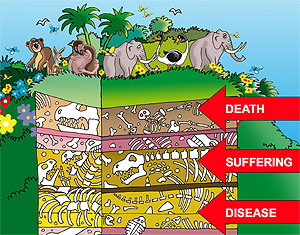
But this picture captures part of this issue very well for those who would confront God's word with the irreverent babblings and contradictions of what is falsely called knowledge (1 Timothy 6:20). Those who willingly deny the global Flood (2 Peter 3:1-7) look at the massive layers of sediment, filled with fossils depicting suffering, death and disease and blindly assert that these fossils are millions of years old. But when did the Fall happen? Before or after these "millions of years"? Is God unjust? When viewed in the light of Scripture this "long ages" or "deep time" view is nonsense and not only absent from, but entirely contradictory to, God's word.

In the light of God's word we look at these massive sediment layers, filled with gruesome fossils, and we see it as a terrifying testament to the wickedness of man and the righteous judgment of God, who looked upon the earth and saw that the thoughts of the hearts of men were only evil continually from birth (Genesis 6:5, 11-13). And so first in the garden of Eden, man and woman were cast out and condemned to die for their sin, and all of creation was cursed by their sin because they had dominion over it, and yet even in this God was abundantly merciful and gracious who caused Abel to present a pleasing sacrifice (Genesis 3:21-4:5) because its blood pointed towards the glory of the Son of God who poured out His blood to ransom a people from the curse from every tongue, tribe and nation (Revelation 5:9). And yet the seed of the serpent was and has always been in enmity against those to whom God sovereignly chooses to be gracious to (Genesis 3:14-15, Romans 8:28-39).

The curse was upon the earth and the wickedness of man waxed worse and worse as it does yet today until violence covered the whole earth and God in His righteous fury sent a Flood to destroy every living thing on the face of the earth except for those entirely undeserving ones whom He had graciously saved in the Ark covered by what pointed to the atoning sacrifice of Christ (Genesis 6:11-22, 7:16-24). And the LORD set up the rainbow in the cloud as sign of His everlasting unconditional covenant which He establishes for His people for the praise of His glorious grace (8:20-9:17).

So, we look at the layers of sediment and the fossils and we see brief time in which the devastating Flood happened upon the earth which laid up these massive sediments full of these creatures buried so rapidly that they became fossils, and we remember too that this earth is also currently being reserved for utter destruction with fire on the Last Day (2 Peter 3:5-15). Not "millions of years". Not evolution. The Creation, the Fall, the Curse, the Flood, the Ark, the Rainbow, the Covenant, the Redemption, the Christ.

As the rainbow is a sign of the covenant to His children, the ominous layers of sediment and fossils are a sign of the past and the coming judgment to the children of the devil. And yet, we who believe by the grace of God understand these things, yet they who have not received the love of the truth do not (2 Thessalonians 2:8-15, 1 Thessalonians 5:1-11), lest they should repent and be healed (Matthew 13:10-17, John 8:42-47, Isaiah 29:10-20, Isaiah 44:1-25, Mark 4:10-13). All glory be to God who works wonders in the heavens and upon the earth, and is righteous and just and good and merciful and gracious in all His works and all His eternal decrees, whose love to His people, and whose hatred toward the wicked will endure forever (Psalm 9:1-20).

Thanks to Creation Ministries International for the picture!
http://creationontheweb.com/images/fp_articles/2008/6105death-suffering.jpg

Sunday, June 08, 2008

Why should we defend the historical truth of the Bible?

I've been realising that many of the most devious attacks against the Gospel come from attacking an issue which seems at first to be secondary. But the Gospel is built upon the real space-time historical events recorded in the Bible; so undermining the historical accuracy and clarity of the Bible is then quite simply an undercover attack on the Gospel itself.

In particular the early chapters of Genesis which lay down the real historical events that give the foundation for all the major Christian doctrines, such as the nature of God, the nature of man, the nature of sin, the consequences of sin, the origin of death, the need for a saviour and more. Once the foundation of these doctrines is removed, the fundamentals doctrines that lay the foundation of the Gospel are removed.

But there is a lot of encouragement to be found, as many have not laid bare their foundations:

See: http://creationontheweb.com/content/view/5774/

R. C. Sproul says: "According to the Reformation hermeneutic, the first option is to follow the plain sense of the text. One must do a great deal of hermeneutical gymnastics to escape the plain meaning of Genesis 1–2."

The more that this age progresses with all its apostasy and lies and deceptions and even false signs and wonders, the more we will need to cling to the Bible and let go of everything else which claims to have any authority on truth.

It is vital that we fervently believe that Scripture itself is the only authority by which to interpret Scripture.

Otherwise we will be caught headlong in the snare of Satan’s lies, the evil of compromise, the malady of the world’s wisdom and the degeneration of doctrine, the death of certainty, the ignorance of the truth, and the defilement of the church.

Yet we have the precious promises of Christ; His Church will endure, His bride will know the truth and the truth will set her free.