Monday, April 17, 2023

Hidden reefs in your feasts of charity


Jude is one of the most astounding letters in the New Testament. It is short, its writer did not write any other part of Scripture, and it very tightly and briefly sticks to just one subject, which is not in fact the subject that Jude wanted to write about initially. It is also very closely paralleled with II Peter 2, similar to the parallels between Ephesians and Colossians, except that these were both written by Paul. The  necessary repetition illustrates the grave importance of its contents.

None of this is what makes it astounding. It is astounding because of the subject that Jude chose not to write about: our common salvation (Jude 1:3). What could be more important than that? This calls us to sit up and take notice. Jude tells us that he had to write instead to exhort us to earnestly contend for the faith. The word "earnestly contend" is used only here in all of Scripture. The same verb (without the prefix here translated "earnestly") is elsewhere translated as "strive" or simply "fight".

This is often taken to be an urgent call to polemics in theological writing and to apologetics generally. While it certainly includes and implies that application, this is not primarily what Jude has in mind. What Jude is concerned about primarily is the exercise of right judgement in the practice of church discipline. Specifically, that such judgement ought to recognize the terrible implications of the doctrine of reprobation for church membership, namely, that there are reprobate hypocrites in the church for whom there is no possibility of remediation and salvation.

The letter is entirely composed around this subject:

  1. Jude warns us that ungodly men who were eternally reprobated have secretly infiltrated the church (Jude 1:4).
  2. Jude tells us to remember that unbelieving reprobate were among God's people brought out of Egypt in the Old Testament and even among the angels so that we do not deny the possibility of their existence (Jude 1:5-6).
  3. Jude highlights Sodom and Gomorrah as specifically designed examples of God's vengeance on the wicked so we do not doubt the end God has appointed for them (Jude 1:7).
  4. Jude outlines various characteristics of these dangerous reprobate hypocrites within the church so that we may recognize and rightly identify them when they expose themselves (recall that they attempt, with significant success, to hide these characteristics):
    1. ungodly (Jude 1:4; 15)
    2. abusing the grace of God as a license for lasciviousness (Jude 1:4)
    3. denying the Lord Jesus Christ (Jude 1:4)
    4. unbelieving (Jude 1:5)
    5. giving themselves over to fornication (Jude 1:7)
    6. going after strange flesh, e.g. homosexuality, paedophilia, bestiality (Jude 1:7)
    7. filthy dreamers who defile the flesh (Jude 1:8)
    8. despisers of authority, ignorantly speaking evil against those in office (Jude 1:8-10)
    9. corrupting themselves like beasts even in what they know naturally (Jude 1:10)
    10. murderous followers of Cain (Jude 1:11)
    11. abusing their gifts and office for material gain like Balaam (Jude 1:11)
    12. rebellious gainsayers like Korah (Jude 1:11)
    13. blasphemers (Jude 1:15)
    14. murmurers and complainers (Jude 1:16)
    15. walkers after their own lusts (Jude 1:16, 18)
    16. capable of making impressive persuasive speeches (Jude 1:16)
    17. manipulating and flattering those in power to gain advantage (Jude 1:16)
    18. mockers (Jude 1:18)
    19. schismatic (Jude 1:19)
    20. unspiritual and sensual (Jude 1:19)
  5. Jude contrasts their attitude toward authority with the archangel Michael's manner in contending  even with Satan (Jude 1:9).
  6. Jude pronounces a curse on them as followers of cursed Cain, Balaam, and Korah and gives analogies to illustrate how cursed they are (Jude 1:11-13).
  7. Jude applies Enoch's prophecy of the Lord's judgement and vengeance to them (Jude 1:14-15).
  8. Jude reminds us that the apostles also wrote about such people (consider Paul's pastoral epistles, and Peter's general epistles, especially the second; Jude 1:17-18).
  9. Jude tells us in contrast to continue building ourselves up in the faith, in prayer, walking in love, and trusting in Christ for mercy and eternal life (Jude 1:20-21).
  10. Finally, Jude tells us to rightly distinguish between such reprobate hypocrites and sinning brethren whom we must attempt to save with compassion with great care for the fiery danger to ourselves and the evil pollution of their sin (Jude 1:22-23).
  11. Lest we should be alarmed by the apostasy and judgement of God against these reprobate hypocrites, whom we had supposed to be sincere and beloved Christians, Jude ends with a doxology praising God for His ability to preserve us from falling and sanctify us (Jude 1:24-25). This mirrors his opening address to us as those who are being sanctified by God, preserved in Christ, and called, in distinction from the reprobate hypocrites he describes (Jude 1:1-2).

Notice that of the long list of characteristics, some of these are very general and simply necessarily the case: they are ungodly and unbelieving, even though secretly so. Some may only occur after they have perhaps been exposed and admonished: they become schismatic and perhaps later then even openly deny Christ. Others may be ongoing for years before discovered and recognized. What is remarkable is that none of these characteristics are explicitly or essentially doctrinal.

When Jude says that they deny the Lord, he does not mean that they start teaching Arianism or some other Christ-denying heresy. Heretics do deny Christ that way, and other letters speak of such false teachers, but it is not primarily what Jude has in view. He means that they deny the Lord by their evil and hypocritical lives. By abusing the grace of God as a cloak and license for sin, they deny the Lord.

Jude describes these people, not as openly repudiating Christ, but as hidden reefs in our feasts of charity (Jude 1:12). The ancient Christians, similar to today, would have meals of fellowship together, especially for the benefit of the poorer brethren. Jude means that the presence of these hypocrites meant that these meals became as dangerous as navigating a ship around hidden reefs. These reprobates are harmful to others, while also being cleverly concealed. They look like normal clouds, but they carry no water. They look like normal trees but their fruit withers, and really they have no fruit, being twice dead and even uprooted. They swell up and impress like powerful waves, but they foam out their shame. They look like normal stars, but like the planets, they move erratically, not staying in their courses, or like falling meteors, they disappear forever.

We can summarize the sinful characteristics listed above as basically four categories of antinomianism:

  1. Sensuality like Sodom (Jude 1:4, 7-8, 10, 16, 18-19)
  2. Rebellion like Korah (Jude 1:8-11, 16, 18-19)
  3. Avarice like Balaam (Jude 1:11)
  4. Hatred like Cain (Jude 1:11)

Any Christian may sin grievously in these general areas of his life, but what makes these hypocrites different is the depth and extent of their sin considering their knowledge of God and their outward hypocritical profession. They pursue these sins with impunity as long as they can get away with it because of their underlying attitude towards God. They behave this way because they fundamentally have no fear of God and are unbelieving. They know the truth, and they can speak very impressively about it, but they do not really love the truth. Having heard and understood the gospel, they infiltrate the church by a false profession and attempt to use the Christian religion as a cloak for their evil.

Compare this with Paul who was formerly an insolent blasphemer and zealous persecutor of the church. He explains that he found forgiveness only because he did so in ignorance and unbelief (I Tim. 1:13). He did not really know what he was doing, like any heathen. But when these hypocrites commit such enormous sins as a lifestyle and do so in hypocrisy over many years while claiming to be a Christian with careful deliberate deceptions through manipulating, flattering, and persuading others, they show themselves to be no different to apostates. That is, by such behaviour, they deny the Lord Jesus Christ, as really and firmly and definitively as an apostate.

This is not like the lamentable falls of David or Peter, though such falls may be as close as a Christian can come to this. Jude refers to the importance of making a distinction and having compassion on some. Astoundingly, for today's sensitive modern church, this means not having compassion on others. No compassion for the followers of Cain, Balaam, Korah, or Sodom in the church today.

Hebrews 6 speaks of apostates, as those who draw back in unbelief, for whom there is then no possibility of being renewed to repentance:

For it is impossible for those who were once enlightened, and have tasted of the heavenly gift, and were made partakers of the Holy Ghost, And have tasted the good word of God, and the powers of the world to come, If they shall fall away, to renew them again unto repentance; seeing they crucify to themselves the Son of God afresh, and put him to an open shame. For the earth which drinketh in the rain that cometh oft upon it, and bringeth forth herbs meet for them by whom it is dressed, receiveth blessing from God: But that which beareth thorns and briers is rejected, and is nigh unto cursing; whose end is to be burned (Heb. 6:4-8).

Hebrews 10 then speaks of apostates who, having received the knowledge of the truth, continue to sin wilfully and presumptuously, i.e. treating the grace of God as license to sin as Jude describes:

For if we sin wilfully after that we have received the knowledge of the truth, there remaineth no more sacrifice for sins, But a certain fearful looking for of judgment and fiery indignation, which shall devour the adversaries. He that despised Moses' law died without mercy under two or three witnesses: Of how much sorer punishment, suppose ye, shall he be thought worthy, who hath trodden under foot the Son of God, and hath counted the blood of the covenant, wherewith he was sanctified, an unholy thing, and hath done despite unto the Spirit of grace? (Heb. 10:26-29)

These practical antinomians are covenant-breakers, subject to the worst punishment, and have no possibility of forgiveness as there is no sacrifice for their sins. Peter, in the parallel to Jude, says that their end is worse than if they had never joined the church and professed to know Christ at all (II Pet. 2:20-22).

John similarly warns against such antinomian hypocrites, calling these apostates "anti-christs" and children of the devil, lumping them together with those who deny that Jesus is the Christ, and comparing them also with Cain (I John 2:22; 3:12):

He that saith, I know him, and keepeth not his commandments, is a liar, and the truth is not in him (I John 2:4).

Little children, it is the last time: and as ye have heard that antichrist shall come, even now are there many antichrists; whereby we know that it is the last time. They went out from us, but they were not of us; for if they had been of us, they would no doubt have continued with us: but they went out, that they might be made manifest that they were not all of us (I John 2:18-19).

Whosoever abideth in him sinneth not: whosoever sinneth hath not seen him, neither known him. Little children, let no man deceive you: he that doeth righteousness is righteous, even as he is righteous. He that committeth sin is of the devil; for the devil sinneth from the beginning. For this purpose the Son of God was manifested, that he might destroy the works of the devil. Whosoever is born of God doth not commit sin; for his seed remaineth in him: and he cannot sin, because he is born of God. In this the children of God are manifest, and the children of the devil: whosoever doeth not righteousness is not of God, neither he that loveth not his brother (I John 3:6-10).

We know that we have passed from death unto life, because we love the brethren. He that loveth not his brother abideth in death. Whosoever hateth his brother is a murderer: and ye know that no murderer hath eternal life abiding in him (I John 3:14-15).

If a man say, I love God, and hateth his brother, he is a liar: for he that loveth not his brother whom he hath seen, how can he love God whom he hath not seen? (I John 4:20)

If any man see his brother sin a sin which is not unto death, he shall ask, and he shall give him life for them that sin not unto death. There is a sin unto death: I do not say that he shall pray for it. All unrighteousness is sin: and there is a sin not unto death (I John 5:16-17).

John agrees with Jude here, that a distinction must be made. John tells us that some must be prayed for who have not sinned a sin unto death, as Jude says, we must have compassion on some. But John and Jude are not dealing with merely speculative or hypothetical situations when they describe those for whom there is no possibility of salvation, and more, whose salvation must not be sought inasmuch as God will not forgive their sins. These apostates, who deny Christ by their antinomian hypocrisy in the church, have committed the unforgiveable sin by blaspheming the Spirit.

Charitable and compassionate church members ought not to be wasting their time and offending God by praying for such people. Well-meaning and conscientious church office-bearers ought not to be wasting their time and offending God by trying to bring them to repentance when God has said that He will not renew them to repentance.

When such a hypocrite has been exposed, for example, as a serial killer, or a sexual predator, or a scheming rebel, or a greedy embezzler, so that he can be plainly seen to have denied Jesus Christ, such a person must ordinarily be viewed as an apostate. He is a candidate for anathemas, not loving church discipline (I Cor. 16:22). And Scripture gives us specific examples of such people.

An excellent example is Alexander the coppersmith, regarding whom Paul, far from praying for his repentance, prays that the Lord rewards him for his evil works (II Tim. 4:14). Paul prays this not out of spite, but out of a knowledge of Alexander's reprobation. Further, this knowledge was not by divine inspiration, but deduced simply from Alexander's apostasy. Not that he necessarily no longer claimed to be a Christian, but that he blasphemed like Hymenaeus (who claimed the resurrection was past already) and did much evil to the apostle Paul (note, Jude's characteristic of rebellion against those in authority). Paul does not tell Timothy to go a give Alexander a gentle pastoral visit to try again to admonish him to repent, but rather, he simply warns him to beware of this person.

In summary, Scripture no where teaches that the judgement of charity is a command to be naive. Rather we are given very many detailed warnings and examples, exhorting us to judge both charitably and righteously, echoing the principle the Lord taught us:

Behold, I send you forth as sheep in the midst of wolves: be ye therefore wise as serpents, and harmless as doves (Matt. 10:16).

Sunday, April 09, 2023

The Equality of Jews and Gentiles in the Church


In a previous blog post, I answered the objections of a brother who did not respond positively to my answer to his questions about amillennialism. Sadly, the brother continued to accuse me of allegorical interpretation, of eisegesis, of promoting "Replacement Theology" heresy, and of pride while failing to interact with the Scriptural arguments I had presented. To these, he added the charge of anti-semitism, claimed that I could not define the church, and claimed Revelation 20 cannot refer to the present time because Isaiah 65:20 teaches that there will be no infant death in the millennium and people would be living to 100 years of age. To his credit, he approved of my view on "salvific essentials," and advised me to pray about my view of eschatology and to keep searching. This blog post includes some of my answer.

Isaiah 65 refers to the eternal state in the new heavens and new earth (Isa. 65:17). It specifically says this in verse 17. It is also, incidentally, a vision using Old Testament pictures and earthly figures to illustrate what the eternal state will be like. If not interpreted as such, one would have to conclude that there is literally death still in the eternal state, which is absurd and contrary to all the rest of Scripture which speaks to the subject of eternal life (e.g., I Cor. 15:53-54). Update: Amazingly, his answer to my explanation of Isaiah 65 was that the "new heavens and new earth" referred to the millennial kingdom--not very literal for a dispensationalist!

I was not previously asked to define the church. Here is my definition: The church is the company of the predestinate. That is, all the elect in Christ from the beginning of history to the end. In the pre-diluvian world, the church was gathered from the line of Seth, until only Noah's family remained. Afterwards, the church was gathered from the line of Abraham. Now, the church is gathered from both Jews and Gentiles, as the Scripture says:

Know ye therefore that they which are of faith, the same are the children of Abraham. And the scripture, foreseeing that God would justify the heathen through faith, preached before the gospel unto Abraham, saying, In thee shall all nations be blessed. So then they which be of faith are blessed with faithful Abraham (Gal 3:7-9).

And again:

For there is no difference between the Jew and the Greek: for the same Lord over all is rich unto all that call upon him (Rom 10:12).

We are the circumcision: 

For we are the circumcision, which worship God in the spirit, and rejoice in Christ Jesus, and have no confidence in the flesh (Phil. 3:3).

We are the true Jews: 

For he is not a Jew, which is one outwardly; neither is that circumcision, which is outward in the flesh: But he is a Jew, which is one inwardly; and circumcision is that of the heart, in the spirit, and not in the letter; whose praise is not of men, but of God (Rom 2:28-29).

Do you, reader, call this heresy and antisemitism? Are you offended by this word? The Jews were also offended, and many to their eternal destruction, as Isaiah prophesied:

As it is written, Behold, I lay in Sion a stumblingstone and rock of offence: and whosoever believeth on him shall not be ashamed (Rom 9:33).

Here is the offence to the unbelieving Jew, that the believer is blessed, and not the mere physical descendants:

And think not to say within yourselves, We have Abraham to our father: for I say unto you, that God is able of these stones to raise up children unto Abraham (Matt. 3:9).

Christ has broken the partition between Jew and Gentile by His cross. We share in the same inheritance and the same promises and the same kingdom:

Wherefore remember, that ye being in time past Gentiles in the flesh, who are called Uncircumcision by that which is called the Circumcision in the flesh made by hands; That at that time ye were without Christ, being aliens from the commonwealth of Israel, and strangers from the covenants of promise, having no hope, and without God in the world: But now in Christ Jesus ye who sometimes were far off are made nigh by the blood of Christ. For he is our peace, who hath made both one, and hath broken down the middle wall of partition between us; Having abolished in his flesh the enmity, even the law of commandments contained in ordinances; for to make in himself of twain one new man, so making peace; And that he might reconcile both unto God in one body by the cross, having slain the enmity thereby: And came and preached peace to you which were afar off, and to them that were nigh. For through him we both have access by one Spirit unto the Father. Now therefore ye are no more strangers and foreigners, but **fellowcitizens** with the saints, and of the household of God; And are built upon the foundation of the apostles and prophets, Jesus Christ himself being the chief corner stone; In whom all the building fitly framed together groweth unto an holy temple in the Lord (Eph. 2:11-21).

And again:

Whereby, when ye read, ye may understand my knowledge in the mystery of Christ) Which in other ages was not made known unto the sons of men, as it is now revealed unto his holy apostles and prophets by the Spirit; That the Gentiles should be **fellowheirs**, and **of the same body**, and **partakers of his promise** in Christ by the gospel (Eph. 3:4-6).

Not those of the law are heirs, but those of faith:

For the promise, that he should be the heir of the world, was not to Abraham, or to his seed, through the law, but through the righteousness of faith. For if they which are of the law be heirs, faith is made void, and the promise made of none effect (Rom 4:13-14).

And the promise of Canaan was the promise of the world pictured by Canaan: the heavenly country which Abraham desired and looked for.

But now they desire a better country, that is, an heavenly: wherefore God is not ashamed to be called their God: for he hath prepared for them a city (Heb. 11:16).

God is therefore ashamed of those who look for an earthly kingdom. The gospel which Christ came to preach, and which we believe and follow, is the gospel of the kingdom of heaven:

And saying, The time is fulfilled, and the kingdom of God is at hand: repent ye, and believe the gospel (Mark 1:15).

Saving the Nations by Casting Out the Prince of This World

The first printed map to show the world as a sphere from 1515 was a collaboration between Albrecht Dürer and Johann Stabius

In a previous blog post, I answered some queries from a brother about amillennialism. I was disappointed in that the brother claimed that it was arbitrary and/or inconsistent for me to interpret the vision of Revelation 20 figuratively. Here I answer this claim and support my interpretation by comparison with Scripture itself.

I had already answered his question about the correct way to interpret Scripture. We ought to interpret Scripture in the way it intends for us to interpret it. History must be interpreted as history. Didactic teaching in letters must be interpreted as such. Parables must be interpreted as parables. Prophetic visions must be interpreted as prophetic visions. Prophetic dreams must be interpreted as prophetic dreams.

Scripture itself does this and teaches us the appropriate context. As an example, Daniel records history, and in that history Nebuchadnezzar is given a dream containing a vision of earthly kingdoms and the kingdom of Christ. Even Nebuchadnezzar understood that this had to be interpreted, that the parts of the statue were intended to represent something figuratively. And Daniel, by the Spirit gives the authoritative interpretation.

Revelation contains a series of prophetic visions given to John, some of which concerned the present (e.g. the seven churches), some pertaining to the recent past (e.g. the ascension and session of Christ), some pertaining to entire New Testament age up to and especially including the end of the world. John is also given visions of the eternal state. The exact phrase "I saw" occurs 35 times in Revelation, which phrase in this context indicates a prophetic vision, and John even refers to that which he saw as being a "vision" (Rev. 9:17). The book opens by specifically telling us that the things contained in it which John "saw" were things that were sent and "signified" (Rev. 1:1). The interpretation of these visions is not by a wild allegorical method according to the imagination of the reader or the speculations of Origen, but by a sober and objective interpretation of Scripture with Scripture. The visions deliberately draw upon ideas explained and taught elsewhere in Scripture.

It is nothing less than disobedience and rebellion against the Scriptures to therefore presume that these visions are intended to represent literal things. Besides which, it would be extreme absurdity. The absurdities and even heresies would be too many to enumerate. Until a man submits himself to the way Scripture chooses to interpret itself, he will make very little progress and profit very little from instruction or discussion with others.

The "thousand years" in the context of the text, in my opinion, fits best with the idea of the church throughout all her generations (cf. Deut. 7:9). The general idea of "thousand" is simply "very many" or even "all" (cf. Ps. 50:10). But whatever reasoning or explanation is given here, there is no doubt that the beginning of this period is the cross of Christ, and the end is the resurrection at the final judgement. It is also clear that this heavenly reign then continues into eternity.

The binding of Satan is specific here, that he can no longer deceive the nations, and more specifically, so he cannot yet bring them all together against the church, that is, as the beastly antichristian kingdom just described in previous visions, building upon what was revealed to Daniel. Furthermore, when Christ came, that is exactly what He did. He "cast" out (or "bound") devils, to show that the kingdom of God was at hand.

When Christ went up to Jerusalem, some Greeks sought after Him, which was a token that His time had come. His response upon hearing this was: "The hour is come, that the Son of man should be glorified" (John 12:23). He explained that this would be by His death on the cross, and that this casting out of Satan, would mean the salvation of the nations:

Now is the judgment of this world: now shall the prince of this world be cast out. And I, if I be lifted up from the earth, will draw all men unto me. This he said, signifying what death he should die (John 12:31-33).

In the Old Testament, the nations were left to themselves (Acts 14:16; 17:30), but the death and resurrection of Christ has brought salvation to the whole world. more than anything else, that is what has characterized the New Testament era, the redemption and gathering of people from every tongue, tribe, and nation under heaven.

A dispensational may call this subjective interpretation and presuppositional bias, but in fact, it arises from Scripture itself. We come to Revelation, written last of all, when John was already old, already with the groundwork of the whole rest of Scripture laid, and we interpret it in that light, and then it makes sense, and it fits within what we have already learned, and then it fills out and informs us more, and edifies and instructs us.

In my previous post, I never suggested a literal throne of David. Christ's throne (or reign) is from heaven and all authority in heaven and earth falls under His rule. David's literal throne was literally a chair in Jerusalem, and figuratively represented his literal reign over a literal small nation in Palestine. Those were types and shadows of better things, as Hebrews (and the rest of Scripture) explains to us. The angel, quoted in Luke's gospel, tells us that Jesus is the promised Son of David, the one who inherits a kingdom far greater than what David ruled over, yet it is called David's throne, because that was a picture and a shadow of what was to come.

Everywhere Scripture teaches us that Christ and His kingdom and His priesthood and His sacrifice and His church is the fulfillment of the types and shadows and promises of the Old Testament. This is not "Replacement theology." This is Fulfillment Theology, also known as New Testament theology, or Biblical theology.

The Star Falling, the Dragon Cast Out, and Satan Bound


In my last blog post, I answered a brother who asked questions about amillennialism. Since his response was considerably less than positive, I took the opportunity to expand upon my original answer and answer some additional points or queries he raised which I now share in this post, and in (DV) some subsequent posts.

I previously related John 12:31 to Rev. 20:3, concerning in the casting out or down of Satan, and referred in general terms to the casting out of devils in the gospels as a sign of the kingdom of God being near and breaking forth. I neglected to mention Luke 10:18 which speaks of a fall of Satan from heaven during the ministry of Christ (in the sending out of the seventy):

And the seventy returned again with joy, saying, Lord, even the devils are subject unto us through thy name. And he said unto them, I beheld Satan as lightning fall from heaven. Behold, I give unto you power to tread on serpents and scorpions, and over all the power of the enemy: and nothing shall by any means hurt you. Notwithstanding in this rejoice not, that the spirits are subject unto you; but rather rejoice, because your names are written in heaven (Luke 10:17-20).

This directly relates to Revelation 9 which speaks of a star falling (peto; same verb) from heaven:

And the fifth angel sounded, and I saw a star fall from heaven unto the earth: and to him was given the key of the bottomless pit. And he opened the bottomless pit; and there arose a smoke out of the pit, as the smoke of a great furnace; and the sun and the air were darkened by reason of the smoke of the pit. And there came out of the smoke locusts upon the earth: and unto them was given power, as the scorpions of the earth have power. And it was commanded them that they should not hurt the grass of the earth, neither any green thing, neither any tree; but only those men which have not the seal of God in their foreheads. And to them it was given that they should not kill them, but that they should be tormented five months: and their torment was as the torment of a scorpion, when he striketh a man. And in those days shall men seek death, and shall not find it; and shall desire to die, and death shall flee from them. And the shapes of the locusts were like unto horses prepared unto battle; and on their heads were as it were crowns like gold, and their faces were as the faces of men. And they had hair as the hair of women, and their teeth were as the teeth of lions. And they had breastplates, as it were breastplates of iron; and the sound of their wings was as the sound of chariots of many horses running to battle. And they had tails like unto scorpions, and there were stings in their tails: and their power was to hurt men five months. And they had a king over them, which is the angel of the bottomless pit, whose name in the Hebrew tongue is Abaddon, but in the Greek tongue hath his name Apollyon (Rev 9:1-11).

The devil is called a star here like in Isaiah 14, where he is pictured by the king of Babylon and called Lucifer or morning/day star (Isa. 14:12). To him (i.e. to this personified star) was given the key of the bottomless pit, so that he can release upon the earth hordes of scorpion-like locusts from its smoke to torment people (Rev. 9:1-11). Our passage in Luke describes the power of the enemy as being like that of scorpions or serpents with the power to hurt. The later part of the same chapter, though another vision, speaks similarly of a demonic army, like lions or serpents (i.e. like the devil; I Pet. 5:8), with the same character of the smoky, fiery, hellish pit, and which hurt or kill the impenitent (Rev. 9:16-21).

Significantly, both in Luke 10 and in Revelation 9, these demonic spirits are unable to hurt or kill God's people (Luke 10:19; Rev. 9:4). In this important sense, these  terrible lion-like armies of locust-scorpions or horsemen-serpents with human-like intelligence and feminine allurements are bound. With regard to the timing of this vision, considering its connection to Luke 10 is that describes the activity of Satan and his host in the New Testament age (Rev. 1:19).

Revelation 12 also speaks of the casting out of a great dragon, specifically after the birth of Christ:

And the great dragon was cast out, that old serpent, called the Devil, and Satan, which deceiveth the whole world: he was cast out into the earth, and his angels were cast out with him. And I heard a loud voice saying in heaven, Now is come salvation, and strength, and the kingdom of our God, and the power of his Christ: for the accuser of our brethren is cast down, which accused them before our God day and night. And they overcame him by the blood of the Lamb, and by the word of their testimony; and they loved not their lives unto the death. Therefore rejoice, ye heavens, and ye that dwell in them. Woe to the inhabiters of the earth and of the sea! for the devil is come down unto you, having great wrath, because he knoweth that he hath but a short time (Rev 12:9-12).

First of all, the dragon in the vision is positively identified as representing the devil, or Satan. Secondly, the timing of this casting out of Satan occurs at the birth and ascension of Christ (Rev. 12:5), and is associated with the coming of the kingdom of God (Rev. 12:10). The result of the casting down of Satan is woe for the inhabitants of the earth, as we just saw in the vision of Revelation 9 (Rev. 12:12). This vision builds upon this further by illustrating that this casting down of Satan also means persecution for the church, but in such a way that the church is miraculously preserved despite all Satan's opposition (Rev. 12:13-17; cf. Matt. 16:18; John 16:33). In this way too, though Satan's casting down means persecution for the church, Satan is nevertheless bound. Incidentally, the Old Testament church pictured by the woman which gives birth to Christ, is the same woman here pictured as the persecuted New Testament church (alluding to the enmity promised in Gen. 3:15).

The verb translated "cast" throughout this chapter is variously, balloekballo [out], or kataballo [down/against]. This is the same verb used in Revelation 20:3, John 12:31, and Matthew 12:28, to which we previously referred. Other details of the vision differ from Revelation 9. In Revelation 9, the key of the bottomless pit given to Satan only allows him to open the bottomless pit to let loose demonic armies on the earth. In Revelation 20, a very different angel with a very different key of the bottomless pit (with a great chain) binds Satan, casts him into the bottomless pit, shuts him up, and sets a seal on him so that he can no longer deceive the nations. This seal does not mean that he cannot loose his demonic armies upon those who do not have the seal of God in their foreheads, nor does it mean that he cannot persecute the church upon the earth. Rather it means that his efforts and abilities are strictly limited. His demonic armies cannot hurt God's elect (Revelation 9), and his persecution cannot destroy the church (Revelation 12) or prevent the gathering of the church from all nations (in Revelation 20). Interpreted correctly, these visions teach exactly what the rest of Scripture teaches about Satan's power and its limits in the New Testament age.

When confronted with the same event or concept described in different places in Scripture by different visions or accounts, the typical tactic of dispensationalists is to propose that these are multiple events. So in warring against the essential unity of Scripture, they have multiple resurrections, multiple comings of Christ,  multiple final judgement, multiple kingdoms of God, multiple peoples of God, multiple covenants of God (not just multiple administrations or revelations), and even multiple new heavens and new earths. Now, the dispensationalist must propose multiple castings down of Satan, but how can he be cast down out of heaven again unless he somehow got back up into heaven? The absurdity of the dispensationalist scheme never fails to reach new depths.

Finally, Revelation 20 describes the loosing of Satan to deceive the nations to gather them together under the anti-christian beast and false prophet to make war against the church (Rev. 20:7-10). Until his "little season," he could not do achieve this goal. This restraint of Satan to prevent the coming of antichrist and the deceiving of the nations before the time is exactly what is described elsewhere:

And you know what is restraining him now so that he may be revealed in his time. For the mystery of lawlessness is already at work. Only he who now restrains it will do so until he is out of the way. And then shall that Wicked be revealed, whom the Lord shall consume with the spirit of his mouth, and shall destroy with the brightness of his coming: Even him, whose coming is after the working of Satan with all power and signs and lying wonders, And with all deceivableness of unrighteousness in them that perish; because they received not the love of the truth, that they might be saved. And for this cause God shall send them strong delusion, that they should believe a lie: That they all might be damned who believed not the truth, but had pleasure in unrighteousness (II Thess. 2:6-12).

Wednesday, April 05, 2023

The Kingdom Without End

A brother asked various questions about amillenialism which I think are worthwhile to share here because I find the answers edifying: How can the millennial kingdom of Revelation 20 be the kingdom that is promised forever and where this kingdom is now? How can we reign with Christ, when we are not yet perfectly holy, and the world is full of suffering and bloodshed? And why should Revelation 20 be interpreted figuratively, but Christ's coming must be a literal bodily event?

Some pertinent Scriptures to these questions are as follows:

But God, being rich in mercy, because of the great love with which he loved us, even when we were dead in our trespasses, made us alive together with Christ—by grace you have been saved— and raised us up with him and seated us with him in the heavenly places in Christ Jesus (Eph. 2:4-6).

If then you have been raised with Christ, seek the things that are above, where Christ is, seated at the right hand of God. Set your minds on things that are above, not on things that are on earth. For you have died, and your life is hidden with Christ in God (Col. 3:1-3).

When Christ came preaching that the kingdom of heaven was at hand, and then suffered and died, and was raised up, even to be seated upon the throne in heaven, and given the name above all (i.e. Lord), this is the kingdom to which He referred (Luke 1:32-33). And this is the kingdom which His parables explain. And this is the kingdom which shall have no end, and which kingdom was prophesied in the Old Testament. This is the kingdom in which all Christians are citizens already, and even, by our union with Christ, already seated with Christ in this heavenly kingdom, as sharing in His anointing by the Spirit, so that we are all prophets, priests and kings. Now, a little, and weakly, hampered by sin, and only seen by faith, but after we have also suffered a little while, our reign will be more full, free, and glorious. Even now, having been born again into a new life, we fight as kings against our sinful flesh, bringing our bodies into subjection ("But I keep under my body, and bring it into subjection: lest that by any means, when I have preached to others, I myself should be a castaway," I Cor. 9:27), and triumph, making progress and taking ground, by the power of Christ.

When John saw the vision of the binding of Satan, ushering in the millennial kingdom, undoubtedly the same kingdom which Daniel saw, smashing the kingdoms of this world) which begins in the age for a "thousand" years and extends into eternity after the final judgement in the new heavens and new earth, he says, "Then I saw thrones, and seated on them were those to whom the authority to judge was committed." (Rev. 20:4; cf. I Cor. 6:2-3). He describes these as the glorified saints, who were persecuted and martyred for their witness, which is given to all Christians to greater or lesser measure ("For it has been granted to you that for the sake of Christ you should not only believe in him but also suffer for his sake," Phil. 1:29):

Also I saw the souls of those who had been beheaded for the testimony of Jesus and for the word of God, and those who had not worshiped the beast or its image and had not received its mark on their foreheads or their hands. They came to life and reigned with Christ for a thousand years. (Rev. 20:4)

This is a kingdom which the world cannot understand and cannot touch (Luke 17:21). Its power is from heaven and nothing can stand against it. The victory of this kingdom, and for all its citizens is assured. And though we walk now in the midst of earthly kingdoms and groan inwardly amidst our own sins and failures, we even now enjoy and partake in the spiritual blessings of this kingdom, which has not even yet reached its final consummation, as it will at the end of the age. And we are assured of its victory, even if the whole world appears to go after the antichristian beastly kingdom, because Christ (and we in Him) is already seated upon the throne in heaven, bringing all of history to the end which He has appointed, gathering His church, and hardening others so that this present evil age becomes fully ripe for the judgement at His coming.

Who shall separate us from the love of Christ? shall tribulation, or distress, or persecution, or famine, or nakedness, or peril, or sword? As it is written, For thy sake we are killed all the day long; we are accounted as sheep for the slaughter. Nay, in all these things we are more than conquerors through him that loved us (Rom. 8:35-37).

Lastly, Revelation 20 is a vision, and therefore intended to be interpreted as figurative language. Revelation 1 explains this, as in fact, all other visions in Scripture. But the literal bodily coming of Christ, in the same way as He ascended, is taught in historical narrative and direct didactic teaching, which is absolutely not intended to be interpreted as a pictorial vision or allegory.

Which [angels] also said, Ye men of Galilee, why stand ye gazing up into heaven? this same Jesus, which is taken up from you into heaven, shall so come in like manner as ye have seen him go into heaven. (Acts 1:11)

Sunday, March 19, 2023

Church Marks vs Church Purity

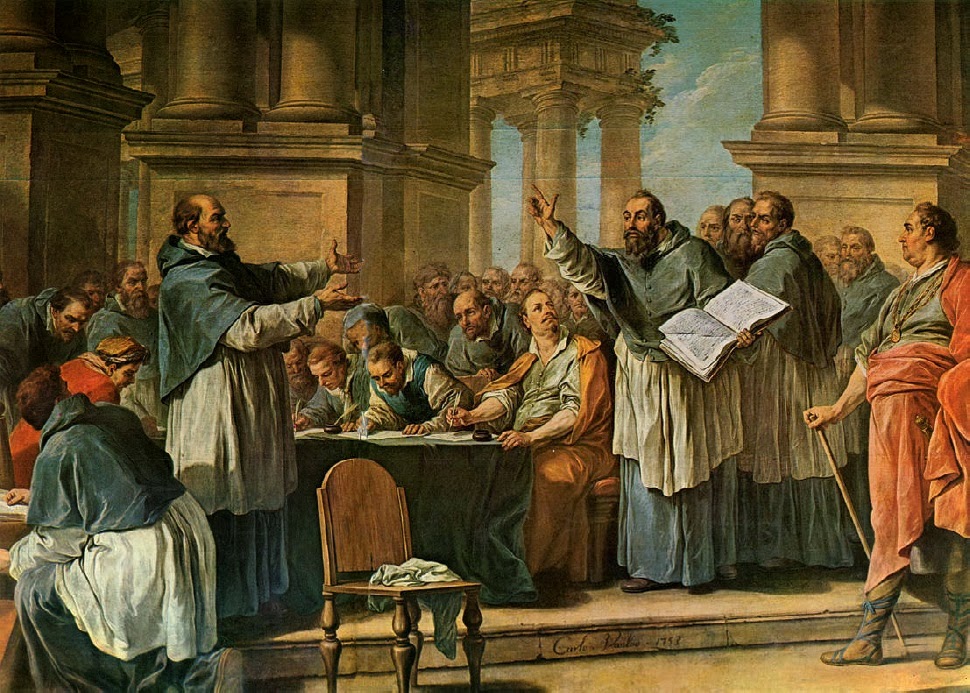
Augustine arguing with donatists by Charles-André van Loo, Public domain, via Wikimedia Commons

In response to Rome's claims, at the time of the Reformation, to be the one true church outside of which there was no salvation, the Reformation defined simple objective criteria by which the true church could be recognized. The Belgic Confession gives us a helpful example of this:

The marks, by which the true church is known, are these: if the pure doctrine of the gospel is preached therein; if she maintains the pure administration of the sacraments as instituted by Christ; if church discipline is exercised in punishing of sin: in short, if all things are managed according to the pure Word of God, all things contrary thereto rejected, and Jesus Christ acknowledged as the only Head of the church. Hereby the true church may certainly be known, from which no man has a right to separate himself [which implies also the positive responsibility to join].

This gives us three marks, with a simple summary. The summary is that for the true church, Christ is acknowledged as the only Head, especially in the subjection of all things to the authority of Scripture. The three marks in particular are:

  1. Gospel preaching
  2. Administration of sacraments
  3. Church discipline

In highlighting these three in particular, the Reformed were taking a stance that the true church ought to be recognized by its institutions, so that any institute claiming to be the true church without these three marks (e.g. Rome) could be rejected and those with these three could be accepted. The confession makes the point that these three were instituted by the Lord Jesus Christ. The three marks are institutional marks and therefore more clearly objective, but also these three are the key institutional forms which are the ordinary (and official) means in our salvation (other important but non-official means, such as fellowship with believers, prayer and Scripture reading/study are not mentioned because the church institute is not required for these).

These three marks represent the benefits of the church institute to the believer from Christ by His Spirit, underscoring the need for believers not to separate themselves from these means as one should not cut himself off from the means whereby he receives his daily bread. In pointing out these three marks, the Reformed confession draws the proper connection between membership in the church and salvation so that Rome's claim about no salvation outside the church of Rome is exposed as empty and meaningless.

By gospel preaching, we are instructed as to the content of our faith, and admonished to faith and repentance. Christ comes and speaks to us in the preaching. By the sacraments, we are given visible signs and seals to assure and strengthen our faith. Christ comes and shows us in the sacraments. By discipline, we are brought back to the right path when we stray. Christ comes and corrects us in discipline. Christ is present in living fellowship and saving power through these means.

The Reformed also distinguished the recognition of organized local congregations as institutional manifestations of the true church from the recognition of people as Christians or members of the church:

With respect to those, who are members of the church, they may be known by the marks of Christians: namely, by faith; and when they have received Jesus Christ the only Saviour, they avoid sin, follow after righteousness, love the true God and their neighbour, neither turn aside to the right or left, and crucify the flesh with the works thereof. But this is not to be understood, as if there did not remain in them great infirmities; but they fight against them through the Spirit, all the days of their life, continually taking their refuge in the blood, death, passion and obedience of our Lord Jesus Christ, "in whom they have remission of sins, through faith in him."

Significantly, the confession does not suggest looking for members of the church in order to recognize the true church. In fact the article opens with a reminder about hypocrites in the church: "But we speak not here of hypocrites, who are mixed in the church with the good, yet are not of the church, though externally in it." Those whom we think may be members of the church may only be external members, that is, hypocrites. But where we find the three marks, we have found what Christ instituted for our good in our salvation and may enjoy the presence of Christ in these means, even if all around us turn out to be mere hypocrites.

This was one of the important lessons that may be derived from the sad history of the Donatist schism. To grossly simplify, one of the key issues in this controversy was that the Donatists claimed that the ordinances instituted by Christ were worthless if administered by an ungodly man (or by extension, a man who later turned out to be ungodly). They had in mind office-bearers or ministers who had compromised their confession of Christ in times of persecution. Whether such men ought to have been permitted to retain their office, or be restored to their office, is a secondary issue for our purposes here. A church may have failures in church discipline without altogether losing that third mark. Augustine's genius was to realize that the efficacy of the official means of salvation in the church (preaching, sacraments, and discipline) did not strictly-speaking depend on the holiness or moral uprightness of the office-bearer administering these means.

This is not to excuse some of the errors that Augustine made (or perpetuated/developed) in his doctrine of the church at this time, or to excuse office-bearers who bring disrepute to their office, to the church, and to Christ. Such office-bearers ought to be disciplined when their faults are uncovered, and deposed if they have shown or made themselves unfit for office. Also, moral failings often work through into a minister's (weak or false) preaching, or an elder's (lack of or corrupt) discipline. Nevertheless, the means themselves, if faithfully administered, retain their benefit to Christ's flock, since their nature is not dependent on the man administering them.

But this also means that the presence of the three marks in a local congregation does not in itself imply that the office-bearers are not hypocrites, or that the members of that congregation are Christians. That the confession gives separate criteria as the marks of Christians also indicates this. In other words, there is no inherent correlation between the three marks and church purity, spirituality, or holiness. This is worth emphasis because the confession speaks repeatedly about the purity of the three marks. Why is the purity of the three marks important, and why is this distinct from church purity?

The purity of the three marks concerns the faithfulness in which they are administered, and has therefore a direct correlation with their potential benefit for God's people. The more pure these marks are therefore, the more important it is for the believer not to separate himself from them, and the easier it is for the believer (ordinarily) to recognize them. This is distinct from church purity because the purity of the marks does not depend directly upon the spirituality of the members of the church. Of course, in the ordinary case, an unfaithful, unholy, and unspiritual church will typically lose the marks very quickly. But there are various reasons why the marks may linger or be administered even when a church as a whole becomes unfaithful. The reasons may be basically the same as the motivations of a hypocrite.

Particularity in the purity of the marks may become a matter of pride for a church, just as the Pharisee who boasts that he pays tithes of all manner of herbs. All the while, just like the hypocrite who secretly hates God and his neighbour, they neglect weightier matters as long as their performance puts on a good show. Christ had much to say about these religious hypocrites:

Woe unto you, scribes and Pharisees, hypocrites! for ye pay tithe of mint and anise and cummin, and have omitted the weightier matters of the law, judgment, mercy, and faith: these ought ye to have done, and not to leave the other undone. Ye blind guides, which strain at a gnat, and swallow a camel. Woe unto you, scribes and Pharisees, hypocrites! for ye make clean the outside of the cup and of the platter, but within they are full of extortion and excess. Thou blind Pharisee, cleanse first that which is within the cup and platter, that the outside of them may be clean also. Woe unto you, scribes and Pharisees, hypocrites! for ye are like unto whited sepulchres, which indeed appear beautiful outward, but are within full of dead men's bones, and of all uncleanness. Even so ye also outwardly appear righteous unto men, but within ye are full of hypocrisy and iniquity. Woe unto you, scribes and Pharisees, hypocrites! because ye build the tombs of the prophets, and garnish the sepulchres of the righteous, And say, If we had been in the days of our fathers, we would not have been partakers with them in the blood of the prophets. Wherefore ye be witnesses unto yourselves, that ye are the children of them which killed the prophets. Fill ye up then the measure of your fathers. Ye serpents, ye generation of vipers, how can ye escape the damnation of hell? (Matt. 23:23-33)

Prior to the captivity in Babylon (and afterwards, leading up to the Pharisees), Judah, in contrast to Samaria which did not have such purity in the outward forms or institutions, practiced this show-religion. Isaiah decries this evil:

To what purpose is the multitude of your sacrifices unto me? saith the LORD: I am full of the burnt offerings of rams, and the fat of fed beasts; and I delight not in the blood of bullocks, or of lambs, or of he goats. When ye come to appear before me, who hath required this at your hand, to tread my courts? Bring no more vain oblations; incense is an abomination unto me; the new moons and sabbaths, the calling of assemblies, I cannot away with; it is iniquity, even the solemn meeting. Your new moons and your appointed feasts my soul hateth: they are a trouble unto me; I am weary to bear them. And when ye spread forth your hands, I will hide mine eyes from you: yea, when ye make many prayers, I will not hear: your hands are full of blood. Wash you, make you clean; put away the evil of your doings from before mine eyes; cease to do evil; Learn to do well; seek judgment, relieve the oppressed, judge the fatherless, plead for the widow. (Isa. 1:11-17)

Christ's warning for us as individuals is also for churches:

In the mean time, when there were gathered together an innumerable multitude of people, insomuch that they trode one upon another, he began to say unto his disciples first of all, Beware ye of the leaven of the Pharisees, which is hypocrisy. For there is nothing covered, that shall not be revealed; neither hid, that shall not be known. Therefore whatsoever ye have spoken in darkness shall be heard in the light; and that which ye have spoken in the ear in closets shall be proclaimed upon the housetops. (Luke 12:1-3)

Some of the letters in the book of Revelation are addressing churches with precisely this kind of evil, and Christ threatens to take away their candlestick. The church that boasts in the purity of its marks, ought to take heed how its purity of life should correspond with these marks. Else, God who abases the proud and lifts up the humble, will remove the source of pride and replace it with everlasting shame.

And unto the angel of the church in Sardis write; These things saith he that hath the seven Spirits of God, and the seven stars; I know thy works, that thou hast a name that thou livest, and art dead. Be watchful, and strengthen the things which remain, that are ready to die: for I have not found thy works perfect before God. Remember therefore how thou hast received and heard, and hold fast, and repent. If therefore thou shalt not watch, I will come on thee as a thief, and thou shalt not know what hour I will come upon thee. Thou hast a few names even in Sardis which have not defiled their garments; and they shall walk with me in white: for they are worthy. He that overcometh, the same shall be clothed in white raiment; and I will not blot out his name out of the book of life, but I will confess his name before my Father, and before his angels. He that hath an ear, let him hear what the Spirit saith unto the churches. (Rev. 3:1-6)

The church of Sardis had a name that it was living. We might say it exhibited the three marks very clearly and purely, and its hypocritical members made a convincing show. But Christ walks amidst the candlesticks, and He says it is, as a whole, to be considered spiritually dead because its works were not perfect before God. The church had some things that remained, which needed held fast to and strengthened. There were some also who had not defiled their garments. The rest had. Those that did not repent and overcome would be blotted out of the book of life. So much for their boasts of church membership in such a supposedly living (or "pure") church. But those who have an ear are called to hear and watch and repent.

The church of Ephesus was not in nearly so bad a condition, and receives various commendations, including for their works, but they had forsaken their first love. The spiritual problem was not that they had preached poorly or administered the sacraments incorrectly (by all accounts, both Sardis and Ephesus were blameless in outward forms). Ephesus was even commended for their discipline of false apostles and Nicolaitans. But like Sardis, Ephesus is warned that unless they repent, Christ would come swiftly, taking them by surprise, to remove their candlestick. The candlestick in this vision is what most closely relates to the three marks we have been examining.

Purity in the three marks is important, and believers must join and not separate from the church which bears these marks, despite the presence of many other faults, but this is no substitute for church purity. Knowing all the right theology is no substitute for personal holiness in a walk of daily repentance and faith. A church having the best doctrinal positions on all points of dogma is not any whit purer because of that, than a hypocrite is purer than a heathen just because he knows the Bible from cover to cover. May we therefore pray:

Deliver me from bloodguiltiness, O God, thou God of my salvation: and my tongue shall sing aloud of thy righteousness. O Lord, open thou my lips; and my mouth shall shew forth thy praise. For thou desirest not sacrifice; else would I give it: thou delightest not in burnt offering. The sacrifices of God are a broken spirit: a broken and a contrite heart, O God, thou wilt not despise. Do good in thy good pleasure unto Zion: build thou the walls of Jerusalem. Then shalt thou be pleased with the sacrifices of righteousness, with burnt offering and whole burnt offering: then shall they offer bullocks upon thine altar. (Psalm 51:14-19)

And the very God of peace sanctify you wholly; and I pray God your whole spirit and soul and body be preserved blameless unto the coming of our Lord Jesus Christ. (I Thess. 5:23)

Saturday, August 06, 2022

Hypo-Calvinism's Resistible Grace


Hypo-Calvinists often make the very same arguments against Calvinism that Arminians make. For example, they lift out of Scripture isolated verses which seem to suggest that God's grace can be resisted to support their false teaching of a universal resistible grace of God which does not actually save. When they do this they behave as heretics not interpreting according to the rule of Scripture which clearly teaches:

Therefore hath he mercy on whom he will have mercy, and whom he will he hardeneth. Thou wilt say then unto me, Why doth he yet find fault? For who hath resisted his will? Nay but, O man, who art thou that repliest against God? Shall the thing formed say to him that formed it, Why hast thou made me thus? (Rom. 9:18-20)
I have declared, and have saved, and I have shewed, when there was no strange god among you: therefore ye are my witnesses, saith the LORD, that I am God. Yea, before the day was I am he; and there is none that can deliver out of my hand: I will work, and who shall let [prevent] it? (Isa. 43:12-13)

Sometimes the hypo-Calvinists claim that they only want to teach that there is a different grace of God which concerns common gifts like rain and sunshine (good providence, but not grace, and which is turned into a trap and a snare to the unthankful and ungodly; Ps. 69:22), that has nothing really to do with salvation, except that it supposedly restrains sin by making people less than totally depraved (in fact, God has appointed many other ways in which the expression of sin is restrained). At the same time, their concern is to prove that God somehow has a will or desire to save the reprobate which is unfulfilled (or effectually resisted). In their clamour to find passages to support this idea (and because the only grace that Scripture knows is saving grace), they fall upon passages that are clearly speaking about salvation.

One of these passages is Acts 7:51, in which Stephen accuses his Jewish hearers (and accusers) that they are uncircumcised in heart and always resist the Spirit just as their fathers did (after giving many examples of the resistance of their fathers to the Spirit). The saving work of the Spirit throughout the entire Old Testament is in view here (not common good gifts like rain and sunshine or any kind of inner restraint of sin). The Arminian and the hypo-Calvinist latch on to the term "irresistible" in the doctrine of "irresistible grace" as if that meant that this grace cannot be resisted in any sense. In fact, the doctrine of irresistible grace is that the grace of God cannot be resisted effectually (because it is God's grace, and God cannot be resisted effectually). Can God be resisted? Yes, of course, Scripture is literally full of examples (as Stephen's speech proves). For example, one might resist God by resisting the powers He has appointed (Rom. 13:2) or by resisting His truth (II Tim. 3:8). But all of this resistance fails miserably:

And all the inhabitants of the earth are reputed as nothing: and he doeth according to his will in the army of heaven, and among the inhabitants of the earth: and none can stay his hand, or say unto him, What doest thou? (Dan. 4:35)

Why do the heathen rage, and the people imagine a vain thing? The kings of the earth set themselves, and the rulers take counsel together, against the LORD, and against his anointed, saying, Let us break their bands asunder, and cast away their cords from us. He that sitteth in the heavens shall laugh: the Lord shall have them in derision. (Ps. 2:1-4)

But the passage itself tells us they were unable to resist the wisdom and Spirit by which Stephen spoke (Acts 6:10; cf. Luke 21:15). Does that mean they didn't resist in any sense? Of course not, the whole passage is a description of their energy and zeal to resist, culminating in their stoning Stephen to death. But they could not effectually resist, so that by their efforts the witness of the church spread further and all the more powerfully (Acts 8:4). Even then they were not satisfied and continued and increased their persecution. One of these persecutors was Paul. Paul also resisted the Spirit in Stephen's witness, even consenting unto his death (Acts 8:1). Yet Paul failed to effectually resist God's will to save him when the time came on the Damascus road.

Did God really only will to save men in general using resistible grace (as the Arminian claims), or did God will to save Paul in particular and make him an apostle to the Gentiles?

Whereof [the gospel] I was made a minister, according to the gift of the grace of God given unto me by the effectual working of his power. Unto me, who am less than the least of all saints, is this grace given, that I should preach among the Gentiles the unsearchable riches of Christ; And to make all men see what is the fellowship of the mystery, which from the beginning of the world hath been hid in God, who created all things by Jesus Christ: (Eph. 3:7-9)

And the salvation of Paul is a pattern for all of us who likewise by nature resist the Spirit:

And I thank Christ Jesus our Lord, who hath enabled me, for that he counted me faithful, putting me into the ministry; Who was before a blasphemer, and a persecutor, and injurious: but I obtained mercy, because I did it ignorantly in unbelief. And the grace of our Lord was exceeding abundant with faith and love which is in Christ Jesus. This is a faithful saying, and worthy of all acceptation, that Christ Jesus came into the world to save sinners; of whom I am chief. Howbeit for this cause I obtained mercy, that in me first [pre-eminently] Jesus Christ might shew forth all longsuffering, for a pattern to them which should hereafter believe on him to life everlasting." (I Tim. 1:12-16)

In the history related by Stephen, God actually accomplished His will (and promise) to save His people despite all the resistance. That's the apostolic explanation in Romans 9:

Not as though the word of God hath taken none effect. For they are not all Israel, which are of Israel: Neither, because they are the seed of Abraham, are they all children: but, In Isaac shall thy seed be called. That is, They which are the children of the flesh, these are not the children of God: but the children of the promise are counted for the seed. (Rom. 9:6-8)

Positively, God's word and promise was effectual! It cannot be otherwise, because it is God's word and promise. God's grace must always be effectual because it is God's grace. Besides, the passage (Acts 7:51) speaks about resisting the Spirit. The Spirit is the omnipotent God Himself who cannot be effectually resisted. God is almighty, therefore His grace is almighty. God is one, therefore His grace is one.

Friday, July 29, 2022

The Harmony of Doxology and Praxeology in Duty-Faith

I recently asked someone "who is the subject of our believing?" and "do we believe unto salvation?" because I was not sure they were comfortable with the biblical answers to those questions ("we believe" and "saved by grace through faith"). This person seemed reluctant to respond, as if the biblical answers to those questions would inherently conflict with the truths that all glory belongs to God, and that our believing (both the will and the act) is the necessary fruit of the effectual work of God's Spirit in us. My concern is that rather than pitting truths that Scripture teaches against each other, we reconcile and systematize the truth and confess it as a whole, not favouring one at the expense of another.

Noah and the ark is a good example. Scripture clearly teaches that Noah found grace in the eyes of the Lord, and that God saved Noah by His grace. Scripture also teaches that by faith Noah built an ark to the saving of his house (Heb. 11:7). How do we reconcile these so that we confess both in harmony and clarity?

The building of the ark by the hand of Noah was part of the necessary manner in which God had determined saved them, and the ark was an instrument (necessary according to God's plan). Therefore God worked effectually in Noah both to will and to do, so that Noah built the ark. Since God worked in Noah, the glory for Noah's willing and Noah's doing must be attributed to God's work in Noah's heart. If that is the case, then all glory for Noah's work, and the fruit of it (the ark), is God's, and all glory for salvation through the ark is God's. Then we need not fear saying with Scripture that Noah built the ark.

In reluctance to give the hearty biblical answer to these questions, apparently concerned that the answers would somehow not attribute all glory to God, this person instead elevated my initial concern by asking me "who is responsible for our believing?" God is responsible for the work He does in our hearts which necessarily and effectually causes us to believe (both our will and our act). We are responsible for our believing. That we are responsible for the duty of believing is evident in that we are commanded to believe, and we are judged for the sin of unbelief. And we all ought to be aware that denying that faith is a duty is the most basic and clear form of hyper-Calvinism.

We ought to be more fearful of falling into that error (clearly condemned by Scripture and the Reformed confessions) than simply making statements that Scripture itself is unashamed to make, such as "Noah built the ark" and "we believe" and "with the heart man believeth unto righteousness". Where appropriate, where we think such statements may be misunderstood (e.g. if talking to an Arminian), we may add clarification to those statements (just as we would clarify that "we believe" if we said "all glory belongs to God" when talking to a hyper-Calvinist).

But we may not accuse or attack people if they do not clarify something exactly to the extent that we would in every situation. In pedagogy it is simply not possible to explain everything all at once. This is why we take a full year or more to go through the Heidelberg Catechism. It's not possible to fit everything into one sermon. There is a lot of content to our (objective) faith, which we must learn and grow in over time - holding the truth together, not raising one statement in conflict with others, but understood as a consistent systematic whole.

A teacher must build, and they must build in a certain order, and step by step, building upon what was laid down previously, sometimes belabouring points that a congregation is weak on, sometimes taking small steps, and being careful not to take too many steps all at once. We cannot condemn them if they don't fully repeat a step they taught in the previous lesson, nor may we cling to one particular lesson and refuse to hear the next. And each lesson will have a different emphasis, so that as a whole, all of the truth is emphasized in its place. We must not ignore and discard last week's sermon when we hear this week's sermon, but we must reconcile these together. And if we cannot reconcile them, we ought to ask others for help, up to and including asking the teacher, because if the teacher cannot reconcile these, then it is quite possible there is some error present which must be uncovered. If the teacher is building carefully, it should be easy to see how all these things are reconciled, but not all teachers are as skilful or use the same method, and as listeners we have to be patient and charitable.

Paul's letter to the Romans is a good example. He emphasizes the glory of God at the end of chapter 11. It is not that he has ignored it up to this point, but he has been building, so that when all these points come together, he can emphasize the glory of God in relation to what has gone before in its place. But he also doesn't stop there, he immediately moves on to practical application (chapters 12-16). There is no true doxology without proper praxeology, but each in its place, and each related to each other in harmony. This is why Calvin's big issue in "The Necessity of Reforming the Church" was that Rome had corrupted the right worship of God. His concern for doxology meant that he was necessarily concerned about praxeology. It would be the height of hypocrisy for the church to preach beautifully and wondrously about the glory of God, and never to preach about how we must therefore glorify Him in everything. Sadly, hyper-Calvinists dive headlong into this hypocrisy when they deny duty-faith.

Tuesday, July 19, 2022

The Time, Necessity, and Activity of our Believing

Suggesting that because the Reformed faith rebukes the errors of hyper-Calvinists who deny that we believe unto salvation, we are somehow claiming credit for faith and teaching it as a condition rather than attributing all glory to God is absurd. Consider this passage in which Paul describes his teaching:

"And I, brethren, when I came to you, came not with excellency of speech or of wisdom, declaring unto you the testimony of God. For I determined not to know any thing among you, save Jesus Christ, and him crucified. And I was with you in weakness, and in fear, and in much trembling. And my speech and my preaching was not with enticing words of man's wisdom, but in demonstration of the Spirit and of power: That your faith should not stand in the wisdom of men, but in the power of God. Howbeit we speak wisdom among them that are perfect: yet not the wisdom of this world, nor of the princes of this world, that come to nought: But we speak the wisdom of God in a mystery, even the hidden wisdom, which God ordained before the world unto our glory: Which none of the princes of this world knew: for had they known it, they would not have crucified the Lord of glory. But as it is written, Eye hath not seen, nor ear heard, neither have entered into the heart of man, the things which God hath prepared for them that love him." (I Cor. 2:1-9)

  1. Paul's preaching was Christ-centred, and specifically centred upon His crucifixion for us.
  2. Christ suffered under Pontius Pilate (one of the princes of this world) historically, and was crucified at a specific time according to the determinate counsel of God (Acts 2:23), therefore the centre of Paul's preaching was primarily this historical event rather than the eternal counsel in which it was determined and planned.
  3. The manner of Paul's speech was not that of a great orator trying to impress with his words, but of a man deeply humbled, broken before God, and in awe at the wondrous grace of God to him personally who was before a blasphemer and persecutor (I Tim. 1:12-16). I allow you to examine and apply this pattern to hyper-Calvinist preachers who typically attract followers by their demeanour and words and actions (with comparisons and incessant accusations against others) presenting themselves as somehow more orthodox and more profound and more powerful in their preaching than those who preach the simple gospel of Christ crucified. Paul simply presents Jesus Christ in power, and himself only in weakness.
  4. The central subject and manner of his preaching were necessary for the source of their faith, because true faith does not stand in the wisdom of men, but in the power of the Spirit. The Spirit is the only source and power of true faith.
  5. Our faith stands and our faith knows and our faith sees. These are inner spiritual activities (though not the works of our hands or deeds of the body). By faith, we stand, we know, and we see. Faith is living and active in us exactly because the source and power of faith is the living and active Spirit who bears witness in us by the word (Heb. 4:12). It cannot be otherwise.
  6. Because the centre of Paul's preaching was Christ crucified, he also spoke about God ordaining this mystery before the world and God preparing these things for them that love Him. Not in or by itself, or as the centre of His preaching, but in connection with and for the sake of the preaching of Christ crucified in time.
  7. By using the words "ordained before", "unto our glory" and "prepared", Paul instructs us that Christ crucified, as well as our faith purchased for us on the cross and by which alone we know what God has prepared for us, are after, in time, and historical, as well as absolutely and sovereignly determined, certain, fixed and caused by God alone, thereby excluding any and all external dependencies, conditions, or prerequisites.

Much more could be said from this passage alone, but faith is knowing what God has prepared for us, and to castigate the Reformed faith as if we say that faith is a condition when we only insist that it is the necessary means by which we know what God has prepared for us, is nothing but baseless slander and a shameless twisting of our confession. Believing the promises is how we receive the promises, and this activity of faith itself is part of what God has prepared for us. By accusing us of teaching faith to be a condition, when we insist that it is a necessary means, the hyper-Calvinists themselves disconnect it from the promises of God and from eternal unconditional election, and by accusing us of teaching faith to be a work of man because we say it is living and active, the hyper-Calvinists themselves disconnect it from the power of the living and active Spirit and make our activity stand in the wisdom of men. Paul spoke concerning such as those who deny the power of God at work in us (chiefly our faith by which power we overcome the world; I John 5:4): "Having a form of godliness, but denying the power thereof: from such turn away." (II Tim. 3:5)

"But God forbid that I should glory, save in the cross of our Lord Jesus Christ, by whom the world is crucified unto me, and I unto the world." (Gal. 6:14)

Consider the official teaching of the Reformed faith in Canons Head I:

Art 3. And that men may be brought to believe, God mercifully sends the messengers of these most joyful tidings to whom He will and at what time He pleaseth; by whose ministry men are called to repentance and faith in Christ crucified. ...

Art 4. The wrath of God abideth upon those who believe not this gospel. But such as receive it, and embrace Jesus the Saviour by a true and living faith, are by Him delivered from the wrath of God and from destruction, and have the gift of eternal life conferred upon them.

Notice it is men who believe (not Christ or the Spirit or God for us, or in us, or on our behalf instead of us) which is described as the activities of receiving and embracing, and we do not have the gift of eternal life and are not delivered from the wrath of God until we believe. These are the ABCs of the Gospel 101 which are being denied by those who are obsessed with pushing everything, including the application of salvation, into eternity past, and who pretend that man's believing activity by which he receives and embraces Christ is a work and a condition rather than the gift of God by the power of the Holy Spirit working in him. And they have the gall to boast of this wretched impious confusion as if it makes them holier or more orthodox or more humble or more God-glorifying while throwing at us the most vehement and despicable accusations that we deny the Gospel.

There is a sound reason why the Canons took this doctrine of our activity of faith unto salvation as their starting point (Art. 1 teaching the justice of God in condemning all mankind, and Art. 2 teaching the manifestation of the love of God in sending Jesus Christ to give life to all who believe). Having explained this first, then the Canons are able to take up the subject of eternal election in its proper place, to explain why some believe and others do not, in contrast to the conditional theology of the Arminians.

Calvin very harshly admonishes his readers when he begins to treat the subject of predestination, since it has to do with God's eternal counsel, so much of which is unimaginably far beyond our comprehension and has not been revealed to us:

First, then, let them remember that when they inquire into predestination they are penetrating the sacred precincts of divine wisdom. If anyone with carefree assurance breaks into this place, he will not succeed in satisfying his curiosity and he will enter a labyrinth from which he can find no exit. For it is not right for man unrestrainedly to search out things that the Lord has willed to be hid in himself, and to unfold from eternity itself the sublimest wisdom, which he would have us revere but not understand that through this also he should fill us with wonder. He has set forth by his Word the secrets of his will that he has decided to reveal to us. (Institutes 3.21.1)

Calvin's approach to this subject, as all others, is to approach only by the "pathway of faith" in Christ crucified as revealed in God's Word alone. He quotes Augustine:

"We have entered the pathway of faith," says Augustine, "let us hold steadfastly to it. It leads us to the King's chamber, in which are hid all the treasures of knowledge and wisdom. For the Lord Christ himself did not bear a grudge against his great and most select disciples when he said: 'I have ... many things to say to you, but you cannot bear them now' (John 16:12). We must walk, we must advance, we must grow, that our hearts may be capable of those things which we cannot yet grasp. But if the Last Day finds us advancing, there we shall learn what we could not learn here." If this thought prevails with us, that the Word of the Lord is the sole way that can lead us in our search for all that is lawful to hold concerning him, and is the sole light to illumine our vision of all that we should see of him [i.e. by faith], it will readily keep and restrain us from all rashness. (Institutes 3.21.2)

Like brute beasts, the hyper-Calvinists charge into the throne room of God's eternal wisdom, not holding to the pathway of faith, not bridled by the revealed Word, and so rush headlong into a labyrinth of their own making, and present us with the rottenness they find there in their own imaginations as if it were God's own secret wisdom (Jude 1:10). From the wisdom of men, may the Lord deliver us, that our faith should stand in the power of the Spirit.

The Canons of Dordt concludes with practical application to keep us from this error, as applicable to the calumnies of modern hyper-Calvinists as it was to those of the Arminians:

... some whom such conduct by no means became, have violated all truth, equity, and charity, in wishing to persuade the public [of various slanders, accusations, false doctrines, and calumnies] and many other things of the same kind, which the Reformed Churches not only do not acknowledge, but even detest with their whole soul. Wherefore, this Synod of Dort, in the name of the Lord, conjures as many as piously call upon the name of our Savior Jesus Christ, to judge of the faith of the Reformed Churches, not from the calumnies, which, on every side, are heaped upon it; nor from the private expressions of a few among ancient and modern teachers, often dishonestly quoted, or corrupted, and wrested to a meaning quite foreign to their intention; but from the public confessions of the Churches themselves, and from the declaration of the orthodox doctrine, confirmed by the unanimous consent of all and each of the members of the whole Synod. Moreover, the Synod warns calumniators themselves, to consider the terrible judgment of God which awaits them, for bearing false witness against the confessions of so many Churches, for distressing the consciences of the weak; and for laboring to render suspected the society of the truly faithful. Finally, this Synod exhorts all their brethren in the gospel of Christ, to conduct themselves piously and religiously in handling this doctrine, both in the universities and churches; to direct it, as well in discourse, as in writing, to the glory of the Divine Name, to holiness of life, and to the consolation of afflicted souls; to regulate, by the Scripture, according to the analogy of faith, not only their sentiments, but also their language; and, to abstain from all those phrases which exceed the limits necessary to be observed in ascertaining the genuine sense of the holy Scriptures; and may furnish insolent sophists with a just pretext for violently assailing, or even vilifying, the doctrine of the Reformed Churches.

Monday, July 18, 2022

Evidence of the Holy Spirit in Us

What is the evidence of the inner work of the Holy Spirit in us? How do we know that we have truly been born again? That our profession is not simply a hypocritical facade but a true confession? There are well-trodden old paths since the Reformation in this crucial area from which we ought to learn very carefully.

Canons of Dordt, Head I, Art. 12:

"The elect in due time, though in various degrees and in different measures, attain the assurance of this their eternal and unchangeable election, not by inquisitively prying into the secret and deep things of God, but by observing in themselves with a spiritual joy and holy pleasure, the infallible fruits of election pointed out in the Word of God - such as [1] a true faith in Christ, [2] filial fear, [3] a godly sorrow for sin, [4] a hungering and thirsting after righteousness, etc."

Note that these fundamental things are internal and are not directly observable by others (which ought to commend to us the judgement of charity), though they ought to and will produce the fruit of a changed walk of life. But no-one ought to doubt his election who has these fruits in his soul, and yet does not see such progress in his life as he hopes for (in fact, he ought to be encouraged by such hope and dissatisfaction with his current progress).

More wisdom from the original "five points of Calvinism", this time from article 16 in the same head of doctrine:

"Those who do not yet experience a lively faith in Christ, an assured confidence of soul, peace of conscience, an earnest endeavour after filial obedience, and glorying in God through Christ, efficaciously wrought in them, and do nevertheless persist in the use of the means which God hath appointed for working these graces in us, ought not to be alarmed at the mention of reprobation, nor to rank themselves among the reprobate, but diligently to persevere in the use of means, and with ardent desires, devoutly and humbly to wait for a season of richer grace. Much less cause have they to be terrified by the doctrine of reprobation, who, though they seriously desire to be turned to God, to please him only, and to be delivered from the body of death, cannot yet reach that measure of holiness and faith to which they aspire; since a merciful God has promised that he will not quench the smoking flax, nor break the bruised reed. But this doctrine is justly terrible to those, who, regardless of God and of the Savior Jesus Christ, have wholly given themselves up to the cares of the world, and the pleasures of the flesh, so long as they are not seriously converted to God."

Again from head V on the certainty of the perseverance of the saints (Art. 10):

"This assurance, however, is not produced by any peculiar revelation contrary to, or independent of the Word of God; but springs from [1] faith in God's promises, which he has most abundantly revealed in his Word for our comfort; from [2] the testimony of the Holy Spirit, witnessing with our spirit, that we are children and heirs of God, Romans 8:16; and lastly, from [3] a serious and holy desire to preserve a good conscience, and to perform good works."

Having this foundational persuasion and assurance of election, the forgiveness of our sins, and of our perseverance to the end, we are encouraged and emboldened to fight our sins in confidence of the mercy of God toward us and of His help and grace to strengthen and preserve us. Then as we bring forth the good fruit of a godly life, we keep ourselves from doubts and falls which would interrupt the exercise of our faith, and in this way we build ourselves up and are strengthened in our precious faith attending diligently upon the means of faith (including the official means of preaching and sacraments, but not neglecting either the other means such as personal Bible-reading and corporate Bible study, private and corporate prayer, fellowship with the saints, etc. along with avoiding things harmful to our faith, such all manner of grievous sins, impenitence, worldliness, idleness, fellowship with the ungodly, etc.). This is the manner of God-worked preservation in us. Articles 12 and 13 of the same head teach us:

"This certainty of perseverance, however, is so far from exciting in believers a spirit of pride, or of rendering them carnally secure, that on the contrary, it is the real source of humility, filial reverence, true piety, patience in every tribulation, fervent prayers, constancy in suffering, and in confessing the truth, and of solid rejoicing in God: so that the consideration of this benefit should serve as an incentive to the serious and constant practice of gratitude and good works, as appears from the testimonies of Scripture, and the examples of the saints."

"Neither does renewed confidence or persevering produce licentiousness, or a disregard to piety in those who are recovering from backsliding; but it renders them much more careful and solicitous to continue in the ways of the Lord, which he hath ordained, that they who walk therein may maintain an assurance of persevering, lest by abusing his fatherly kindness, God should turn away his gracious countenance from them, to behold which is to the godly dearer than life: the withdrawing thereof is more bitter than death, and they in consequence hereof should fall into more grievous torments of conscience."

The full Canons of Dordt, written as an explanation of points of doctrine from the Reformed (Belgic) Confession and Reformed (Heidelberg) Catechism to resolve the Arminian controversy (who denied the possibility of assurance of perseverance), and accepted ecumenically by all the Reformed churches of that day (e.g. British, Dutch, French, German, etc.): https://www.prca.org/cd_index.html

A Plea for Creeds: https://cprc.co.uk/pamphlets2/pleaforcreeds/