Sunday, April 09, 2023

The Star Falling, the Dragon Cast Out, and Satan Bound


In my last blog post, I answered a brother who asked questions about amillennialism. Since his response was considerably less than positive, I took the opportunity to expand upon my original answer and answer some additional points or queries he raised which I now share in this post, and in (DV) some subsequent posts.

I previously related John 12:31 to Rev. 20:3, concerning in the casting out or down of Satan, and referred in general terms to the casting out of devils in the gospels as a sign of the kingdom of God being near and breaking forth. I neglected to mention Luke 10:18 which speaks of a fall of Satan from heaven during the ministry of Christ (in the sending out of the seventy):

And the seventy returned again with joy, saying, Lord, even the devils are subject unto us through thy name. And he said unto them, I beheld Satan as lightning fall from heaven. Behold, I give unto you power to tread on serpents and scorpions, and over all the power of the enemy: and nothing shall by any means hurt you. Notwithstanding in this rejoice not, that the spirits are subject unto you; but rather rejoice, because your names are written in heaven (Luke 10:17-20).

This directly relates to Revelation 9 which speaks of a star falling (peto; same verb) from heaven:

And the fifth angel sounded, and I saw a star fall from heaven unto the earth: and to him was given the key of the bottomless pit. And he opened the bottomless pit; and there arose a smoke out of the pit, as the smoke of a great furnace; and the sun and the air were darkened by reason of the smoke of the pit. And there came out of the smoke locusts upon the earth: and unto them was given power, as the scorpions of the earth have power. And it was commanded them that they should not hurt the grass of the earth, neither any green thing, neither any tree; but only those men which have not the seal of God in their foreheads. And to them it was given that they should not kill them, but that they should be tormented five months: and their torment was as the torment of a scorpion, when he striketh a man. And in those days shall men seek death, and shall not find it; and shall desire to die, and death shall flee from them. And the shapes of the locusts were like unto horses prepared unto battle; and on their heads were as it were crowns like gold, and their faces were as the faces of men. And they had hair as the hair of women, and their teeth were as the teeth of lions. And they had breastplates, as it were breastplates of iron; and the sound of their wings was as the sound of chariots of many horses running to battle. And they had tails like unto scorpions, and there were stings in their tails: and their power was to hurt men five months. And they had a king over them, which is the angel of the bottomless pit, whose name in the Hebrew tongue is Abaddon, but in the Greek tongue hath his name Apollyon (Rev 9:1-11).

The devil is called a star here like in Isaiah 14, where he is pictured by the king of Babylon and called Lucifer or morning/day star (Isa. 14:12). To him (i.e. to this personified star) was given the key of the bottomless pit, so that he can release upon the earth hordes of scorpion-like locusts from its smoke to torment people (Rev. 9:1-11). Our passage in Luke describes the power of the enemy as being like that of scorpions or serpents with the power to hurt. The later part of the same chapter, though another vision, speaks similarly of a demonic army, like lions or serpents (i.e. like the devil; I Pet. 5:8), with the same character of the smoky, fiery, hellish pit, and which hurt or kill the impenitent (Rev. 9:16-21).

Significantly, both in Luke 10 and in Revelation 9, these demonic spirits are unable to hurt or kill God's people (Luke 10:19; Rev. 9:4). In this important sense, these  terrible lion-like armies of locust-scorpions or horsemen-serpents with human-like intelligence and feminine allurements are bound. With regard to the timing of this vision, considering its connection to Luke 10 is that describes the activity of Satan and his host in the New Testament age (Rev. 1:19).

Revelation 12 also speaks of the casting out of a great dragon, specifically after the birth of Christ:

And the great dragon was cast out, that old serpent, called the Devil, and Satan, which deceiveth the whole world: he was cast out into the earth, and his angels were cast out with him. And I heard a loud voice saying in heaven, Now is come salvation, and strength, and the kingdom of our God, and the power of his Christ: for the accuser of our brethren is cast down, which accused them before our God day and night. And they overcame him by the blood of the Lamb, and by the word of their testimony; and they loved not their lives unto the death. Therefore rejoice, ye heavens, and ye that dwell in them. Woe to the inhabiters of the earth and of the sea! for the devil is come down unto you, having great wrath, because he knoweth that he hath but a short time (Rev 12:9-12).

First of all, the dragon in the vision is positively identified as representing the devil, or Satan. Secondly, the timing of this casting out of Satan occurs at the birth and ascension of Christ (Rev. 12:5), and is associated with the coming of the kingdom of God (Rev. 12:10). The result of the casting down of Satan is woe for the inhabitants of the earth, as we just saw in the vision of Revelation 9 (Rev. 12:12). This vision builds upon this further by illustrating that this casting down of Satan also means persecution for the church, but in such a way that the church is miraculously preserved despite all Satan's opposition (Rev. 12:13-17; cf. Matt. 16:18; John 16:33). In this way too, though Satan's casting down means persecution for the church, Satan is nevertheless bound. Incidentally, the Old Testament church pictured by the woman which gives birth to Christ, is the same woman here pictured as the persecuted New Testament church (alluding to the enmity promised in Gen. 3:15).

The verb translated "cast" throughout this chapter is variously, balloekballo [out], or kataballo [down/against]. This is the same verb used in Revelation 20:3, John 12:31, and Matthew 12:28, to which we previously referred. Other details of the vision differ from Revelation 9. In Revelation 9, the key of the bottomless pit given to Satan only allows him to open the bottomless pit to let loose demonic armies on the earth. In Revelation 20, a very different angel with a very different key of the bottomless pit (with a great chain) binds Satan, casts him into the bottomless pit, shuts him up, and sets a seal on him so that he can no longer deceive the nations. This seal does not mean that he cannot loose his demonic armies upon those who do not have the seal of God in their foreheads, nor does it mean that he cannot persecute the church upon the earth. Rather it means that his efforts and abilities are strictly limited. His demonic armies cannot hurt God's elect (Revelation 9), and his persecution cannot destroy the church (Revelation 12) or prevent the gathering of the church from all nations (in Revelation 20). Interpreted correctly, these visions teach exactly what the rest of Scripture teaches about Satan's power and its limits in the New Testament age.

When confronted with the same event or concept described in different places in Scripture by different visions or accounts, the typical tactic of dispensationalists is to propose that these are multiple events. So in warring against the essential unity of Scripture, they have multiple resurrections, multiple comings of Christ,  multiple final judgement, multiple kingdoms of God, multiple peoples of God, multiple covenants of God (not just multiple administrations or revelations), and even multiple new heavens and new earths. Now, the dispensationalist must propose multiple castings down of Satan, but how can he be cast down out of heaven again unless he somehow got back up into heaven? The absurdity of the dispensationalist scheme never fails to reach new depths.

Finally, Revelation 20 describes the loosing of Satan to deceive the nations to gather them together under the anti-christian beast and false prophet to make war against the church (Rev. 20:7-10). Until his "little season," he could not do achieve this goal. This restraint of Satan to prevent the coming of antichrist and the deceiving of the nations before the time is exactly what is described elsewhere:

And you know what is restraining him now so that he may be revealed in his time. For the mystery of lawlessness is already at work. Only he who now restrains it will do so until he is out of the way. And then shall that Wicked be revealed, whom the Lord shall consume with the spirit of his mouth, and shall destroy with the brightness of his coming: Even him, whose coming is after the working of Satan with all power and signs and lying wonders, And with all deceivableness of unrighteousness in them that perish; because they received not the love of the truth, that they might be saved. And for this cause God shall send them strong delusion, that they should believe a lie: That they all might be damned who believed not the truth, but had pleasure in unrighteousness (II Thess. 2:6-12).

Wednesday, April 05, 2023

The Kingdom Without End

A brother asked various questions about amillenialism which I think are worthwhile to share here because I find the answers edifying: How can the millennial kingdom of Revelation 20 be the kingdom that is promised forever and where this kingdom is now? How can we reign with Christ, when we are not yet perfectly holy, and the world is full of suffering and bloodshed? And why should Revelation 20 be interpreted figuratively, but Christ's coming must be a literal bodily event?

Some pertinent Scriptures to these questions are as follows:

But God, being rich in mercy, because of the great love with which he loved us, even when we were dead in our trespasses, made us alive together with Christ—by grace you have been saved— and raised us up with him and seated us with him in the heavenly places in Christ Jesus (Eph. 2:4-6).

If then you have been raised with Christ, seek the things that are above, where Christ is, seated at the right hand of God. Set your minds on things that are above, not on things that are on earth. For you have died, and your life is hidden with Christ in God (Col. 3:1-3).

When Christ came preaching that the kingdom of heaven was at hand, and then suffered and died, and was raised up, even to be seated upon the throne in heaven, and given the name above all (i.e. Lord), this is the kingdom to which He referred (Luke 1:32-33). And this is the kingdom which His parables explain. And this is the kingdom which shall have no end, and which kingdom was prophesied in the Old Testament. This is the kingdom in which all Christians are citizens already, and even, by our union with Christ, already seated with Christ in this heavenly kingdom, as sharing in His anointing by the Spirit, so that we are all prophets, priests and kings. Now, a little, and weakly, hampered by sin, and only seen by faith, but after we have also suffered a little while, our reign will be more full, free, and glorious. Even now, having been born again into a new life, we fight as kings against our sinful flesh, bringing our bodies into subjection ("But I keep under my body, and bring it into subjection: lest that by any means, when I have preached to others, I myself should be a castaway," I Cor. 9:27), and triumph, making progress and taking ground, by the power of Christ.

When John saw the vision of the binding of Satan, ushering in the millennial kingdom, undoubtedly the same kingdom which Daniel saw, smashing the kingdoms of this world) which begins in the age for a "thousand" years and extends into eternity after the final judgement in the new heavens and new earth, he says, "Then I saw thrones, and seated on them were those to whom the authority to judge was committed." (Rev. 20:4; cf. I Cor. 6:2-3). He describes these as the glorified saints, who were persecuted and martyred for their witness, which is given to all Christians to greater or lesser measure ("For it has been granted to you that for the sake of Christ you should not only believe in him but also suffer for his sake," Phil. 1:29):

Also I saw the souls of those who had been beheaded for the testimony of Jesus and for the word of God, and those who had not worshiped the beast or its image and had not received its mark on their foreheads or their hands. They came to life and reigned with Christ for a thousand years. (Rev. 20:4)

This is a kingdom which the world cannot understand and cannot touch (Luke 17:21). Its power is from heaven and nothing can stand against it. The victory of this kingdom, and for all its citizens is assured. And though we walk now in the midst of earthly kingdoms and groan inwardly amidst our own sins and failures, we even now enjoy and partake in the spiritual blessings of this kingdom, which has not even yet reached its final consummation, as it will at the end of the age. And we are assured of its victory, even if the whole world appears to go after the antichristian beastly kingdom, because Christ (and we in Him) is already seated upon the throne in heaven, bringing all of history to the end which He has appointed, gathering His church, and hardening others so that this present evil age becomes fully ripe for the judgement at His coming.

Who shall separate us from the love of Christ? shall tribulation, or distress, or persecution, or famine, or nakedness, or peril, or sword? As it is written, For thy sake we are killed all the day long; we are accounted as sheep for the slaughter. Nay, in all these things we are more than conquerors through him that loved us (Rom. 8:35-37).

Lastly, Revelation 20 is a vision, and therefore intended to be interpreted as figurative language. Revelation 1 explains this, as in fact, all other visions in Scripture. But the literal bodily coming of Christ, in the same way as He ascended, is taught in historical narrative and direct didactic teaching, which is absolutely not intended to be interpreted as a pictorial vision or allegory.

Which [angels] also said, Ye men of Galilee, why stand ye gazing up into heaven? this same Jesus, which is taken up from you into heaven, shall so come in like manner as ye have seen him go into heaven. (Acts 1:11)

Sunday, March 19, 2023

Church Marks vs Church Purity

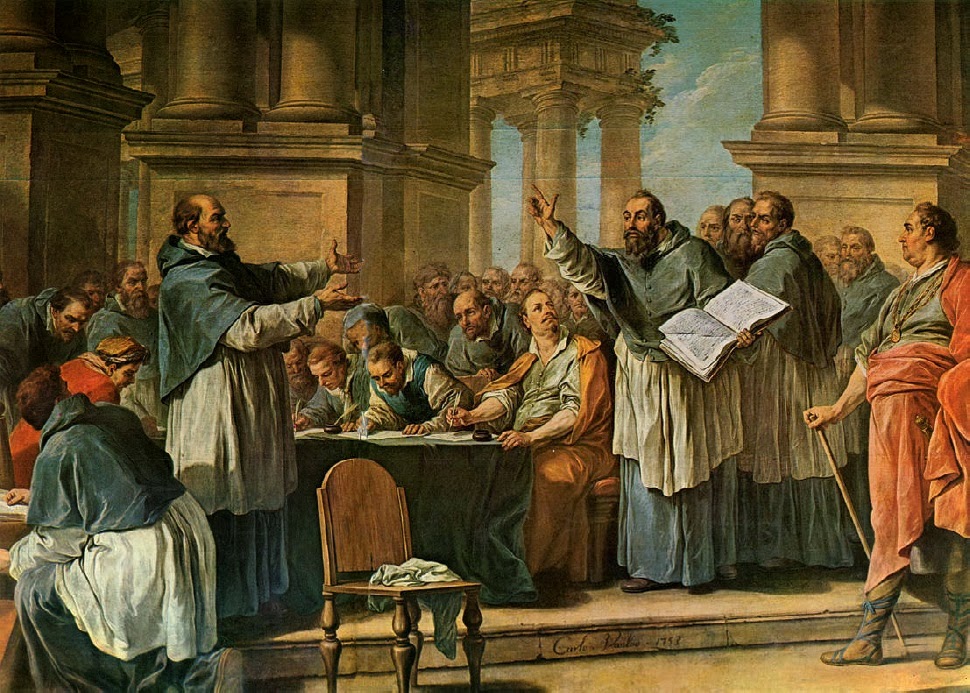
Augustine arguing with donatists by Charles-André van Loo, Public domain, via Wikimedia Commons

In response to Rome's claims, at the time of the Reformation, to be the one true church outside of which there was no salvation, the Reformation defined simple objective criteria by which the true church could be recognized. The Belgic Confession gives us a helpful example of this:

The marks, by which the true church is known, are these: if the pure doctrine of the gospel is preached therein; if she maintains the pure administration of the sacraments as instituted by Christ; if church discipline is exercised in punishing of sin: in short, if all things are managed according to the pure Word of God, all things contrary thereto rejected, and Jesus Christ acknowledged as the only Head of the church. Hereby the true church may certainly be known, from which no man has a right to separate himself [which implies also the positive responsibility to join].

This gives us three marks, with a simple summary. The summary is that for the true church, Christ is acknowledged as the only Head, especially in the subjection of all things to the authority of Scripture. The three marks in particular are:

  1. Gospel preaching
  2. Administration of sacraments
  3. Church discipline

In highlighting these three in particular, the Reformed were taking a stance that the true church ought to be recognized by its institutions, so that any institute claiming to be the true church without these three marks (e.g. Rome) could be rejected and those with these three could be accepted. The confession makes the point that these three were instituted by the Lord Jesus Christ. The three marks are institutional marks and therefore more clearly objective, but also these three are the key institutional forms which are the ordinary (and official) means in our salvation (other important but non-official means, such as fellowship with believers, prayer and Scripture reading/study are not mentioned because the church institute is not required for these).

These three marks represent the benefits of the church institute to the believer from Christ by His Spirit, underscoring the need for believers not to separate themselves from these means as one should not cut himself off from the means whereby he receives his daily bread. In pointing out these three marks, the Reformed confession draws the proper connection between membership in the church and salvation so that Rome's claim about no salvation outside the church of Rome is exposed as empty and meaningless.

By gospel preaching, we are instructed as to the content of our faith, and admonished to faith and repentance. Christ comes and speaks to us in the preaching. By the sacraments, we are given visible signs and seals to assure and strengthen our faith. Christ comes and shows us in the sacraments. By discipline, we are brought back to the right path when we stray. Christ comes and corrects us in discipline. Christ is present in living fellowship and saving power through these means.

The Reformed also distinguished the recognition of organized local congregations as institutional manifestations of the true church from the recognition of people as Christians or members of the church:

With respect to those, who are members of the church, they may be known by the marks of Christians: namely, by faith; and when they have received Jesus Christ the only Saviour, they avoid sin, follow after righteousness, love the true God and their neighbour, neither turn aside to the right or left, and crucify the flesh with the works thereof. But this is not to be understood, as if there did not remain in them great infirmities; but they fight against them through the Spirit, all the days of their life, continually taking their refuge in the blood, death, passion and obedience of our Lord Jesus Christ, "in whom they have remission of sins, through faith in him."

Significantly, the confession does not suggest looking for members of the church in order to recognize the true church. In fact the article opens with a reminder about hypocrites in the church: "But we speak not here of hypocrites, who are mixed in the church with the good, yet are not of the church, though externally in it." Those whom we think may be members of the church may only be external members, that is, hypocrites. But where we find the three marks, we have found what Christ instituted for our good in our salvation and may enjoy the presence of Christ in these means, even if all around us turn out to be mere hypocrites.

This was one of the important lessons that may be derived from the sad history of the Donatist schism. To grossly simplify, one of the key issues in this controversy was that the Donatists claimed that the ordinances instituted by Christ were worthless if administered by an ungodly man (or by extension, a man who later turned out to be ungodly). They had in mind office-bearers or ministers who had compromised their confession of Christ in times of persecution. Whether such men ought to have been permitted to retain their office, or be restored to their office, is a secondary issue for our purposes here. A church may have failures in church discipline without altogether losing that third mark. Augustine's genius was to realize that the efficacy of the official means of salvation in the church (preaching, sacraments, and discipline) did not strictly-speaking depend on the holiness or moral uprightness of the office-bearer administering these means.

This is not to excuse some of the errors that Augustine made (or perpetuated/developed) in his doctrine of the church at this time, or to excuse office-bearers who bring disrepute to their office, to the church, and to Christ. Such office-bearers ought to be disciplined when their faults are uncovered, and deposed if they have shown or made themselves unfit for office. Also, moral failings often work through into a minister's (weak or false) preaching, or an elder's (lack of or corrupt) discipline. Nevertheless, the means themselves, if faithfully administered, retain their benefit to Christ's flock, since their nature is not dependent on the man administering them.

But this also means that the presence of the three marks in a local congregation does not in itself imply that the office-bearers are not hypocrites, or that the members of that congregation are Christians. That the confession gives separate criteria as the marks of Christians also indicates this. In other words, there is no inherent correlation between the three marks and church purity, spirituality, or holiness. This is worth emphasis because the confession speaks repeatedly about the purity of the three marks. Why is the purity of the three marks important, and why is this distinct from church purity?

The purity of the three marks concerns the faithfulness in which they are administered, and has therefore a direct correlation with their potential benefit for God's people. The more pure these marks are therefore, the more important it is for the believer not to separate himself from them, and the easier it is for the believer (ordinarily) to recognize them. This is distinct from church purity because the purity of the marks does not depend directly upon the spirituality of the members of the church. Of course, in the ordinary case, an unfaithful, unholy, and unspiritual church will typically lose the marks very quickly. But there are various reasons why the marks may linger or be administered even when a church as a whole becomes unfaithful. The reasons may be basically the same as the motivations of a hypocrite.

Particularity in the purity of the marks may become a matter of pride for a church, just as the Pharisee who boasts that he pays tithes of all manner of herbs. All the while, just like the hypocrite who secretly hates God and his neighbour, they neglect weightier matters as long as their performance puts on a good show. Christ had much to say about these religious hypocrites:

Woe unto you, scribes and Pharisees, hypocrites! for ye pay tithe of mint and anise and cummin, and have omitted the weightier matters of the law, judgment, mercy, and faith: these ought ye to have done, and not to leave the other undone. Ye blind guides, which strain at a gnat, and swallow a camel. Woe unto you, scribes and Pharisees, hypocrites! for ye make clean the outside of the cup and of the platter, but within they are full of extortion and excess. Thou blind Pharisee, cleanse first that which is within the cup and platter, that the outside of them may be clean also. Woe unto you, scribes and Pharisees, hypocrites! for ye are like unto whited sepulchres, which indeed appear beautiful outward, but are within full of dead men's bones, and of all uncleanness. Even so ye also outwardly appear righteous unto men, but within ye are full of hypocrisy and iniquity. Woe unto you, scribes and Pharisees, hypocrites! because ye build the tombs of the prophets, and garnish the sepulchres of the righteous, And say, If we had been in the days of our fathers, we would not have been partakers with them in the blood of the prophets. Wherefore ye be witnesses unto yourselves, that ye are the children of them which killed the prophets. Fill ye up then the measure of your fathers. Ye serpents, ye generation of vipers, how can ye escape the damnation of hell? (Matt. 23:23-33)

Prior to the captivity in Babylon (and afterwards, leading up to the Pharisees), Judah, in contrast to Samaria which did not have such purity in the outward forms or institutions, practiced this show-religion. Isaiah decries this evil:

To what purpose is the multitude of your sacrifices unto me? saith the LORD: I am full of the burnt offerings of rams, and the fat of fed beasts; and I delight not in the blood of bullocks, or of lambs, or of he goats. When ye come to appear before me, who hath required this at your hand, to tread my courts? Bring no more vain oblations; incense is an abomination unto me; the new moons and sabbaths, the calling of assemblies, I cannot away with; it is iniquity, even the solemn meeting. Your new moons and your appointed feasts my soul hateth: they are a trouble unto me; I am weary to bear them. And when ye spread forth your hands, I will hide mine eyes from you: yea, when ye make many prayers, I will not hear: your hands are full of blood. Wash you, make you clean; put away the evil of your doings from before mine eyes; cease to do evil; Learn to do well; seek judgment, relieve the oppressed, judge the fatherless, plead for the widow. (Isa. 1:11-17)

Christ's warning for us as individuals is also for churches:

In the mean time, when there were gathered together an innumerable multitude of people, insomuch that they trode one upon another, he began to say unto his disciples first of all, Beware ye of the leaven of the Pharisees, which is hypocrisy. For there is nothing covered, that shall not be revealed; neither hid, that shall not be known. Therefore whatsoever ye have spoken in darkness shall be heard in the light; and that which ye have spoken in the ear in closets shall be proclaimed upon the housetops. (Luke 12:1-3)

Some of the letters in the book of Revelation are addressing churches with precisely this kind of evil, and Christ threatens to take away their candlestick. The church that boasts in the purity of its marks, ought to take heed how its purity of life should correspond with these marks. Else, God who abases the proud and lifts up the humble, will remove the source of pride and replace it with everlasting shame.

And unto the angel of the church in Sardis write; These things saith he that hath the seven Spirits of God, and the seven stars; I know thy works, that thou hast a name that thou livest, and art dead. Be watchful, and strengthen the things which remain, that are ready to die: for I have not found thy works perfect before God. Remember therefore how thou hast received and heard, and hold fast, and repent. If therefore thou shalt not watch, I will come on thee as a thief, and thou shalt not know what hour I will come upon thee. Thou hast a few names even in Sardis which have not defiled their garments; and they shall walk with me in white: for they are worthy. He that overcometh, the same shall be clothed in white raiment; and I will not blot out his name out of the book of life, but I will confess his name before my Father, and before his angels. He that hath an ear, let him hear what the Spirit saith unto the churches. (Rev. 3:1-6)

The church of Sardis had a name that it was living. We might say it exhibited the three marks very clearly and purely, and its hypocritical members made a convincing show. But Christ walks amidst the candlesticks, and He says it is, as a whole, to be considered spiritually dead because its works were not perfect before God. The church had some things that remained, which needed held fast to and strengthened. There were some also who had not defiled their garments. The rest had. Those that did not repent and overcome would be blotted out of the book of life. So much for their boasts of church membership in such a supposedly living (or "pure") church. But those who have an ear are called to hear and watch and repent.

The church of Ephesus was not in nearly so bad a condition, and receives various commendations, including for their works, but they had forsaken their first love. The spiritual problem was not that they had preached poorly or administered the sacraments incorrectly (by all accounts, both Sardis and Ephesus were blameless in outward forms). Ephesus was even commended for their discipline of false apostles and Nicolaitans. But like Sardis, Ephesus is warned that unless they repent, Christ would come swiftly, taking them by surprise, to remove their candlestick. The candlestick in this vision is what most closely relates to the three marks we have been examining.

Purity in the three marks is important, and believers must join and not separate from the church which bears these marks, despite the presence of many other faults, but this is no substitute for church purity. Knowing all the right theology is no substitute for personal holiness in a walk of daily repentance and faith. A church having the best doctrinal positions on all points of dogma is not any whit purer because of that, than a hypocrite is purer than a heathen just because he knows the Bible from cover to cover. May we therefore pray:

Deliver me from bloodguiltiness, O God, thou God of my salvation: and my tongue shall sing aloud of thy righteousness. O Lord, open thou my lips; and my mouth shall shew forth thy praise. For thou desirest not sacrifice; else would I give it: thou delightest not in burnt offering. The sacrifices of God are a broken spirit: a broken and a contrite heart, O God, thou wilt not despise. Do good in thy good pleasure unto Zion: build thou the walls of Jerusalem. Then shalt thou be pleased with the sacrifices of righteousness, with burnt offering and whole burnt offering: then shall they offer bullocks upon thine altar. (Psalm 51:14-19)

And the very God of peace sanctify you wholly; and I pray God your whole spirit and soul and body be preserved blameless unto the coming of our Lord Jesus Christ. (I Thess. 5:23)