Showing posts with label review. Show all posts

Sunday, December 01, 2013

How NOT to train up a child - Michael Pearl

I read about this sad story recently about a well-known but dreadful book by Michael Pearl. Training a dumb animal is nothing like bringing up a child in the nurture and admonition of the Lord. The rod cannot be used without reproof. Our discipline must be limited by what a child can properly understand--otherwise it is not spiritual discipline, just senseless violence. Also just as we ought to flee temptation, we ought to keep our children away from temptation, not put stumbling blocks in front of them.

To be honest, I would not let people like that even train my dog (if I had one). 
"A righteous man regardeth the life of his beast: but the tender mercies of the wicked are cruel." - Prov. 12:10.
As for Christ's little ones: 
"And, ye fathers, provoke not your children to wrath: but bring them up in the nurture and admonition of the Lord." - Eph. 6:4.
"Fathers, provoke not your children to anger, lest they be discouraged." - Col. 3:21.
"The rod and reproof give wisdom: but a child left to himself bringeth his mother to shame." - Prov. 29:15.
The goal of discipline administered by Christian parents ought never to be to train children to achieve some kind of outward show of absolute obedience. It ought to be spiritual discipline to aim at a child's sanctification. That is what it means to nurture them in the Lord: they are like little olive plants that are weak and need to be carefully and lovingly nurtured (sometimes pruned) to become strong (Psalm 128:3). Not to tear them down, but to build them up. If it is to be spiritual then it must necessarily come with the Word of God - otherwise it is worthless because all our growth in grace comes by the word, and there is no edification without understanding (I Cor. 14:9ff), therefore the child must be taught to understand the Word of God. Also since the goal is the sanctification of the child, that means that children may only be chastened for sin (not for accidents, mistakes, weakness, etc), and the chastening must be appropriate and proportionate to the sin.

God's Fatherhood of us is our model. That God wills us always to be assured of our salvation (Rom. 8:15-16; Gal. 4:57; etc), teaches us that we too must always assure our children of our love for them, especially as we seek their salvation, to lead them away from sin and temptation, to lead them with us to Christ for forgiveness daily, and this means too that since it is sinful for them to disobey us, we ought not make the temptation more difficult for them by laying down burdensome and overbearing commandments on them. Instead we need to be gentle, knowing that they are weak vessels like us, yet even weaker. And unless we know in ourselves our own weakness as deeply as we ought, we will not be as gracious with our children as we ought to be. Who is sufficient for the heavy responsibility to be a father to one these little citizen's of Christ's kingdom. Considering the task, I would despair except that I trust that if God has entrusted one of His beloved elect to my care, then He will also work by His grace in me as an instrument in His hand for their benefit - because I know that God works all things for the good of His elect. 

By the way, I don't believe in presumptive regeneration. But I'm not a Baptist either, so I don't believe in presumptive un-regeneration. I believe we ought to view and treat all the children of believing parents as everyone else in the church; elect and beloved, etc (even though we know that just as there will be hypocrites among confessing adults, there will be reprobates among the children - in other words, that is not a sufficient reason biblically to view either an adult or a child in the church uncharitably). 

A friend directed me to this review. I want to highlight a very important that Rachel Miller makes in that review article - children have emotional needs. In fact, if I have learnt anything as a parent, it is that we can never know exactly what the reason for a child's crying might be. They might be crying because they are hungry, or thirsty, or too cold, or too warm, or a bit sick, or a bit uncomfortable, or because they want someone to talk to them, or to be with them, or to hold them. It is very likely that they themselves very often don't know what they are crying about, and maybe often they just feel a need to cry for no real reason other than that. And whatever the reason may be, even if they do not know themselves, unless they can tell us, then we cannot know.

But are we not the same? Do we not sometimes feel like we don't know what is wrong, and just want to cry to our heavenly Father? He is always ready and willing to hear our cries, no matter how often or how loud and fervent they might be. To bring our cries before God is not at all the same as murmuring and complaining against Him and His good providence - His fatherly kindness. It is an act of worship when we bring our cries before Him, because in doing so we confess that He alone is the one who always hears us and ultimately from whom all our comfort comes no matter what may be the reason for our cries. I don't have a lot of experience as a parent (one year today), but I guess that one of the richest experiences of any parent is when a child seeks their comfort from you, and I believe that God, who comforts us so that we can comfort others, works through us parents to comfort His children.

Ultimately our cries to God are a manifestation of this: "And not only they [the brute creation], but ourselves also, which have the firstfruits of the Spirit, even we ourselves groan within ourselves, waiting for the adoption, to wit, the redemption of our body." (Romans 8:23). And in this is our comfort; the Spirit expresses far more deeply to God what cannot express rightly (because of our sin, and more simply our weakness, and limited nature): "Likewise the Spirit also helpeth our infirmities: for we know not what we should pray for as we ought: but the Spirit itself maketh intercession for us with groanings which cannot be uttered. And he that searcheth the hearts knoweth what is the mind of the Spirit, because he maketh intercession for the saints according to the will of God. And we know that all things work together for good to them that love God, to them who are the called according to his purpose." (Rom. 8:26-28). And since Christ knows the mind of His own Spirit dwelling in us, so He knows exactly how to intercede for us. And so we have the knowledge that everything is worked out by God for our good, because of His eternal love for us in Christ.

We will continue to offer up cries to God until our final redemption at the coming of the new age, and then there will be no more crying and our Father will have wiped away every tear from our eyes: "And I heard a great voice out of heaven saying, Behold, the tabernacle of God is with men, and he will dwell with them, and they shall be his people, and God himself shall be with them, and be their God. And God shall wipe away all tears from their eyes; and there shall be no more death, neither sorrow, nor crying, neither shall there be any more pain: for the former things are passed away." (Rev. 21:3-4).

Isn't this the kind of fatherhood that we ought to try to emulate: to wipe away the tears of our children, by giving them the comfort of us being with them, and them with us?

To presume that their crying is some kind of sophisticated sinful manipulation is not only absurd (from the point of view that even though their fallen human nature is utterly depraved, its expression is nevertheless restricted by their lack of development in strength, intelligence, etc), but also, and more importantly it is fundamentally uncharitable, and therefore un-Christian. It comes from a radically wrong mindset. Christian love demands this: "Charity suffereth long, and is kind; charity envieth not; charity vaunteth not itself, is not puffed up, Doth not behave itself unseemly, seeketh not her own, is not easily provoked, thinketh no evil; Rejoiceth not in iniquity, but rejoiceth in the truth; Beareth all things, believeth all things, hopeth all things, endureth all things. Charity never faileth..." (I Cor. 13:4-8). If we would desire that people be charitable with us in all our weaknesses, should we not be charitable to others - especially our own children? If we do not provide a living example of Christian love to our children, they will not learn it from us.

And even if it was only ever sinful crying, that would not change our responsibility as parents. We may never accuse another (whether our children or otherwise) of lying when we do not really know. The unregenerate wicked only ever sin, and yet they often speak truthfully in their sinning if it will get them want they want. Yet as Christians, we may not even presume that our children are unregenerate. I would guess in the theology of the Pearls however, they do presume this. And they propose a very different unbiblical way of the salvation of infants and children - salvation by physical discipline through the efforts of parents, rather than by grace through faith in Christ.

Wednesday, July 11, 2012

Recognising a true church requires objective criteria!

A friend recently brought this article to my attention: http://www.insight.org/library/articles/church/how-to-recognize-a-healthy.html?t=Church

What follows is my rather blunt response.

Recognising a true church requires objective criteria!

The translation of Acts 2:43 is very wrong! It's says, "And fear came upon every soul:" That's the reverent loving fear of God which is a mark of every Christian, and the beginning of wisdom. It is seen not in emotional experiences but in obedience to His commandments, as Christ said, if you love me, obey my commandments. In this verse in Acts, Luke is not talking about a sense of awe in their worship services - he's talking about the godly obedience in the hearts of these early Christians.

The first point only begs the question: what is it that glorifies God? To this question, every Tom, Dick, and Harry has a different answer. The only way to judge this is by asking, is this church faithful to SCRIPTURE.

The instruction here is imbalanced because it immediately speaks of the important of good application without insisting upon what must come first - correct sound biblical doctrine. The biblical presentation is different - right knowledge of God always manifests itself in right practice in the lives of believers (otherwise they are hypocrites!). Paul's prayer for the Ephesians begins with this petition for them - heavenly wisdom, knowledge and understanding of God. II Peter sums up the Christian life, "grow in the grace and knowledge of Christ". John 17:3 says, eternal life is this, to know God in Jesus Christ whom He has sent. The Bible is the revelation of Jesus Christ, so that knowledge of the Scriptures is the only source of knowledge of God.

Unbelievers also show seemingly genuine concern for one another, as the saying goes, birds of a feather flock together. They may be very warm and naturally affectionate towards one another, united in their rebellion against God. Again, Scripture must be the judge, objectively. We cannot tell what love is in people's hearts except in the expression of it, which we may not be able to distinguish from the "love" of hypocrites!

Furthermore, we must not confuse the healthiness of believers with the healthiness of the church. Obviously the two are related, but remember that there are always hypocrites in the church, and the saints are filled with all manner of weaknesses too, even though there may be nothing wrong with the church. We must not blame the church for all of our own failings and weaknesses. Often there is some blame there, but not at all always!

Historically this subject was dealt with, especially when the church was coming out of apostate Rome. Then it became necessary to establish more clearly how the Bible teaches us to objectively judge what is a church and what is not, because it is not enough for an institution to take to itself the name "church". The Mormon "church" does this (as does Rome) but judged by the Bible, they are not churches at all! So, how do we judge, and how did Christians historically learn to judge this? Again, look at their confessions, where they tell us how the judge, and bear witness of the wisdom that the Spirit worked in their hearts. Guido de Bres, who was martyred for his faith wrote a confession for the Belgian Reformed churches while in prison, which was recognised as so biblical, indisputable, and helpful, in time of great controversy, that the continental European Reformed churches universally approved of it, and began to use it as their official confession. In it, Guido explains what the Bible displays as the three marks by which a church can be recognised. The healthiness of the church is directly related to the church's faithfulness to these.

First, is the pure preaching of the biblical Gospel. That stands to reason for anyone who knows the Bible even a little. It cannot be a church which doesn't preach the true Gospel. The biblical Gospel is simply the good news about Jesus Christ, what He has done to save us. It is not, therefore, instruction about how we may save ourselves by our own will or work, or how to make the world a better place to go to hell from, or how to be successful in life, or any number of other popular false gospels!

Second, is the sacraments that Jesus Christ instituted for His church. A group which doesn't have these two sacraments of the Lord's Supper and baptism, can clearly not be called a church. It is not a church which replaces the sacraments with corruptions that have no bearing to what Christ instituted, such as the Eucharistic sacrifice of the Mass, or which add to these sacraments many more which Christ never authorised!

Thirdly, is biblical Christian discipline. Christ instituted this too in His church, and gave authority to the church to carry out this discipline with the keys of the kingdom. Naturally, this implies that a church has ruling officebearers (elders who meet the biblical requirements) who can carry out this discipline, according to the biblical mandate and readmit repentant brethren (which also implies official church membership!). This implies also that the elders have the rule over the administration of the sacraments, to refuse those who are impenitent and unbelieving. That which does not have this rule, and corrupts the sacraments by allowing all and any to take part asking no questions cannot be considered a manifestation of the kingdom of God - the church.

Finally, in these, the long-confessed attributes of the church are maintained. Unity, so that we have the same Lord, and believe the same Gospel and so on; catholicity, so that none are excluded or discriminated against on the basis of anything other than impenitence in life or doctrine; holiness maintained by Christian discipline; and apostolicity, doctrinal faithfulness to the teaching of the apostles.

I don't get why this article ignores these long-established doctrines concerning the church.

Friday, April 22, 2011

Book Review: "Whosoever Will"

In this book, the author expounds the glorious truth that "every one that asketh receiveth; and he that seeketh findeth; and to him that knocketh it shall be opened." The subject is introduced by means of the words of hymn, which like many such hymns, is technically orthodox, yet usually sung and explained to promote heretical ideas.

In explaining the biblical way to understand, "whosoever will may come," the author first asks to whom is it that the willing may come. The ultimate answer given is God. And the author develops the significance of this answer by speaking about who the true God is in relation to sinful man. The undeniable conclusion for the reader who believes the plain teaching of Scripture is that God Himself must make man willing to come to Him through Christ. The author continually brings the reader back to consider the motivations and desires of the heart behind all our willing and doing, which especially demonstrates the impotence of the sinner, and begging hawkers of a false impotent Christ.

Hoeksema continues on this theme by presenting in great detail and majesty the identity of Christ as the Rest-giver, the Fountain of Living Waters, the Bread of Life, the Liberator, the Light and the Resurrection. In all of these, and especially in the last, it is seen incontrovertibly that the sinner cannot even will to bring himself to this Christ of the Scriptures, but rather Christ is the one who powerfully works in the sinner to bring him to life and make him willing.

"The will to come to Him, therefore, must be motivated by the desire to come to God, the longing for rest, a hunger and thirst after righteousness, a yearning after true freedom, love of the light, and the earnest desire to be delivered from death and to be quickened unto a new life."

This marvel of how God makes the sinner willing and draws him to Christ is explored with simplicity, clarity and precision. Man coming to Christ is shown to be an entirely spiritual act, consisting of "contrition, recognition, aspiration, and appropriation." These four are shown to necessary rely upon the monergistic work of God in drawing the sinner; conviction, illumination, allurement, and sealing. These meaningful terms are biblical explained, always in such a way that these truths are applied to the believing reader, both to comfort, and exhort.

Three important subjects in connection with this are dealt with in the concluding chapters. The author shows that the preaching of the true Gospel by faithful ordained ministers is the means which God uses to draw His elect. Particular emphasis is placed on the need for God's people to hear the word of God in the preaching, because the word of man has no power. Next, the common objection that the doctrine of God's sovereignty in salvation leaves no room for man's responsibility is shown to be the same objection laid against Paul in Romans 9, and not only erroneous, but proud and ungodly.

Finally as Hoeksema speaks of the need to grow in the grace and knowledge of Jesus Christ, the importance of the ministry of the Word and of membership in the true church is underscored. This teaching about the church is sorely needed. This excellent book is easy to read, written in an engaging style, and deals very helpfully with very important doctrines.

Available from the RFPA bookstore.

Tuesday, February 15, 2011

Review: Contending for the Faith

No other book that I have read has been more helpful in my understanding the present condition of the church world today.

Each chapter of the book treats a separate heretic/heresy in church history, from the very early church all the way up to recent times. It is written in a very easy to read style, despite the complexity of some of the heresies discussed (since every heresy tends to be quite complicated in comparison to the simple truth). Reading it was like sitting with a father, being patiently told the long story of the family's history. Colourful stories and characters are painted in each chapter, which helps not with the flow and enjoyment of the reading, but also in understanding how the heretics, and their heresies developed.

Only the chapter on the Marrow men controversy became a little difficult to follow, but with good reason considering the difficulty of the issues involved. When men attempt the impossible in trying to find common ground between the truth and the lie, it always ends up with confusion. Simple overall principles like this, teaching about the character of heresies, and those who propagate them, were smoothly drawn out of the many examples.

Each chapter, a little story in itself, like every good story, contains important lessons to be learnt. Occasionally the lesson was longer than the story - but always very rewarding. The lessons contain enlightening analyses of the heresies, and bring the light of God's word to bear on each issue. Especially helpful was the distinctively Reformed protrayal of the issues involved. The truth was set very clearly in opposition to what was false or distorted, and the real character and root of the error became clear. Because of this, the book shows the reader where the same errors are found today, and how best to correct them and guard against their reccurance.

The wealth of the specific biblical subjects dealt with throughout this book is truly astounding. People in the confused church world today need to absorb the lessons in a book like this, to know the history of the church, and how God has led her and preserved her, and caused her to confess Him more and more clearly and fully throughout the ages. It is a terrible shame when we don't learn the lessons of history, and of incalculable help to us when we do.

I wish all the professing Christians that I know near where I live would read this book and see things as clearly as they are presented in it. It's available from our own Limerick Reformed Bookstore for the Republic of Ireland, and from the CPRC Bookstore for the UK and the rest of Europe, and from the RFPA  for America and the rest of the world.

Sam W.

Friday, February 11, 2011

Selling Out Scripture for Evolutionism

"It is something like a case of an honest, God-fearing grocery store owner being robbed at gunpoint by a murderous crook. Investigating the incident, the crook tells the police that the store owner gave him everything from the store, while the owner says that the criminal boldly threatened his life. The policeman, content to adopt the crook's version, tells the store owner that he must have been under the influence of a powerful narcotic when he gave all those things to the crook, or that his description of the robbery cannot be taken literally. The owner really meant that his gift to the robber can be construed as robbery because his conscience so smote him when he saw the poverty of the crook that it compelled him to give the store's contents to the crook. So theistic evolutionists are ready to sell out Scripture for evolutionism, and they do it by explaining that the scriptural narrative of creation cannot possibly be taken literally."

Such is the verdict of Prof. Herman Hanko in his section on evolutionism in his unique book on the history of heretics in the church over the last two thousand years, "Contending for the Faith" (http://www.rfpa.org/catalog/product_info.php?cPath=23&products_id=114). I'm amazed at how vivid and accurate this illustration is!

Monday, February 07, 2011

Pharisees think that Sabbath-keeping is legalistic

Perhaps there is no other thing which modern Evangelicals associate more with the Pharisees and their legalism, than Sabbath-keeping. But was it not the case that they distorted what true Sabbath-keeping was about? Listen to this compelling argument from Walter Chantry's "Call the Sabbath a Delight!"

"At this time in our Lord's earthly ministry [Matthew 12:1ff and Luke 6:1ff], Jesus was pledged to fulfill all righteousness even under the Mosaic judicial and ceremonial laws. It was He alone who perfectly lived by the system given under Moses. He and His disciples could not sweep away any Old Testament law as irrelevant if Jesus were to fulfill His mission as Messiah. Our Lord is not suggesting to the Pharisees that it is permissible to break the law because the law must be changed.
"To the contrary, Jesus is accusing the Pharisees of a fundamental misunderstanding of the Sabbath law. Their views were entirely mistaken and could not be defended from Old Testament Scriptures. They had blundered seriously in handling Biblical passages on the law. Our Prophet is defending His practice because it is in complete harmony with Old Testament standards. He had not in any way disregarded the Sabbath!
"This observation is of the highest significance in our day. It is important because some breathe the spirit of the Pharisees and would reintroduce their stern demands within the modern church. However, even more shocking than those who wish to reconstruct a Pharisaical attitude toward the Sabbath are those who wish to abolish the Sabbath in our day. These people suggest that the Pharisees were right, not Jesus. They try to persuade us that if one day in seven must be kept holy to the Lord, it is inevitable that we will take up the Pharisees' way of doing so! They imply or declare that the only possible way to keep the fourth commandment is in the way of Pharisaical strictness. Their opinion is that the only alternative to the rigidity of the Pharisees is total abolition of the day. Such a position leads to the conclusion that the Pharisees were correct in accusing our Lord and His disciples of Sabbath-breaking. This approach toward rescinding the fourth commandment is an intolerable sacrilege! Jesus' pattern of behaviour is in full compliance with the Sabbath law."

In this masterful book, Chantry also powerfully brings Scripture to bear against some of the most common, and superficially convincing arguments against keeping one day in seven holy to the Lord:


"Some of the Continental Reformers and Reformation creeds reason something like this. Christians have ceased from seeking God's favour by good works and have instead relied upon the works of Jesus Christ to save them. This rest of the Christian from a works way of salvation is akin to God's ceasing from his works at creation. The Old Testament weekly Sabbath prefigured this resting upon Christ. Now we have the reality and no longer need the shadow. However, Christians, too, need a day of worship; but the Lord's Day is not identical with the fourth commandment Sabbath.
"At best this is a jumble of poorly worked-through ideas. At worst some of the Reformers have misled us at this point. It appears that some Reformed thinkers could not escape the influence of one of their leading doctrines even when it did not apply to the subject which they were handling.
"Some who are newly come to the doctrines of grace find God's sovereignty in every Bible verse and feel compelled to expound that theme in every message. A few Reformers seemed to feel compelled to discuss justification by faith when defining the nature of Sabbath-keeping. To them ceasing from works could only mean to cease to rely on works religion to be saved. However, the parallel does not hold in Biblical passages on the subject.
"God ceased from glorious and righteous works when He entered His rest. He entered rest satisfied and delighted in the work He had done. When the Jews were called to work six days and rest on the seventh in imitation of their Creator, it was not being suggested that they try to earn salvation by their obedience to the law. Such a course was nowhere recommended by Moses! Galatians 3 explicitly denies such a position. All mankind was given six days to do all his own legitimate works. On the seventh he was to cease from these (good) works to worship and serve the Lord. Man is to share God's delight in divine works. He is to enter God's rest, which has nothing to do with a former miserable works religion."

Throughout this short, yet thorough book, the common New Testament passages misused to deny that the fourth commandment is applicable to Christians are explained. Romans 14:5-6, Col. 2:16-17, and Gal. 4:9-10, all speak against Christians keeping the ceremonial and judicial laws which were shadows and have been fulfilled with the coming of the reality which is Christ. He proves that the fourth commandment was not included in these ceremonial or judicial laws, and that these passages have in question the feast days and special sabbaths pertaining to them. Rather, the fourth commandment is a moral one, and was laid down, not by Moses, but by a creation ordinance as was marriage.

He also proves conclusively from various passages (and especially with a watertight exposition of Hebrews 3:1-4:11) that not only is the fourth commandment still applicable to Christians today (as with all the other moral commandments), but also that the day has been changed by the Lord of the Sabbath, Christ, to the first day of the week (which was the day Christ entered His rest), instead of the seventh (on which God entered His in the beginning). The book demonstrates the grievous error of antinomianism proving that the moral law of God was not abolished. It also traces much of the attitude against Sabbath-keeping to the Scripture-dividing heresy of dispensationalism which says that most of the Bible is not really applicable to the church in the New Testament. In connection with this, he proves that keeping the law was never a means of salvation; rather, salvation by grace through faith has always been the way (his simple clear arguments on this point are stunning). Positively, Chantry patiently explains the purpose of the law, both the moral law, and the ceremonial and judicial laws.

Besides this essential framework, he gives wonderful pastoral instructions regarding the motive of all law-keeping - not in order to merit or earn anything, but out of the overflow of sincere gratitude in love for God. He exposes in detail the error of the Pharisees and gives wise and pastoral warnings against it, using the clear examples given by Jesus Christ. These parts of the book make it especially a worthwhile read, and also very beneficial even for those who may already be convinced that "there remaineth therefore a Sabbath for the people of God." - Heb. 4:9. If you are not convinced of this doctrine yet, then read the book, and I doubt you will have an argument remaining - indeed if your authority is Scripture alone, you will most likely "Call the Sabbath a Delight". :)

The book is available on Amazon here. http://www.amazon.co.uk/Call-Sabbath-Delight-Walter-Chantry/dp/0851515886/ref=sr_1_1?ie=UTF8&qid=1297080652&sr=8-1

Monday, October 05, 2009

How Do I Know God's Will For My Life?

On Thursday, 24th of September, Rev. Angus Stewart gave a lecture entitled, “Guidance: How Do I Know God's Will For My Life”. This included a robust and comprehensive defense of sola Scriptura over against all the insane notions of various kinds of fanatics, charismatics, pentecostals, Arminians, etc. It began by examining all the wild, wacky, and wonderful ideas about guidance that abound today, and which are utterly false and lead people into all kinds of difficulties. I remember as a young Christian in the Methodist church hearing all these ideas about guidance and seriously desiring to be led by God – especially as regards what career to pursue (I had heard no small voice in my head as a call such as the Methodists seemed to speak of, and thought it very easy to fall into being guided by my own desire or pride). I would ask people about it and at various youth conferences I would go to the lectures/workshops on “guidance”.

I guess I heard a few useful things, like letting the Bible fall open randomly and blindly putting your finger on a verse is downright stupid, but I think I knew all those things already - the inituitive Christian hermeneutic militates against it. It all really caused me to despair about what to put on my CAO form for a college course to go to after writing my Leaving Certificate exams. Why? Because I had not heard any “voice” telling me what to do – I did not have the kind of subjective, supernatural, experiential “calling” like the Methodists so often spoke of, and so I assumed that either they were just talking trash or God was determined not to guide me. In the end I made a decision, hoping that I would receive some special supernatural revelation later eventually. This of course seriously harmed my assurance too. If I do not receive such guidance in such a manner, does God really love me? Of course, biblically speaking, to receive a direct revelation from God is to be a prophet, and the prophets, along with the apostles, are laid in the foundation of the church with Christ (Eph. 2:20).

Once the coffin had been nailed firmly shut (and a few more planks hammered on top) on all these unclean spirits of “guidance”, the meat of the lecture was expounded. The all-sufficiency of the Holy Scriptures that the man of God may be complete, thoroughly equipped for every good work is the answer to how we are to know God's will for us. A careful distinction was made between God's commands and God's purposes (since these can both be referred to ambiguously as His "will"), and it was highlighted in view of this, that while we can certainly be outside God's will of command by walking in disobedience (in which case we ought to repent), we cannot be outside God's good and perfect purposes. Rev. Stewart proved a number of crucial principles from Scripture, and how God guides us as we apply these wise biblical principles to our circumstances:
  • How does God guide Himself? First of all, is His own glory, and His own glory in Christ, and His own glory in Christ in the salvation of His elect church (Col. 1:16ff).
  • This model is given in the Lord's Prayer (Matt. 6:9-13), so we are admonished to seek first the kingdom of God and His righteousness (Matt. 6:31-34).
  • We are aided by the Psalms by which we teach and admonish one another to be guided rightly (e.g. Psalm 23, 25, 37, 73, 119, 143).
  • It is hypocrisy to claim to seek God's guidance if we are not obeying His commandments – of which the ten commandments are a summary, and include the 4th commandment (Exo.20).
  • We are guided by many biblical examples, both positive and negative; the patience of Job; the longsuffering of Joseph; and the folly of Jonah.
  • Luther famously contended that the Spirit guides us by the Word and prayed that he may be content with this alone – and prayer cannot be a substitute for diligent study of Scripture and thinking biblically, but rather, in prayer we ask that we may be given the ability and willingness to do these things.
  • Advice from others is also not a substitute for the above, but ought to be sought in order that we may benefit from the experience and knowledge of others to make more informed biblical decisions (Prov. 11:14; 24:3-7).
The lecture was finished with a few concrete examples of how to apply biblical principles to various key areas of decision-making; dating, church, and employment. See here also concerning work (I Cor. 7:17-24). Finally, Rev. Stewart mentioned decisions in which we cannot clearly see which is better either way, sometimes it is needless to devote much thought to it, such as what brand of beans to purchase, and in others, at least if the more difficult option is taken, it will work for our sanctification (Jas. 1:3). In all these things of course, we must trust that God works all things together for good (Rom. 8:28), even when we make foolish decisions (as sadly we often do - Prov. 24:9). Thank God for another fabulous lecture, soon to be available on Youtube!

Friday, September 25, 2009

John Calvin: Man or Monster?

Perhaps one of the most controversial, ubiquitously hated and slandered characters in history is the great Reformer John Calvin. Mention his name in many circles, and the response of cold and bitter contempt will be unparalleled (often the same circles of such as who try to hide their worship of men like Rob Bell, Rick Warren, Bill Hybels, John Wesley, etc, depending on their particular tastes and the demands of the worldly culture or philosophy in their particular situation). Suggest that you have read a book by this man, and measure how rapidly the accusation will arise that you are following a man instead of Christ!

But I prefer to leave such bigotry and Anabaptistic fanaticism (by which they would cut themselves adrift from all the saints in Christ who came before them - just as they cut off their children) with the attention it deserves. I recognise John Calvin, and many others like him as my spiritual fore-fathers in the faith once delivered unto the saints. And what is he but a minister by whom God brought many to believe in Christ at the time of the Protestant Reformation? The Holy Spirit attributes similar descriptions both the Apostle Paul and to Apollos, who were mere men, yet they were used by God in the ministry of the Gospel of Christ (I Cor. 3:4-9).

Usually Calvin is portrayed as the "Protestant Pope of Geneva", a cruel tyrant, the evil executor of Michel Servet, a prideful polemicist, and many other horrid depictions besides, such as know no end. Few others have been smitten with so many manifestly rotten and vile slanders, but what is the truth about this Reformer? Have those who take so great a delight, along with so little care in calumniating him ever endeavoured to explore this enigma? That is very doubtful in my experience. More often than not they hold merely to hearsay about twisted representations of his doctrine and life. This book dispels such misrepresentations, and demonstrates unequivocally from his actual correspondences, reviewed by an excellent student of his history, how deeply filled this man of God was with great compassion, zealous love, moving sympathy, and fierce devotion to God, the church, and his dear fellow saints, friends, wife, and family.

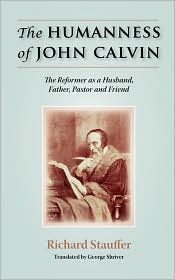
Since I finished the lengthy introduction, I've been craving an opportunity to write a review of this book. Now, a shock for everyone - it is neither doctrinal, not polemical. It is simply biographical. Last Saturday evening I read "The Humanness of John Calvin: The Reformer as Husband, Father, Pastor, and Friend" written by Richard Stauffer, and translated from the French by George Shriver. You will not find a study of Calvin's theology here, though a new book by Engelsma which I am persuaded by many, deals with this subject superbly (I hope to review this in due course too, though I've a heavy weight of other books to get through first).

The author portrays the Christian man Calvin, as a man deeply connected with both the greatest of joys and griefs of his friends. As I have read a number of Calvin's works this year (since it is after all the 500th anniversary of his birth), I have for the most part read a lot of his polemical works on various issues of quite practical importance for myself. I find much encouragement in his godly argumentation, lofty respect for Holy Scripture, powerful logic, and uncompromising detestation of all manner of blasphemies, idolatries, superstitions and heresies. Yet, I perhaps have greater joy in seeing the sweet love for God and the church from which his fierce polemics flow. From this he derives his steadfast tenacious commitment to the truth of Scripture, the grace of God by which his heart was bound to the lives of the saints.

Read this book, and see how deeply Calvin shared in the trials and troubles of his many friends. See how hard he worked in maintained these friendships over great distances, and great differences, and in great hardships. And perhaps then, you may see a glimpse of the fruit of that true theology which God had granted to him in a great measure of clarity. And then perhaps, see how difficult it would be to come close to emulating such an great example of genuine Christianity. May many think twice before blasting him with all the criticisms they can muster. May we first take the planks out of our own eyes, and remember that there is none that doeth good, and it is God that justifieth - and that, not by works, lest we should all perish everlastingly.

I thank God for faithful ministers and godly examples like John Calvin that He has granted graciously to His church, because I know that it pleases God to place such treasures in jars of clay (II Cor. 4:6-7). This book definitely wins my approval. I don't know where the best place to purchase the book is, but a simple web search should find it no problem.

Sam W.

P.S. I felt that a few quotes would also be appropriate, first one that cannot be found in this book, but found in Calvin's famous reply to Sadoleto's attempt to win over the Genevans:
"For then only do pastors edify the Church, when, besides leading docile souls to Christ placidly, as with the hand, they are also armed to repel the machinations of those who strive to impede the work of God."
And from the book itself, as a hint of its contents, wherein Calvin is writing to Guillaume Farel concerning the plague that had swept through Strasbourg, including his own household:
"To the cruelty of the sorrow has been violently added an anxious fear for those who survive. Night and day my wife is in my thoughts, deprived of advice since she is denied her husband's presence. Bereavement over my excellent Charles [that is, de Richebourg] torments me in a particular way - he, who in four days had been deprived of his only brother and of his teacher whom he loved as a father. These events bring me such sadness that they completely overwhelm my soul and break my spirit."
Try to call him "monster" after reading this little book.

Saturday, September 19, 2009

Visit to the Protestant Reformed churches in Michigan!

It's just been about a week since I've been back in Ireland - and I have been hard at work! I recently visited the United States of America for the first time, and for two weeks. We spent two wonderful weeks with the saints in the Protestant Reformed churches in Michigan! There are so many aspects of this time that bring me great delight when I consider their memory. I'd like to record a few here - what I love about the Protestant Reformed churches and what in particular I loved in the time that we spent there. We met a lot of people, but I won't go into all those details.

"After 500 Years: John Calvin for Reformed Churches Today" - how much did I enjoy this conference? In many ways. First, of course, the speeches and lectures themselves, all of which will be available on the conference DVD which can be ordered now from the website. Each lecture was superb - but I admit that I enjoyed Prof. Engelsma's on "Calvin's Doctrine of the Covenant" the most. I hear that a lot of the speakers had much more material than they were able to squeeze into the time frame - so I hope that if a written format is released, this material will be available.

Rev. Chris Connors spoke with great insight on "Calvin's Doctrine of Predestination", exhorting us over and over - "thus far, and no further!" Should we draw back from the confession and proclamation of God's glory in unconditional election and reprobation, we are guilty of unbelief - yet should we attempt to go beyond what has been revealed to us in God's counsel by vain speculation - we are guilty of idolatry, crafting a false god of our own making. I had an opportunity to speak with Rev. Connors on a few occasions also, for which I am very thankful.

Rev. Stewart, endearingly referred to as "the Irish Bulldog", spoke of "Calvin's Doctrine of Justification", how any justification with which we cannot consider the Judgment Day "with singular delight" is not the justification revealed in the Gospel of Christ. We are greatly indebted to God's work through the frail, sickly, compassionate Reformer. Prof. Gritters reminded us at length of the example set for Reformed ministers in John Calvin, on how rarely God grants such gifts to His church, and what difference it would make if any today could come close to emulating the life and work of Calvin.

The other masterful lectures dealt with Calvin's struggle for church discipline by Prof. Cammenga, as church reformer by Prof. Dykstra, and as expositor and preacher by Rev. Keys. There was a lot that could be learnt from each of these. I was inspired to purchase a number of books while I was there - though I'll leave that discussion for more specific book reviews.

I greatly appreciated all the Protestant Reformed people that I was given the privilege of meeting at the conference too. They are certainly a "peculiar people"! Peculiar especially for their great kindness and love for the truth. Time would fail me to tell of all the wonderful virtues and treasures of God's glory I found among these people. Sure, they have their sins too, and certainly we only have the small beginnings of obedience, but those glimmers of pure light are enough to blind such people as myself who live amongst such deep darkness. These delightful and beautiful virtues are the fruit of true Spirit-filled preaching of the whole counsel of God in the lives of God's people. Of this I have no doubt.

Oh, and they were yet so quick to point to their faults! How often we heard the lament, "We are so ungrateful for what God has given us!" And how often they would tell us how we had encouraged them! What a glorious God we have that such earthen vessels as ourselves could yet be employed by the hand of our gracious Father for our mutual edification. Yet I am still quite certain that we were the more encouraged party.

Needless to say, we were so loaded with invitations to dinner, that our friend Martyn was soon to be employed as a full-time secretary to organise our busy social calendar. For two weeks we learnt the rules of "Dutch bingo", and experienced exquisite culinary delights (some more so than others, I am constrained to concede). But all this faded into nothing compared to the precious fellowship we were constantly greeted with. I miss everyone terribly, and I hope that God may grant to us that we could meet again soon. We made sure to give plenty of invitations to the British Reformed Fellowship Conference in Wales next year.

Perhaps the most shocking was how in the homes of these Reformed believers we could see a glorious manifestation of God's covenant with us and our children, maintained from generation to generation of them that fear Him. Seeing the beauty of this doctrine put in practice by the grace of God, serves to demonstrate how much we must detest the error of the Anabaptists for the sake of God's glory and love for His church for which Christ died, lambs as well as sheep.

There is much more that I could write – we were granted many more precious memories that could be shared. But for now I'll leave this here, and perhaps I relate more at another time. Hold your breath for episode two of our American escapades! Coming soon, with accounts of highly lauded seminary classes, and much more!

Sam W.

UPDATE: I've been informed by a certain PR gentleman that I have portrayed the PR folk in too favourable a light. This is quite possible, since he knows them far more intimately than I. But speaking of my experiences, and those particular people I met, I consider my representation faithful and accurate. I could have chosen to be more critical and tried to highlight their sins, but I am quite confident that they already have plenty of people around them to do this for them everyday. I feel the efforts of my criticism would be better employed elsewhere first - and of course first of all at myself.

Friday, August 28, 2009

God works in a mysterious way - His wonders to perform!

I have just finished reading one of the most outrageous, shocking, man-humbling, God-exalting, books ever compiled:

Calvin's Calvinism - including God's Eternal Predestination and Secret Providence, A Brief Reply, and Reply to the Slanderous Reports, written by that inescapably biblical Reformer, John Calvin, of unparalleled significance in that glorious work of God, the Protestation Reformation, and translated from the Latin by Henry Cole, first published in 1856, and now published again by the RFPA with absolutely essential and hugely helpful historical introductions by Prof. Russell J. Dykstra of the Protestant Reformed Theological Seminary.

Anyone who has quarrel with Calvinism can turn here to read the man's own words as he demonstrates with candid language and compelling truth-power how thoroughly biblical and apostolic, not his doctrine, but God's doctrine of absolute, all-encompassing, unconditional, glorious, good, and perfect predestination is. Opponents of this doctrine need to take up their bitter argument with God Himself, and read His own Holy Word to be soundly refuted and silenced. Calvin, perhaps more capably and more clearly than others who have endeavoured to write on this subject defending the glory and majesty of the eternal and immutable God who works all things after His own good pleasure, wields the Sword of Spirit mightily, by God's grace to rend asunder all the calumnies and insane ravings given birth by the unbridled, astonishing pride, and bestial reasoning of heretics. Need I say, read it!

In this masterpiece of exegesis and apologetics, Calvin almost preempts the theodicy of the final judgment on the last day, so far does he see through this dark glass into that unapproachable light. Brandishing the revealed things of God as a mighty hammer, he crushes the unimaginable arrogance of those mere mortals of clay who presume to pontificate upon the supposed unrighteousness in God's secret things: "Nay but, O man, who art thou that repliest against God?" (Rom. 9:20).

Calvin says memorably that their purpose is nothing more than, "...to fabricate monsters of [their] own brain and to slaughter them in [their] own imagination, glorying to [themselves] in a mighty triumph..." He expresses the futility of their audacity and profanity very clearly, "Now, then, dog as you are, bark as loud as you will. You will no more obscure the glory of God by your revilings than you can obscure the brightness of the sun by spitting in his blazing face."

But this is not a subject for mere talk - it is massively practical. It changes everything in how we view everything that ever happens, or has happened, or will happen everywhere, without exception. And it changes how we live in that assured confidence - the confidence that God works all things for the good of them that love Him, who are the called according to His purpose (Rom. 8:28). Calvin calls it one of the "first principles" of godliness.

Take for example, the recent atrocity committed by Mark Driscoll, reviewed perhaps as graciously as possible here: http://www.irishcalvinist.com/?p=3221

To put things in perspective, you can read an interview between Michael Horton and Robert Schuller here: http://www.whitehorseinn.org/free-articles/interview-with-robert-schuller.html

There's no question, Schuller is a wolf, teaching people to be lovers of themselves - that the ultimate condition of sin is not loving yourself - i.e. being proud of yourself. Now Mark Driscoll himself has some very objectionable views (some very dangerous!) - but I am still hoping that he will grow out of them. Maybe not - and for sure I would not recommend his preaching to anyone, even though he is a breath of fresh air compared to most. My own comments, were these:

Pragmatism is a heinous and evil sin – especially for a Calvinist. I’m trying to be gracious with Driscoll, because he’s come from terrible stuff, and improved a lot in many areas. I think he’s still got a lot to learn. But this is one lesson which I think he should have learnt before, and I hope that he will see this and not do likewise again.

It’s always difficult for onlookers I think – because we know people need to hear the Gospel – it’s always difficult for us to say that no matter what our ideas are or what we think would work, that He requires that we worship Him according to His commandments and no other way. Pragmatism is a [sic] evil philosophy – one for which Saul lost his kingship. This should be a warning for us.

But the other side of it is this. As Calvinists, while we ought to be confident in God’s unhindered purposes when we refuse to fall into pragmatism – however enticing it may be, we also can see that just as God uses all things for good – he can use even the sin of pragmatism for good. It may be that God used Driscoll’s sin here to bring life and light to members of that congregation.

Who are we to reply against God? Did not God cause David to count the number of the children of Israel? Did not God use the Babylonians to chastise His people? Did not God use the Jews and Gentiles and Pilate and the Sanhedrin to crucify Christ? God performed righteous acts in all these things – carrying out His good and perfect purposes – but there is still a warning.

Calvinism is the sworn enemy of antinomianism! Shall we sin that grace may increase? GOD FORBID! But if our unrighteousness commend the righteousness of God, is God unrighteous who taketh vengeance? GOD FORBID! And not rather, (as we be slanderously reported, and as some affirm that we say,) Let us do evil that good may come? Whose damnation is just. How shall we, that are dead to sin, live any longer therein?

In love for Driscoll, we ought to have more than a raised eyebrow for him ("open rebuke is better than hidden love") – even though we worship God for having brought the Gospel to that congregation (even through such an instrument), and while we certainly do not foolishly charge God with Driscoll’s sin of pragmatism.

I just finished reading this book by Calvin – amazing how it deals with this: http://rfpa.org/Scripts/prodView.asp?idproduct=59

“O the depth…!”

The point is this - that God works everything for good does nothing to justify the evil sins of the instruments He uses - including Mark Driscoll, as much as their sins do nothing to mar the supreme righteousness of God, and the guilt can only be ascribed to the sinner, not to the one who is just and true in all His works. Anyone who would try to deny this need only study the prophet Habbakkuk.

I have said it before that Arminianism is at base, Romanism, and atheism. Nothing could be more evident when we look at the doctrine of God's providence. Theodicy is not a concern of Arminianism, because in this hellish system, there is no God of providence. This is their insane and heretical "apologetic". I recently heard a man reasoning from the supposed free will of man, who went so far as to say that not God, but people are in control. One cannot argue with the validity of his argument - only with his premise. I am glad that the Bible denies this so strongly. So, I conclude this review of Calvin's best treatment of predestination with a memorable comment from Prof. David J. Engelsma:

"Always the gospel of salvation by grace alone provokes the response that this gospel denies the responsibility of man and makes God the author of sin (see Romans 3:5-8, 31; Romans 6:1; Romans 9:19). If the message of the church does not elicit this response, the church may well ask whether it is preaching the gospel of grace."

Do you believe the Gospel of grace? Is the defense of God's glory in all providence a concern for you? It certainly was for Calvin.

- Sam W.

P.S. This book has many other commendable merits, which at this point I'll only briefly mention. In it, Calvin's absolutely repudiates any notion of a "free offer" calling it a "puerile dream". He repeatedly, and emphatically, and logically, argues that God does not will that all are saved, and that it is a denial of the oneness, and immutability of God's will to teach such a thing. He touches on the subject of infant baptism - in denying the "absurdities" of Pighius, he also denies the imaginations of those who now currently teach a conditional covenant - proving unequivocably that the sacraments profit only the elect, just as the PRCA hold and teach.

Clarkians would appreciate also how Calvin never allows an inconsistency or contradiction. He often exclaims on how we can only see so far into those depths of God's wisdom, and frequently warns us of presumption and pride in trying to peer beyond the limits of our own feeble minds, but at the same time, he utterly denies any form of Van Tilianism - indeed defending God's providence by showing how it is logically consistent, and refuting his opponents by showing how their positions is logically inconsistent. Finally, in Reply to the Slanderous Reports, he also underscores, and exposes the profound idiocy of building upon human imaginations, instead of upon Scripture alone. At this point, I have to quote at length:
"As to your description of the nature of the true God, let readers judge how appropriately you argue concerning his divine being from the absurd fact that you make the beginning of all true knowledge of him to proceed from common sense. That there is a God is a truth received by the one consent of all nations and all ages, because the seed and principle of this knowledge is imparted by nature in every human mind. But how shall reason define what God is, when by its own power of sight, it can do nothing but turn the truth into a lie and adulterate whatever of light and understanding true religion and faith possess. The Holy Spirit commands us to become fools, if we would be the true learners of heavenly doctrine, because the natural man himself can neither receive nor taste anything of divine wisdom. On the contrary, you would have human reason and common sense to form a judgment of the great and adorable God. And you would not only set up reason, which by its blindness ever extinguishes God's glory as a leader and guide, but you would exalt that blind reason above Scripture itself. What marvel is it, then, if you should permit, without hesitation, religions of all kinds to be confounded together and should consider the Turk - who is enveloped in the deliriums of Mohammed and who adores as his deity no one knows what - as much a worshiper of God as he who calls upon the Father of Christ our redeemer, instructed by the sure word and faith of the everlasting gospel? Although you do not patronise infidels seriously is a fact proclaimed aloud by those sarcastic grins of yours, which show your teeth gnashing at every plainest and holiest article of our faith while the excuses that you make for the superstitions of all nations prove your malicious purpose to be to root out of the earth every doctrine of that holy religion that the sacred oracles of God reveal and teach."
Then Calvin places his finger on the vital point:
"Out of that very human reason that is the mother of all errors, you form that God of yours, who wills, without any election or predestination of his own, that all men should be saved. Has, then, the word election, which occurs so frequently in Scripture, no meaning whatever? Is it altogether a vain and empty term? Have the law, the prophets, and the gospel no meaning whatever when they everywhere proclaim aloud that all those chosen by the eternal counsel of God before the foundation of the world are called and illuminated unto salvation? We repeat, is the united and harmonious testimony of the law, the prophets, and the gospel an utter vanity when they pronounce, free from all ambiguity, that the source and cause of eternal life is the free love of God by which He has loved and embraced not all mankind, but those out of mankind whom He pleased? What will you gain after all, I ask you, by thus roaring against this truth a hundred times over? You dazzle the sight of the ignorant and the inexperienced by setting before their eyes as a shining cloud your doctrine that God will have all men to be saved."
Modern moderate "Calvinists", who everywhere boast the same doctrines as these heretics that Calvin is refuting, are manifestly not proper Calvinists at all. More importantly, they are not biblical - which is exactly what Calvin here exposes.

Wednesday, July 22, 2009

How greatly God has blessed us through the CPRC

The last year has been amazing. We have visited the CPRC a number of times. Once, we visited for a short weekend, and I remember spending the afternoon with Francesco De Lucia (one of CPRC's zealous translators) at Philip Rainey's house. We had a marvellous lunch, finished off with reading and discussing Luke 18 together - one of my favourite passages for the defense of not merely baptism of believing members of households, but infant baptism too, and especially, since "of such are the kingdom of God" and except we receive the kingdom of God as a little child we shall "in no wise enter therein".

It was a great encouragement too, to spend the afternoon talking with Philip and his wife and Francesco, to learn about his struggles in a compromising church so similar to my own and how "the lines are fallen unto [us] in pleasant places; yea [we] have a goodly heritage" (Psalm 16). It is good to hear the confession of the saints, and how we dwell in unity together as brothers like the unity of the Spirit that anoints our great high priest, Jesus Christ, and which fills God's temple (Psalm 133) where there is eternal life in the knowledge of Him (John 17:3). I have to explain, that here in Limerick, I would hear no-one outside the small number of the LRF who would reject the "free offer" and stand for it as Philip Rainey has done, and suffered for it - although this has clearly worked out for his good, and our good too, as his witness encourages me to follow such a godly example. The scarcity of such a witness makes it all the more precious to me.

Each time I visit the CPRC, especially joining them in the public worship service, I am quite in awe of how God closely dwells among His people, and the unimaginable difference between the true and the false church. Before I first came, I had never experienced anything like it, nor could I have imagined it - and I am further convinced of the extreme darkness covering this nation, and of the overflowing abundance of God's grace in Christ, flowing to me, and all the saints from sovereign and gracious predestination. Nothing else could explain why my eyes have been opened while so many others remain obstinately blind to the things made manifest to them all.

The mealtimes at the Stewarts, and our walks/hikes together are exceedingly precious to me also, where we spoke like men who dream (Psalm 126), and rejoiced in God, peering into the everlasting truths revealed to us in Scripture by our God and Saviour, and singing psalms to Him in thankfulness. These are marvellous things, which seem almost out of place here on earth, and amidst so much evil and sin, in the world and even in ourselves. To be singing the songs of heaven, and dwelling with the God of heaven, and hearing His heavenly voice, all here on earth! That is a wondrous thing. I long for the day in which we in the LRF, if it so pleases our ascended Lord, should be granted a minister of the word - and yet even now how greatly are we blessed to have such unity and fellowship, and joy in the truth, to be remembering Zion together, here in Babylon! Visiting the CPRC has shown me a little bit of what Zion is like, so that I would long for it more and more dearly, even with tears.

For this reason, we ought always to be zealous that God is worshipped only according to his commandments and no other way - for how can we profane that holy hill with sick and lame sacrifices (Mal. 1:14), and idolatry? The hypocrites here, and false churches constantly cry out for compromise, and the glory of God to be brought lower than a man, and for Jerusalem to be torn to the ground, only that they can mock the saints with vain superstitions, blasphemies, and abominations. And they even seem oblivious to how greatly God hates such obscenities - and in such blindness are incapable of loving God or His saints, only objecting that we do not follow their traditions and that we strenuously object to their evil practices and demonic doctrines.

And in that same ignorance, they leave true believers, the scattered sheep, also in ignorance to be tossed to and fro with every kind of deceit. How gracious God has been to have shed His light here on us! And how great our responsibility is to show forth His praises, so that the hypocrites are uncovered and their deceits laid low in the dust. To see the lampstand in Ballymena stirs us up in praying, hoping, and working that God may establish such a pillar and ground of the truth here.

So, it is encouraging to see God at work in some of our close friends, who more frequently join us on Sundays, gradually having the scales taken from their eyes. One came with us to the CPRC once too, and we spent a lot of time with Francesco, and visited the Giant's Causeway, and the Silent Valley reservoir. Of course it was the fellowship which I appreciated most. Conversations with Francesco are always a great blessing to me, and I think they were for everyone else there too. I remember that Sunday we heard a sermon on what it means to be a true Jew, and also a sermon on the Father's hand in providence. There is no comparison between biblical preaching, and the poisoned gloop that is served up in the "churches" in Limerick.

Am I being too harsh, or too extreme? Is it as bad as I paint it? Definitely not - probably not harsh and extreme enough, because the false church is always even immeasurably worse on the inside than it looks on the outside (Eze. 8). "Nice" people abound here, but hell too is full of "nice" people. How are they "nice" anyway when they contradict and oppose Scripture (the very words of the Spirit of Jesus Christ!) at every turn - just as they oppress and crush the saints? I cannot think of the blessedness of my visits to the CPRC without contrasting them with the Satanic synagogues here in Limerick - each commends and vividly illuminates the true nature of the other, so that I rejoice more in the former, and detest more the latter. It is the difference between the kingdom of Christ and the kingdom of darkness. One is a sheepfold, the other is a pig sty.

When Rev. Stewart was here, he preached a fiery sermon on the fires of division that Christ has come to bring upon the earth, and I found myself willing too, that this fire were already kindled here in Limerick (though it is in part), so that there would be a clear separation between those who love God by His grace, and those who hate Him by nature as reprobate children of Satan. His exhortations were much needed, as it is very difficult not to cave in to the pressure exerted on us from every direction. But we stand by the power of God who graciously sends us His word, and His strength and truth fights our battles for us on these banks of the Red Sea, so that we will see greater wonders than these. Left to ourselves, I shudder to think of the depths of destruction to which our depravity would take us.

There is so much I could tell of our time with Rev. Stewart and his wife, and how wonderful a time we had in the services, worshipping the living God in our midst, and in our meals and peaceful times in the afternoons. Each of us greatly benefitted from this time. It was powerful reminder of how there is always a remnant according to the election of grace - another passage that was preached on from I Kings 19 about the still small voice. But I'll not write a book here - yet.

I should finally say that the lectures have been superb, and I had long and enjoyable discussions with Rev. Stewart about evolutionism and creationism, which is an area of particular interest to me, from a scientific perspective too. It is amazing how any real scientist could believe evolutionary theory, except for total depravity. Of course, the materialists, like stupid monkeys, are busy chewing off the branch that they are sitting on - because any sort of science is impossible without biblical presuppositions. Atheism is the worst religion for science, since it inherently denies all the basic tenets that science is based upon. No surprise there, about the marvellous capabilities of the human nature to hold the truth in unrighteousness (Rom. 1:18). So, I am further astounded by the miracle of grace that has redeemed us, and therefore may we continue to stir one another up to praise our Rock.

I am very excited about the prospect of visiting the saints of the PR churches in America!

Peace be to all the saints only (I Cor. 16:22),

Sam W.

Saturday, July 04, 2009

Invitation to biblical preaching!

Dear, yet scattered, believers in Limerick,

See details below for the next upcoming lecture held by the Limerick Reformed Fellowship. Please let others know, spread the news by using one of the primary means that God has appointed in personal evangelism - the invitation! I am convinced that you who love the Bible and spend much time meditating upon its glorious truths about our gracious Saviour, all know very well that there is an extreme lack of good, solid, and substantial biblical preaching in Limerick at the moment (the difference is between night and day). Now it is my duty (not to be shirked, by any means) to only speak the truth here in honesty and clarity (you must judge whether it is), but if the truth offends, that is not my fault (Gal. 4:16), and if I offend, then please forgive me. We are in a good example of the captivity in Babylon (Psa. 137) and the long-prophesied "famine of the Word" (Amos 8:11-14). And this is even though the Great Commission is that all peoples are taught to obey all things that Christ has commanded us (Matt. 28:20), and that the church must teach the whole counsel of God (Acts 20:17-38), and keep nothing back that is profitable (and all Scripture is profitable - II Tim. 3:16)!

Yet there is much that the broad local groups who proudly wear the name "church" would shun to teach (but who do not bear the marks thereof, e.g. "World Outreach Christian Church" who profanely preach that earthly prosperity is the Gospel of God - I Tim. 1:5-20; I Tim. 6:3-10; "Christ Church" which allows any and all heathen and ungodly hypocrites to be partakers at the Lord's Table - I Cor. 11:27-34; "Abundant Life" which despises the Spirit who speaks by the Holy Scriptures by calling the imaginations and emotions of their own sinful hearts to be God's revelation - Jer. 23:15-17; "Mallow Street Christian Fellowship" which rebukes those who testify to the Gospel of sovereign grace alone, and against the errors of Rome's works-righteousness - Gal. 1:6-10; 5:1-12; II Tim. 4:1-5, and this is merely a cursory glance at the multitudinous wicked errors and profanities by which they manifest the lack of love both for our Holy and Almighty God and for His beloved redeemed people, and this I think is not by my judgment, but Scripture's testimony to them - John 12:48; 7:24). Ought we to be ashamed of the Gospel (Rom. 1:16-17)? Otherwise how is God's righteousness revealed from faith to faith (Rom. 10:13-17), and how will God save and sanctify His people by the truth (John 17:17-19)? But the foundation of the Lord stands sure, He knows who are His (II Tim. 2:19; Rom. 8:28-39), so let us depart from iniquity.

This is a good opportunity for starved people to get well fed (Isa. 55:1-13), to be more fully prepared in our life-long battle against our own sinful natures, the world of the ungodly, and Satan who is the spirit at work in the children of disobedience (Eph. 2:2). Not only that, but amongst the rampant disunity (which must be unity in doctrine if it is to be unity in love - I Cor. 1:10; I Cor 13:6 - and neglect of doctrine is not godly unity, it is merely unity with Satan's damning lies - I Tim. 4:16) among believers in Limerick, with God's sheep being scattered (Jer. 23:1-40 see also: http://www.cprcextra.co.uk/Godsnearness.mp3) and blown about by every wind of doctrine (Eph. 4:14), trained and qualified and lawfully called and ordained ministers are God's primary appointed means in this age to bring about unity (Eph. 4:1-16). And this work is His not ours - for we have strength neither to work nor will unity, except by God's working and willing in us for His name's sake (Phil. 2:13; Isa. 59:1-21). This is why we hold these lectures - for your eternal good, so that we all are conformed to the image of Christ.

Finally with this exhortation, which I hope you will consider and be stirred up by (and as the Bereans, study the Scriptures which for good reason with patience I have noted carefully, since Christ's words are spirit and life - John 6:58-65), I also want to recommend this sermon which speaks about our office as prophets in God's kingdom - and as such our own individual and corporate responsibility for the preaching, and how to exercise that responsibility for the glory of God, and the good of His people in every tribe, tongue, and nation. As a fireman ought to know and be acquainted with his office as fireman, to fulfill it, so every believer ought to know and be instructed in the exercise of their triple office as king, priest, and prophet (I Pet. 2:9). Otherwise, there is no end to the fiery catastrophe (Hos. 4:6; II Thess. 1:8; John 17:3). See: http://www.cprfextra.co.uk/officebeliever5.mp3

"For God is my record, how greatly I long after you all in the bowels of Jesus Christ. And this I pray, that your love may more and more abound in knowledge and in all judgment; That ye may approve things that are excellent; that ye may be sincere and without offense till the day of Christ; Being filled with the fruits of righteousness, which are by Jesus Christ, unto the glory and praise of God." - Phil. 1:8-11.

Now, I have told you in advance so that you can plan to keep the time free and come if at all possible, and I have endeavoured (though feebly and amidst much sinfulness and pride, for which I hope you will be enabled to forgive me), and will continue to strive according to God's working in me, despite my many and grievous sins and failings, to love you more, and to seek to keep the unity of the Spirit in the bond of Christ, for which reason I cannot but cling to the truth (it is our belt) which has fallen in the streets in this city (Isa. 59:14-16), and the establishment of a pillar and ground of the truth in a local instituted manifestation of the church (I Tim. 3:15), reformed according to the Word of God alone (not after man's traditions, or his superstitions, or imaginations, or feelings, all of which are the vile overflow of his totally depraved, even Satanic nature - John 8:42-47, worse than a world of sewage - Matt. 15:3-20; Mark 7:9-23; Col. 2:20-23; John 4:23-24; Gen. 8:21; Jer. 17:9; Heb. 13:15; Mal. 1:6-2:8 and we are all the priests of His heavenly Kingdom), in which God's sheep will hear the voice of the Great Shepherd who gave His life for us (John 10:1-30).

And He will without fail lead us who believe in Christ alone, though through perils and troubles in this Babylon, which is doomed to destruction for our sakes (Isa. 43; Rev. 18-19; Psa. 137; Rom. 9:16-23), to green pastures and quiet waters, to dwell in the house of the Lord forever (Psa. 23; Eph 2:1-22). May we be obedient to Him, by His grace alone, that in all things He would be glorified, as He is worthy. If nothing else commends this lecture to you, for your good, and the good of others, then at least may my witness (however frail and flawed) in this message commend it to you by the authority and clarity of the perfect, powerful Word of God which communicates lucidly with us (by the soul-illuminating, eye-opening Spirit of God who mightily causes us sinners to believe it!) far better than we can communicate amongst ourselves. I also still hope that we will be able to support one another in working and praying together for biblical reformation, as it is the only strait (i.e. tortuous!) and narrow way in which we must seek to glorify and enjoy God, for the salvation of predestined souls, and the worship He deserves in all purity (Psa. 24:3-6).

Love in Christ, who has purchased us as His everlasting possession to show forth His praises (I Pet. 1:18-25),

Your servant, as every believer is, for His sake,

Sam.

P.S. You may pass this message on to whoever you think may profit from it. I'm especially thinking of lots of people in Christ Church whom I remember. It would be good to see them again, and for them to know that I did not leave to forsake them, but to benefit them, Lord-willing, if they are His.

--

PUBLIC LECTURE
The Four Horsemen of Revelation 6
What are the 4 horsemen?
Do they ride forth today?
How do they help believers and the church understand the world
and history, calming our fears and bringing us comfort?
Speaker: Rev. Angus Stewart
of the Covenant Protestant Reformed Church
Ballymena, N.I. (www.cprc.co.uk)
Venue: An Cistin, Conradh na Gaeilge Hall, Thomas Street, Limerick City.
7.30pm, Thursday 30th July, 2009
www.limerickreformed.com