Tuesday, November 25, 2008

New Direction for Blog


I've decided that the kind of posts I've been writing here on this blog have not always been entirely appropriate. For example, if I am commenting on theological issues, it should really be under more supervision for something so public as a blog. I am pretty sure that apart from my earliest posts (in which I was starved of biblical teaching, and still attending what I later saw to be a false church), my more recent posts have not contained anything which is going beyond the teaching of my church and I have been careful to prove meticulously what I say from the Bible. But it was coming close in some areas to presumptuously assuming the role of teaching, while not having been appointed a teacher, which is a very dangerous place to be in.

The reason these particular issues were in my heart was due to the false doctrines with which some of my friends seem to be affected. In future I hope to perhaps address these by maybe posting links to various appropriate articles from my church's website and writing a short review/recommendation, and direct my blog more towards news of what's been happening with Limerick Reformed Fellowship, and some of the various adventures the Lord brings me through, and of course poetry and praises for those rare occasions (rare only because every detail is to the praise of God and our observation and understanding is sorely limited and pitiful) in which we catch a bright and clear glimpse of God working out all things for the good of His people and His glory.

The reason I always mention those two together (the good of His people and His glory) is because the greatest and only delight of His people (though not in their flesh yet) is His glory. In Him glorifying Himself, He is working for the highest good of His people. And in working for thehighest good of His people, He is glorifying Himself. The two are inextricably linked and it is impossible to mention the one without also having mentioned the other anyway. In the blog, I hope to continue to draw attention to this, and to evangelize for the Church, while being careful to usurp no other office than what God has given to me: that of "believer".
"Eternal life is this, to know the only true God, and Jesus Christ whom [He] has sent." - John 17:3.
- Samuel W.

Calvinists notice embedded visual patterns quicker than Atheists

I commented on this article from New Scientist with what I could see to be the only reasonable response:

Calvinistic Attention To Detail

Tue Nov 25 13:55:19 GMT 2008 by Samuel Watterson

The interpretation of the findings seems rather skewed, like many "findings" of modern science, such as those reported in this popular magazine. I would suggest that the findings more likely suggest that in general Calvinists, due to their religion have developed a keener attention to detail. Atheists don't have this because they have all learnt, without exception, that the closer they pay attention to detail, the more insurmountable challenges they find against their viewpoint, such as the irreducible complexity of the bacterial flagellar motor, which is of course why the Bible calls them fools. Calvinists, on the other hand have a religion which is built upon keen attention to detail; historically no other religion so highly regards the importance of every word of the Bible, because it was this attention to detail that led Luther to conclude that the Bible was self-authenticating and self-interpreting, and to conclude that most fundamentally, the Roman Catholic institution had got the Gospel totally wrong. It was the same attention to detail that led Calvin to develop these views and logically connect the details of the Bible to expound right doctrine. It is the same attention to detail which Calvinist pastors use before every sermon to ensure that they speak only what the Bible teaches, and the same that every Calvinist member of these churches use to judge what they hear against the Bible. Without this attention to detail, they cannot be called Calvinists with respect to the tradition of the Reformers. Attention to detail is (at least in part) an acquired trait, one which is developed with constant practice. The right conclusion here would seem to be that those most practiced in attending to detail would be the best at it, in general, which as I've put forward, would seem to be the Calvinists.

The reason I see for this attention to detail being a decidedly Christian characteristic is because I believe that God's sovereignty in all things is such that every most minuscule detail of this world is entirely and independantly governed and controlled in every way by God's eternal providence for His saints and for His own glory.

In short, if God is attentive to details, then us Christians should be too. And the antithesis tells us that the ungodly are not attentive to details. If the scientists had simply read the Bible, they wouldn't need to have conducted the experiment...

Thursday, November 20, 2008

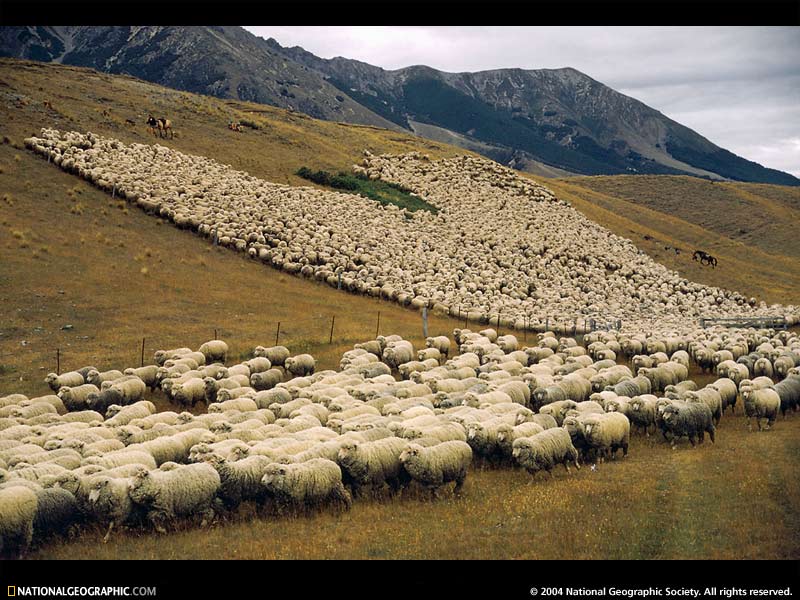
I just wanna be a sheep!

"I am the good shepherd: the good shepherd giveth His life for the sheep... But ye believe not because ye are not of my sheep, as I said unto you. My sheep hear my voice, and I know them, and they follow me: and I give unto them eternal life; and they shall never perish, neither shall any man pluck them out of my hand." - John 10:11, 26-28.
By linking the previous two posts together, we can begin to understand why it is that only Christ's sheep hear His voice and follow Him. Central to a correct understanding of this is, I believe, that Christ gave His life for the sheep, with the necessary inference that He did not give His life for those who are not His sheep. This is the reason that He gives the Pharisees for their lack of belief. So we see this; that the result of Christ giving His life for His sheep is that they believe.

We found previously from 1 Corinthians 2, how it was necessary for receiving the spiritual things of God, such as the Gospel, that one has a spiritual mind. This prerequisite for belief is therefore having a spiritual mind. We concluded that this spiritual mind (which is life and peace), rather than a carnal mind was a result of having received the Spirit of God. This is the rebirth, or regeneration, which we learn occurs when, by the Spirit's work alone we hear Christ preaching to us (Lazarus, come forth!), and by the Spirit's work alone we believe.
"Jesus said unto her, I am the resurrection and the life: he that believeth in me, though he were dead, yet shall he live. And whosoever liveth and believeth in me shall never die. Believest thou this?" - John 11:25-26.
Romans 6 to 8 teach us not only that the power of regeneration (the mortification of the old nature, and the quickening of the new) is the power of the Spirit of Christ, but also, since it is the Spirit of Christ, it is the power of being united in the death and resurrection of Christ. We are told that it is by union in Christ's death and resurrection that this regeneration occurs by the Spirit of Christ. But how are we (or were we) united in Christ's death and resurrection, and how is it that some are undeservedly regenerated by the Spirit and others deservedly are not?

We find the answer to these two question in one place: the eternal decree of election and reprobation. This is the fountain of our salvation, the basis by which we are eternally united with Christ, and so united in His death and resurrection. This is union is the basis by which Christ is our representative and substitute, so that not only did He fully pay for all our sins, but that we are now clothed in His righteousness, partakers of Him and all His benefits in the unbreakable covenant relationship of love with the Father, sealed in His blood. And being elect in Christ, we are thereby also united with the Spirit of Christ.

Now we see that it is by being united in Christ from before the foundation of the world by election, that the Spirit worked regeneration in our hearts when the Gospel was preached to us, and not in the hearts of the wicked reprobate. The others had no union with the Spirit of Christ by election, and therefore no union with Christ in His death and resurrection, and therefore Christ did not pay for their sins, and so they will be condemned deservedly for their wickedness.

Therefore, though this union is manifest in the course of history by faith, and by this faith we are consciously in union by the Spirit with Christ (because by faith, the Word dwells in us, who is God, the Lord Jesus Christ, the revelation of the Father to us), it is an eternal union by the fountain of election. And this should greatly humble us who believe by the Spirit, and spur us on with confidence to love and good deeds to bring thanksgiving to God, as we remember that our salvation is entirely undeserved and eternal, sealed by the blood of the Lamb before the foundations of the world in the book of life, though we see its manifestation in the course of history:
"And all that dwell upon the earth shall worship [the beast], whose names are not written in the book of life of the Lamb slain from the foundation of the world." - Revelation 13:8.
I hope you will correct me if this does not seem entirely accurate.

Love in Christ,

- Samuel W.