Friday, October 24, 2008

Why am I a young-earth creationist?

First of all, I believe in the biblical and reformational principle of Sola Scriptura (2 Timothy 3:13-4:4, Hebrews 4:12, 2 Peter 1:16-2:3, Psalm 19:7-12, Acts 20:20, 27).

I do not find the idea of long ages or evolution in the Bible, and instead I find clear refutations of them in the plain matter of fact account at the beginning of a book about history (Matthew 1:1, Genesis 2:4, 5:1, 6:9, 10:1, 11:10, 11:27, 25:12, 25:19, 36:1, 36:9, 37:2, 1 Timothy 1:4, 4:7, 6:3-4, 6:20, 2 Timothy 4:4, Titus 1:14, 2 Peter 1:16, Titus 3:9, Matthew 22:29-32, Mark 7:9-13, 12:24-27, Luke 16:27-31, 24:27, 44-46, John 5:45-47, etc) of a six-day, miraculous finished creation, timed according to evening and morning of the 24 hour rotations of the earth (Genesis 1:1-2:4), which is then used as a model for our six-day working week and sabbath (rest, Exodus 20:8-11), which then is placed perfectly at the beginning of meticulous chrono-genealogies by the ages of the ancients and their ages at the birth of their sons (Genesis 5, 11, 1 Chronicles 1-9, Luke 3:23-38) and the subsequent and direct chronologies of events dated by years of kings etc (see Genesis - 2Kings - Nehemiah / 1Chronicles - Nehemiah), and in the matter-of-fact account of one man and one woman being created from which this unbroken line of descendants arises, and more specifically, the descendant/seed: the Lord Jesus Christ.

Now see that all creatures were created in these specifically 24hr days (Genesis 1:20-2:1), to multiply according to their own kind (Genesis 1:21-22, 24-25, 2:19-20). Notice, first, created as separate kinds, as kinds of fish, kinds of beasts, and kinds of birds etc, and second, that they reproduce according to their own kind. Granted, there is variation within these kinds (not the human definition of species, mind you) due to the various pressures of environment and degeneration and degradation due to the curse and bondage to decay which came as a result of man (Genesis 3:17-19, Romans 8:20-22, Isaiah 24:1-6), but God's decrees are more immovable than the universe.

Then couple that with the all theological arguments based on these simple historic facts, that by the sin of one man, Adam, all men, being his descendants, were born in sin, that death and suffering came about as a result of this Fall, and that also by the obedience of one man, the Lord Jesus, many will be saved (Romans 5:12-6:2, 1 Corinthians 15:21-22, 45-50), and that all peoples all over the earth are one blood (Acts 17:23-26, Genesis 3:20, 9:19), that Christ is then therefore our kinsman-redeemer (Hebrews 2:14-17, Leviticus 25:25), that women should not teach or be in authority over man because Adam was formed first and Eve was deceived (1 Timothy 2:11-14, Genesis 2:21-23, 3:4-17), and I could go on.

Also the treatment of these historical records by the biblical writers and the Lord Jesus who said, "From the beginning, God made them male and female." (Matthew 19:3-9, Genesis 2:21-24, Matthew 5:31-32, Mark 10:11-12, Luke 16:16-17, Romans 7:2-4). And so the basis for condemning all forms of homosexuality, bestiality, fornication, concupiscence, lust, adultery, divorce (though sufferable on account of fornication whereby the marriage is already defiled), remarriage (while the spouse is still alive) as perversions is laid down steadfast in the foundation of solid historical fact and again I could go on.

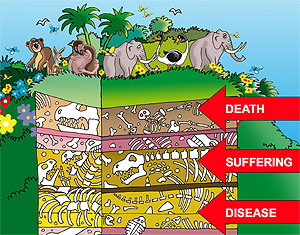
But this picture captures part of this issue very well for those who would confront God's word with the irreverent babblings and contradictions of what is falsely called knowledge (1 Timothy 6:20). Those who willingly deny the global Flood (2 Peter 3:1-7) look at the massive layers of sediment, filled with fossils depicting suffering, death and disease and blindly assert that these fossils are millions of years old. But when did the Fall happen? Before or after these "millions of years"? Is God unjust? When viewed in the light of Scripture this "long ages" or "deep time" view is nonsense and not only absent from, but entirely contradictory to, God's word.

In the light of God's word we look at these massive sediment layers, filled with gruesome fossils, and we see it as a terrifying testament to the wickedness of man and the righteous judgment of God, who looked upon the earth and saw that the thoughts of the hearts of men were only evil continually from birth (Genesis 6:5, 11-13). And so first in the garden of Eden, man and woman were cast out and condemned to die for their sin, and all of creation was cursed by their sin because they had dominion over it, and yet even in this God was abundantly merciful and gracious who caused Abel to present a pleasing sacrifice (Genesis 3:21-4:5) because its blood pointed towards the glory of the Son of God who poured out His blood to ransom a people from the curse from every tongue, tribe and nation (Revelation 5:9). And yet the seed of the serpent was and has always been in enmity against those to whom God sovereignly chooses to be gracious to (Genesis 3:14-15, Romans 8:28-39).

The curse was upon the earth and the wickedness of man waxed worse and worse as it does yet today until violence covered the whole earth and God in His righteous fury sent a Flood to destroy every living thing on the face of the earth except for those entirely undeserving ones whom He had graciously saved in the Ark covered by what pointed to the atoning sacrifice of Christ (Genesis 6:11-22, 7:16-24). And the LORD set up the rainbow in the cloud as sign of His everlasting unconditional covenant which He establishes for His people for the praise of His glorious grace (8:20-9:17).

So, we look at the layers of sediment and the fossils and we see brief time in which the devastating Flood happened upon the earth which laid up these massive sediments full of these creatures buried so rapidly that they became fossils, and we remember too that this earth is also currently being reserved for utter destruction with fire on the Last Day (2 Peter 3:5-15). Not "millions of years". Not evolution. The Creation, the Fall, the Curse, the Flood, the Ark, the Rainbow, the Covenant, the Redemption, the Christ.

As the rainbow is a sign of the covenant to His children, the ominous layers of sediment and fossils are a sign of the past and the coming judgment to the children of the devil. And yet, we who believe by the grace of God understand these things, yet they who have not received the love of the truth do not (2 Thessalonians 2:8-15, 1 Thessalonians 5:1-11), lest they should repent and be healed (Matthew 13:10-17, John 8:42-47, Isaiah 29:10-20, Isaiah 44:1-25, Mark 4:10-13). All glory be to God who works wonders in the heavens and upon the earth, and is righteous and just and good and merciful and gracious in all His works and all His eternal decrees, whose love to His people, and whose hatred toward the wicked will endure forever (Psalm 9:1-20).

Thanks to Creation Ministries International for the picture!
http://creationontheweb.com/images/fp_articles/2008/6105death-suffering.jpg

Tuesday, October 14, 2008

What does "grace alone" mean?

Grace is not simply a vehicle which we must avail of, or a means by which we must save ourselves – this is the Romish doctrine. Grace is the might and power that saves us. The Gospel is not merely the means or vehicle of salvation, it is the power. Christ's work on the cross is not merely a means but it is the power alone which saves us. Faith in response to hearing the Gospel is a means, but the means and power of it all cross of our Lord alone. This is what I mean when I say grace alone.

The Arminian turns the cross into simply a means, whereby our decision or faith is the power, when they deny that their decision or faith comes from the power of the cross alone. When they say grace alone, they mean grace is a necessary means or vehicle, but they deny that it is also the power by which we avail of the means. Grace alone is both the only power and means, because it produces the vehicle of faith in us.

Rome teaches that we receive grace by doing all kinds of things (works, prayers, communion, confession, baptism), Arminians teach that we receive grace by a decision (by our own mighty, sovereign and unconditional “free will”), but the Gospel teaches us that we respond in faith to the hearing of the Gospel because we have received grace (election and regeneration bought by the cross, so that the Justifier is just), and that we do good works because we have received grace and that we are built up in faith by the preaching of the word and communion and baptism because we have received grace.

Rome teaches that we are justified by faith and works, Arminians teach that we are justified by faith which we receive (at least in part) from our own “free will”. The Gospel tells us that we are justified by faith alone without works. What is meant by this? That our justification is by grace alone. Yet, Rome and the Arminian both agree – justification is indeed by grace alone, they cry! But from where does this grace proceed? Initially, both Rome and the Arminian will say from Christ's sacrifice on the cross alone! But when questioned further about how this grace is received, finally Rome says from our own faith and works.

The Arminians are more subtle and say from faith alone! But as to where this faith is from, they may even say faith is a gift but concede that they receive it (at least in part) because of their own “free will”. And when asked where the outcome of the decision of their “free will” came from, they go no further and quietly and subtly admit that it is of themselves. When asked about those who are not saved, they will say it is because they chose to reject God's free offer of salvation and the gift of faith which they could have received if they had only been a little less hard-hearted.

In short, that despite God's eternal and ardent love for them, He could not convince them to accept His love and the free offer of salvation which the Arminian hastens to add is by grace alone and by faith alone and in Christ alone. And they imagine God to be weeping in heaven for all the people which He will be throwing into hell after having done everything He could for them. Or they say that God is not weeping and that at a certain point (perhaps the time of their death – which incidentally is determined by the Sovereign God), God decides to stop loving them and starts hating them instead and so does not weep to throw them into hell.

But what do I mean when I say grace alone and faith alone and Christ alone. I mean this:

“God forbid, that I should boast except in the cross of my Lord Jesus Christ!” Galatians 6:14.


According to the Gospel where does justification proceed from, and where does faith proceed from? Indeed justification is receiving grace – the grace of justification. And this justification is received by faith alone without works. And that's the key – without works. True faith is that which has no confidence in the flesh and declares that absolutely nothing but Christ's death and resurrection accomplished the entirety of our salvation. Here's the problem with the Romish and Arminian doctrine – they add something which somehow proceeded only from themselves to the means by which they are saved. With Rome it can be indulgences, prayers, works, all kinds of things, with the Arminian it is more subtle – a tiny little decision only. But the problem is that the Arminian says the decision is (at least in some tiny small part) of their own “free will”. This is mostly clearly protrayed when they will not answer the question the Apostle Paul asks:

“What maketh thee to differ?” 1 Corinthians 4:7.


The Gospel tells us that only the grace of God makes us different to those who are not saved. And that it is Christ alone who has saved us by His death and resurrection. If there are those who are not saved it is because Christ did not die for them. If we are saved because Christ alone has saved us, they are not saved because Christ has not saved them.

“What do you have that you did not receive, and if you received it, why do you boast as if you had not received it?” - 1 Corinthians 4:7.


In the Arminian denial that the decision of their “free willl” was not of themselves but received, they therefore boast. Therefore their confidence is in the flesh. They believe they are saved because of something they did not receive (the decision of their “free will”). What is something they did not receive? It is not grace, it is not a gift. But what does Scripture tell us? That faith comes by hearing and hearing by the word of Christ (Romans 10:17). Only those who hear the preaching of the Gospel will believe. And why do some who hear the Gospel not believe? Why do some love the truth and some do not? The Arminian says “Because of my choice to accept the free offer of blood poured out for me, and because of their rejection of the blood poured out for them.” The problem is that it isn't whether Christ's sacrifice was acceptable to them but whether it is acceptable to God – the very same who made the sacrifice – it is the only sacrifice He is pleased with! And therefore the Gospel says, “Only because of infinite power of the precious blood of the Saviour poured out to redeem His people. The only way there could be some not saved is because the blood was not poured out for them.” And Scripture testifies abundantly:

“... because they received not the love of the truth, that they might be saved. And for this cause God shall send them strong delusion, that they should believe a lie. That they all might be damned who believed not the truth, but had pleasure in unrighteousness. But we are bound to give thanks always to God for you, brethren beloved of the Lord, because God hath from the beginning chosen you to salvation through sanctification of the Spirit and belief of the truth. Whereunto he called you by our Gospel, to the obtaining of the glory of our Lord Jesus Christ.” 2 Thessalonians 2.


“But though He had done many miracles before them, yet they believed not on Him. That the saying of Isaiah the prophet might be fulfilled, which he spake, Lord who hath believed our report? And to whom hath the arm of the Lord been revealed? Therefore they could not believe, because that Isaiah said again, He hath blinded their eyes, and hardened their heart, that they should not see with their eyes, nor understand with their heart, and be converted, and I should heal them.” John 12.


“Unto you therefore which believe he is precious: but unto them which are disobedient, the stone which the builders disallowed, the same is made the head of the corner, And a stone of stumbling, and a rock of offense, even to them which stumble at the word, being disobedient: whereunto also they were appointed. But ye are a chosen generation, a royal priesthood, a holy nation, a peculiar people; that ye should show forth the praises of Him who hath called you out of darkness into His marvelous light.” - 1 Peter 2.


So there is no difference between the Arminian doctrine and the Romish doctrine except that one is more subtle than the other. What does “without works” mean? It means without anything that we did not receive. Grace is something received. Works are the opposite: something not received. Grace is a gift of God, works are anything not from God, anything from ourselves. As the Scripture also says:

“And if by grace, then it is no more of works: otherwise grace is no more grace. But if it be of works, then is it no more grace: otherwise work is no more work.” - Romans 11:6


Test yourself to see whether you have true faith that is has no confidence in the flesh. Test yourself to see whether you believe in salvation by grace alone without works, or whether you believe in salvation by works. Rome believes that something in how salvation is received is of man (of works). The Arminian also believes that something in how salvation is received is of man (of works). For the Arminian it is a decision from a “free will” of themselves. If it is not of God then it is of man, and if it is not a gift, then it is a work.

Grace is something received. Grace alone is when even the receiving is by grace alone. If we receive something by ourselves (our own “free will”) then we have not received it by grace alone but by ourselves – work. But salvation is either of works or of grace – it is either of God or of man. It cannot be both as the verse above tells us incontrovertibly.

For further study about the necessity of the "receiving" of grace being by grace alone: Acts 18:27, Romans 1:5, Phil 1:29, John 1:12-13, 1 Corinthians 15:10, Ephesians 2:8-10, Titus 3:4-11, James 1:16-17, John 3:27, John 15:1-6, etc.

Monday, September 29, 2008

My Shepherd

Psalm 23:1
"The Lord's my shepherd, I shall not want."


This precious portion of Scripture speaks of a depth of matter which we could never fathom, and such as we will never, in all eternity. Here are two statements, penned by the sweet psalmist of Israel, David. Here, David wrote as he was carried by the Holy Spirit. David was inspired to write this as the Lord revealed it to him.

As a shepherd himself, when still a boy, he understood what a shepherd was. He understood their role and purpose. He understood the different motivations and the difficulties. He understood the dangers and the commitment and vigilance required. David himself often went after a lion or bear that was endangering the flock, and the Lord delivered the bear and lion into his hands. David knew that a shepherd's role was to look after his sheep. How well a shepherd performs this role is measured by two factors - the shepherd's motivation and ability.

In this verse, David has come to realise that the Lord is his shepherd. To begin with, David has first acknowledged that he is a sheep, not only so, but the Lord's sheep. A sheep who knows the Lord and is known by Him. A sheep who hears His voice and follows. He acknowledges that he is not in control but that God is - therein lies his comfort and ours in this Psalm. The shepherd guides the sheep and keeps the sheep on the right path. The shepherd guards and protects the sheep and makes sure nothing can attack the sheep.

Often the shepherd will have to use forceful measures, the staff and rod to keep the sheep on the right path and away from danger. But this is for their good. Here we see the comfort also, which David recognises - the comfort of discipline keeping him on the right path and away from danger. In this David recognises also that he is stubborn and prone to wander. He delights in this discipline because he dare not imagine where he would be without it.

Secondly, that as David is a sheep, he declares that the Lord is his shepherd. It is one thing to have good friends and family to help look after you and keep you on the right path, but it is entirely another to have the Lord watching over you. As it says, "the Lord who watches over Israel does not slumber nor sleep." Even the best of earthly shepherds must sleep, but not God - God never loses sight of His sheep, they are always before Him and He will not cease to watch them and will not sleep. This is the care of the Lord.

There is no danger ahead, which the Lord has not seen and will not protect His sheep from. Indeed, in His sovereignty, He has ordained these dangers to show His sheep how much the length to which He would go to protect them, and the almighty power of His protection. An earthly shepherd may occasionally come across dangers unforeseen and too great and lose his precious sheep. Not so, with the Lord. "He looketh on the earth, and it trembleth."

Not only does the Lord never tire of watching over His sheep, He also delights to watch over them. Some shepherds may be hired men, working only for money, and for others it may be their livelihood. One cares not for the sheep because he does not need them and is only interested in money, and the other cares for them only because he needs them. God is a shepherd unlike either of the two - He cares for His sheep not because He needs them; He cares for them despite not needing them. God cares for His sheep unconditionally. He needs nothing from them, and yet His care is greater than any other. He needs no reason from them to care for them, He is content to bestow His almighty care on them merely by His sole delight and choice.

How deep and rich is this care that the Lord has for His sheep? Immeasurable. If the Lord is unchangeable and infinite, then so too is His care for His sheep. God is not a man that He should relent. If God has decreed an unconditional promise to be David's shepherd, then He will "hasten His word to perform it." "If we are faithless, He remains faithful, for He cannot deny Himself." God has not said to David, "I will be your shepherd unless you wander from me." He has said, "I am your shepherd, and when you wander, I will bring you back, I will fight for you, I will not let you go, I will be jealous for you, I will discipline you, I will keep you on the right path, I will speak my word to you, I will cure you of your wanderings." Otherwise, David would have found no comfort and could not have said, "I shall not want."

David has, in this opening statement of this Psalm, in short, realised that God has chosen to be his shepherd. David has realised that he belongs to the sheep-flock of God. He has realised he has found grace in the eyes of the Lord. He has realised that he belongs to the Lord eternally. In response to this revelation, "The Lord is my shepherd", David says, "I shall not want."

"I shall not want."

This should be the response of all who call upon the name of the Lord. All who the Lord has called His own and ransomed by the blood of His Son, Jesus Christ. If the Lord has bought us with His blood, He will not, cannot, forsake us. If his sheep wander, He will search high and low to bring them back. Christ came to seek and to save that which was lost. The Lord God Almighty's decree has not failed, the precious blood of Jesus has not failed, the power of the Holy Spirit has not failed. "I will hasten my word to perform it." If Jesus Christ has died and risen again for His sheep, that sovereign unconditional promise of the Lord come to pass, then believe on Christ as one of His sheep and you will say: "The Lord is my shepherd, I shall not want."